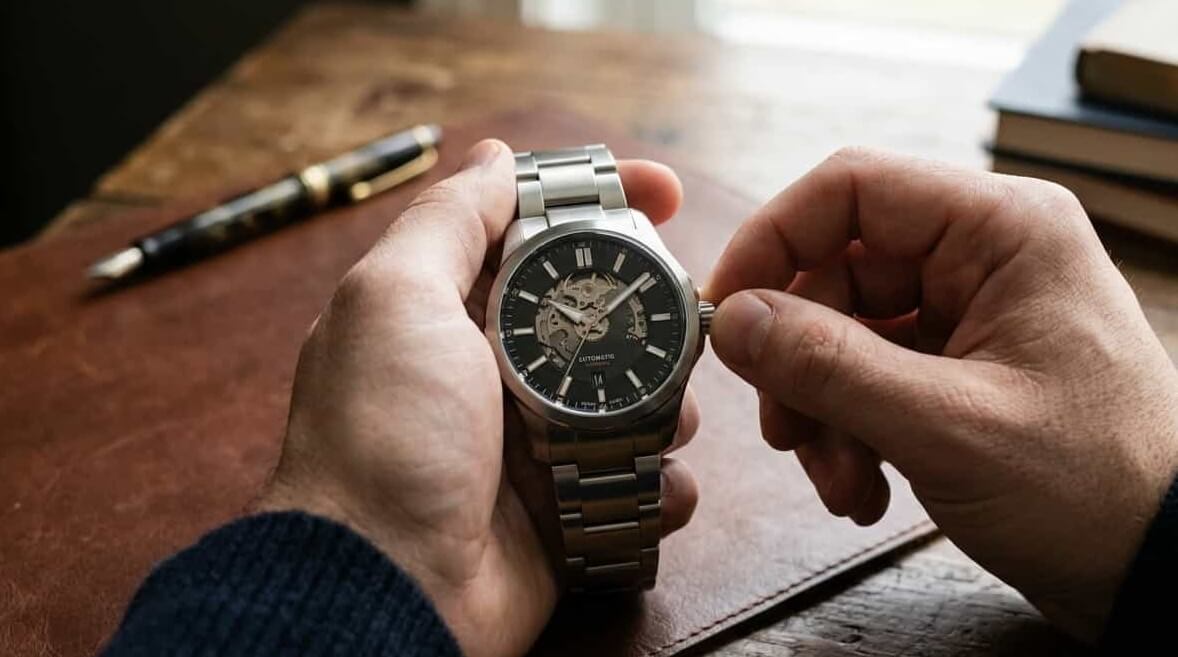

Can You Wind an Automatic Watch? (Short Answer)
Yes, you can wind an automatic watch by hand, and it is safe to do so when done gently. An automatic watch is still a mechanical watch at its core—it simply uses a moving weight called a rotor that winds itself as you wear it throughout the day. When your watch has stopped, hasn’t been worn for a while, or is running low on power, a quick manual wind can get it running again without any risk of damage to the mainspring (the watch’s energy storage spring) under normal circumstances.
The real concern is not gentle winding itself, but forcing a crown that feels rough, gritty, or stuck. If you encounter resistance that feels wrong—sudden tightness or grinding sensations—stop immediately. Do not power through. This protects the delicate winding train (the parts that transfer your winding motion to the mainspring).
Quick Q&A
- Can I wind it? Yes. Hand-winding is a normal part of automatic watch ownership, and knowing how to wind an automatic watch properly is an essential skill.
- Is it safe? Yes, when you wind gently and stop if something feels rough or stuck.
- When should I do it? After the watch has stopped, after a day or two without wearing it, or when it feels like it’s running low.
- Will I break the mainspring? No. Modern automatic movements are designed with built-in protection that prevents the mainspring from being damaged by normal manual winding.
Think of manual winding like topping up a battery. Your watch stores energy in its mainspring. Wrist movement charges it automatically when you wear it, but if the watch has been sitting idle, a few gentle turns of the crown (the small knob on the side of the watch case) can restore that energy quickly so the watch starts ticking again.
Next, we’ll explore how an automatic watch actually works so you understand why this is possible and safe.
How an Automatic Watch Works (Beginner’s View)
An automatic watch is a type of mechanical watch—a timepiece powered by a wound metal spring rather than a battery. Understanding how this spring gets wound and stays wound will make the winding process feel straightforward rather than mysterious.
At the heart of every automatic watch sits a tightly coiled metal ribbon called the mainspring. This spring stores energy, much like a compressed coil in a toy. As the mainspring slowly uncoils, its energy flows through a series of interlocking gears called the gear train, which move the hands forward in precise, measurable steps. The familiar tick-tock sound you hear comes from the escapement—a mechanism that releases energy in tiny, regulated bursts.
The key difference between an automatic watch and other mechanical watches lies in how the mainspring gets recharged. Inside an automatic watch lives a weighted semicircular piece called a rotor. As you move your wrist throughout the day, the rotor swings freely, and this motion winds the mainspring back up automatically. This is why automatic watches are sometimes called “self-winding”—they charge themselves through your natural arm movement. In contrast, a manual-wind mechanical watch has no rotor and must be wound by hand regularly to keep running.
Here is the energy flow in simple steps: your wrist movement causes the rotor to swing; the rotor winds the mainspring tighter; the mainspring slowly uncoils and drives the gear train; the hands sweep forward; the escapement meters out the release. This elegant cycle repeats as long as the mainspring has stored energy and as long as you wear the watch regularly.
The practical implication is this: even though your automatic watch winds itself during normal wear, it can still run down. If you leave it on a shelf for several days without wearing it, the mainspring will gradually lose its charge, and the watch will eventually stop. Similarly, if you wear your watch for only a few hours a day or very lightly, it may not accumulate enough winding energy to keep accurate time. In these cases, a gentle hand wind can restore the power reserve and get your watch running smoothly again.
Next, we’ll walk through the safe, step-by-step winding process and explain what to feel for along the way.
Step-by-Step: How to Wind an Automatic Watch by Hand
Winding an automatic watch by hand is straightforward when you follow a calm, methodical approach. The key is consistency, gentle motion, and paying attention to how the crown feels as you turn it. Below is a safe, repeatable procedure that works for most automatic watches, whether the crown screws down or simply pushes in.
The Winding Procedure
Step 1: Take the watch off your wrist and hold it securely. Never wind a watch while wearing it. The movement and pressure from your wrist can strain the stem (the shaft connected to the crown) and risk snapping it. Set the watch on a soft surface like a watch cushion or hold it gently in your hand with the dial facing toward you.
Step 2: Check that the crown is fully pushed in (neutral position). For a standard crown, it should be flush against the case. This is the normal winding position. If you accidentally pulled the crown out earlier, push it back in until it sits completely flush.
Step 3: If your watch has a screw-down crown (common on sports and dive watches), gently unscrew it counterclockwise until it releases and pops out slightly. This brings it to the neutral winding position. Do not force it; three to four gentle turns usually disengage the threads.
Step 4: Hold the watch steady in your non-dominant hand. With your other hand, begin turning the crown clockwise. Clockwise means rotating the crown away from you as you look directly at it head-on, the same direction clock hands move. Use smooth, even turns rather than jerky or forceful motions. You should feel the gears engage as the mainspring gathers energy.
Step 5: Wind for roughly 20 to 30 gentle turns as a starting guideline. The exact number varies by movement and manufacturer, so these are ballpark figures. Most modern automatics reach full power reserve well before 40 turns. You do not need to count precisely; focus on consistency and feel.
Step 6: Pay close attention to the crown’s resistance. Light, smooth tension is normal and expected. As you wind, the crown may gradually feel slightly firmer—this is fine. However, if you suddenly encounter grittiness, a rough grinding sensation, or a sharp binding feeling, stop immediately. Do not force the crown past this point. This sensation usually signals that the mainspring has reached capacity or that something is not moving smoothly.
Step 7: Once you have wound the watch (or felt clear resistance), gently push the crown back to its fully seated position. If it is a screw-down crown, gently screw it back down clockwise until it is snug. Do not over-tighten; a firm, gentle snug fit maintains water resistance without stressing the mechanism.
Step 8: Put the watch back on your wrist. The watch is now wound and ready to run. If the watch had stopped, you should see the seconds hand moving within a few seconds.
Safe Winding Routine for an Automatic Watch
- Remove the watch from your wrist and place it on a soft surface or hold it securely in your hand.
- Confirm the crown is pushed in fully (or unscrew a screw-down crown until it releases to neutral).
- Hold the watch steady with the dial facing you.
- Turn the crown clockwise with smooth, even motions—no jerking or hard twisting.
- Complete approximately 20 to 30 gentle turns or until you feel light resistance.
- Stop if the crown becomes rough, gritty, or feels bound; do not force it further.
- Push the crown fully back in (or screw it back down if screw-down type).
- Confirm the seconds hand is moving before putting the watch back on.
- Put the watch on and resume wearing it normally.
Normal Tension Versus Stop-Now Resistance
As you wind, you will feel the crown gradually offer more resistance. This is healthy and expected. Normal tension feels like a gentle, consistent push-back—similar to winding a music box. You can continue through this sensation without worry. In contrast, a stop-now resistance feels abrupt, rough, or grinding. It may sound or feel like the gears are not moving smoothly. If you encounter this, pause and try turning in the opposite direction slightly to release any bind, then stop winding. If the crown remains stuck or gritty, have it checked by a professional rather than forcing it.
Next, we will explore how to recognize which way the crown turns and what the different crown positions control.
How Often Should You Wind an Automatic Watch?
Automatic watches can continue running for extended periods when fully wound, even off the wrist, so how often to wind depends on your wear pattern rather than a fixed daily schedule. If you wear it regularly, you may rarely need to hand-wind it at all.
Here are simple rules of thumb to guide you. If you wear your automatic most of the day with normal movement, the rotor keeps the mainspring charged, and you likely won’t need manual winding. Skip wearing it for a day or two? A brief top-up helps get it going smoothly again. If it has stopped completely, give it a manual wind before setting the time and putting it on. Notice it running slow or not keeping time as usual? Try a top-up wind, though some watches need winding more often than others—check your manufacturer’s guidance if available.
Should I wind my automatic watch everyday? Not necessarily—it ties directly to your wear pattern. Daily active wear like walking or chores often powers it fully via wrist motion alone. With desk work or lighter activity, a quick morning wind a few times a week keeps things consistent. Do automatic watches need winding if you rotate between several watches? A short wind revives each one before wearing. For guidance on keeping a watch collection in good condition, see our general care guide.
For a quick reference, here’s an at-a-glance table with common situations.
| Situation | What to do (how many gentle turns + check time) | Why it helps |
|---|---|---|
| New watch | Roughly 20–30 gentle turns, then check if seconds hand moves | Provides a reliable start from a full stop |
| Just stopped | Roughly 20–30 gentle turns until smooth running | Recharges the mainspring to resume normal operation |
| Worn daily | Usually none needed; top-up only if running slow | Maintains power in active routines |
| Not worn for 1–2 days | Roughly 20–30 gentle turns before wearing | Provides a quick boost after short storage |
| Not worn for a week+ | Roughly 20–30 gentle turns, confirm running, then set time | Revives it fully from long downtime |
Take the example of someone who wears their automatic most weekdays but takes it off for the weekend. On Monday morning, remove it from storage, give it roughly 20–30 gentle turns until the seconds hand sweeps smoothly, set the time, and wear it—no need for daily winding if your routine stays consistent, as two days off rarely drains it fully.
These scenarios keep your watch running without guesswork. Next, we’ll clarify which way to wind and how the crown positions work.
Which Way to Wind and How the Crown Positions Work
One of the most common sources of confusion when learning how to wind an automatic watch is understanding which direction to turn the crown and which crown position to use. Getting these details right ensures you wind safely and avoid accidentally adjusting the date or time when you only mean to power up the watch.
Winding Direction: Clockwise
For the vast majority of modern automatic watches, you wind by turning the crown clockwise. When we say clockwise, we mean turning the crown in the same direction a clock’s hands move—viewed head-on as you look directly at the crown knob on the side of the watch. If you imagine looking at the crown straight on, clockwise means turning it away from you at the top and toward you at the bottom. This is the standard winding direction for most automatics and is designed to be intuitive and comfortable.
It is worth noting that a small number of specialized movements may wind counter-clockwise instead. Always check your watch’s manual or manufacturer guidance if you are unsure, as this can vary by brand and caliber. However, for the vast majority of watches you are likely to own, clockwise is correct.
Crown Positions: Understanding the Three Positions
The crown on an automatic watch has multiple positions, each controlling a different function. Understanding these positions is essential because you must wind only when the crown is in its normal, pushed-in position. Using the wrong position can accidentally adjust your date or time, or may not wind the watch at all.
Below is a table summarizing the typical crown positions and their functions:
| Crown Position | What It Controls | When to Use While Winding |
|---|---|---|
| Position 1 (pushed in / neutral) | Winding the mainspring | This is the only position for winding. Always ensure the crown is fully pushed in before you begin. |
| Position 2 (middle / pulled out one click) | Usually the date wheel (varies by watch) | Do not wind in this position. This position is for adjusting the date only. |
| Position 3 (fully out) | Hour and minute hands (time setting) | Do not wind in this position. This position is for setting the correct time only. |
How to Recognize Each Crown Position
When the crown is in position 1 (the winding position), it sits flush against the watch case—fully pushed in and flush with the side of the watch. This is the normal resting state.
To move to position 2, you gently pull the crown outward. You will typically feel a small click or notch as it settles into the middle position. In this position, the crown extends slightly from the case, and turning it adjusts the date (on most watches, though some models place the date function elsewhere).
To reach position 3, you pull the crown all the way out to its fullest extension, usually feeling another click. In this position, turning the crown rotates the hands to set the time. The crown extends noticeably from the case.
After setting the date or time, you push the crown firmly back to position 1 (you may feel it click back into place) to return to the winding-ready state and to protect the movement from dust and moisture.
The Safety Rule: Wind Only in Position 1
This is the golden rule: never attempt to wind your watch when the crown is in position 2 or 3. Winding in the wrong position can cause unintended changes to the date or time display and may place strain on the wrong internal mechanisms. Always confirm the crown is fully pushed in and flush with the watch case before you begin winding.
Next, we’ll explore what happens if you wind more than the recommended number of turns, and why modern automatic watches are designed to handle this safely.
Can You Overwind an Automatic Watch?
The short answer is that modern automatic watches are built with protection against the kind of damage that overwinding used to cause. However, you can still damage other components if you force the crown when it resists.
Many modern automatic watches are designed with a slipping protection mechanism inside the mainspring barrel. Once the mainspring reaches full tension, this mechanism allows the spring to slip slightly rather than continue coiling tighter. Think of it as a safety valve: extra normal winding turns get absorbed harmlessly instead of straining the mainspring itself. This design means that winding a few extra gentle turns beyond what you might need will not break the mainspring or ruin your watch.
The real risk comes from forcing the crown. If the crown feels gritty, binding, or suddenly very tight, continuing to push can damage the winding train (the parts that transfer your winding motion to the mainspring) and other gear components. These parts are delicate and not protected by the slip mechanism. Forcing past resistance is what actually causes problems.
What Different Sensations Mean While Winding
- Smooth and easy: The crown turns freely with little resistance. This is normal at the start of winding. Continue with gentle, steady turns.
- Gradually increasing, gentle tension: As you wind, you may feel the crown becoming slightly stiffer—this is the mainspring gathering energy. This sensation is normal and safe. Keep winding until resistance becomes firm.
- Sudden firm resistance or binding: The crown suddenly feels hard to turn, gritty, or like it has hit a wall. Stop immediately. Do not force it further.
- Grinding or clicking sensation: You feel grinding, unusual clicking, or vibration in the crown. Stop at once and do not wind again until you have checked the crown position or had the watch inspected.
If you encounter firm resistance or a gritty feeling and you are certain the crown is in the correct neutral position (pushed fully in, not partially pulled out), stop winding. Verify the crown is seated properly by gently pushing it in again. If the rough sensation returns on your next winding attempt, have the watch checked by a professional before continuing.
Next, we will cover what to do when you first receive a new automatic watch or when you pick up one that has stopped running.
First Time With a New or Stopped Automatic Watch
A new automatic watch that arrives in the box or a watch you haven’t worn in weeks may be completely stopped—and that’s completely normal. The mainspring has unwound, so the watch needs a manual wind to get running again. The good news is that winding an automatic watch for the first time is straightforward and takes just a few minutes.
The First-Use Playbook
- Remove the watch from your wrist and place it on a soft surface (a desk pad or cloth works well).
- Locate the crown on the side of the watch and ensure it is fully pushed in (neutral position). If your watch has a screw-down crown, unscrew it gently by turning counter-clockwise until it pops out slightly, then ensure the crown itself is pushed all the way in.
- Hold the watch face-up in your left hand and use your right hand to turn the crown clockwise (away from you) roughly 20 to 30 gentle, steady turns. You should feel light resistance gradually increasing—this is normal as the mainspring gathers energy. Stop if you encounter sudden firmness, grinding, or gritty sensations.
- Stop winding and watch the second hand (the thin hand, usually at the edge of the dial). Within a few seconds to a minute, it should begin ticking. If it doesn’t move after a few gentle winds, continue with another 10 turns and check again.
- Once the seconds hand is moving, the movement is running. Now pull the crown out to the full position (position 3) to set the time. Rotate the crown gently until the hour and minute hands show the correct time.
- If your watch has a date window, you can usually adjust the date by pulling the crown to the middle position (position 2) and rotating. Check your specific watch manual, as date position varies by model.
- Once time and date are correct, push the crown firmly back in to the neutral position. If you have a screw-down crown, screw it back in clockwise until it is snug (do not force it).
- Your watch is now ready to wear. Put it back on your wrist and enjoy.
If you adjust the date and it doesn’t update by morning, try again the next day—this is a normal quirk of how the date mechanism cycles on most automatics.
New Watch? Do This First
- Check that the crown is fully pushed in (or unscrewed to pushed-in if screw-down).
- Wind clockwise roughly 20 to 30 gentle turns while the watch sits on a soft surface.
- Confirm the seconds hand begins moving within a minute.
- Pull the crown to position 3 (fully out) and set the time.
- Adjust the date at position 2 if your watch has one.
- Push or screw the crown back in fully before wearing.
Real Examples: What This Looks Like
You just unboxed a new automatic watch that’s not running yet. Remove it from the box, place it on a desk pad, and take a moment to locate the crown. Push it in fully. Using steady, gentle clockwise turns, wind it roughly 25 times. After a few turns, you may hear a soft whirring sound—that’s normal and means the movement is starting to engage. Keep going until you reach roughly 25 turns. Stop and watch the dial for a few seconds. The second hand should begin its rhythmic tick. Once it’s moving, pull the crown all the way out, set the time by rotating the crown slowly, and you’re done. Push the crown back in and put the watch on.
You pick up a watch that stopped overnight because you didn’t wear it the previous day. The seconds hand is stationary. Take off the watch, place it on a soft surface, and ensure the crown is pushed in. Wind it gently clockwise, counting to roughly 20 or 25 turns. Check the seconds hand—it should be ticking within a few seconds. If it is, great; you can skip the time-setting step if the watch still shows the correct time (which it likely does, since it stopped only recently). If the time has drifted slightly or you want to double-check, pull the crown out and adjust it. Push the crown back in and wear it as usual.
When setting up your new watch or winding an automatic watch for the first time, patience and gentleness are your best tools. There is no rush; taking 30 seconds to wind properly ensures your movement gets a good, clean start.
Next, we’ll cover the everyday safety habits and handling tips that keep your automatic watch happy for years to come.
Safe Winding and Handling Habits for Automatic Watches
Gentle, mindful handling is the key to keeping your automatic watch in good working order. Below are the essential do’s and don’ts that will help you avoid common mistakes and protect the delicate mechanisms inside.
Do
- Remove your watch from your wrist before winding. Winding while wearing the watch puts unnecessary stress on the stem (the rod attached to the crown), which can bend or snap over time.
- Wind in a calm, seated position on a soft surface. This protects your watch if you accidentally slip or drop it during the winding process.
- Use gentle, smooth turns. There is no need to crank the crown hard; steady, light pressure is all you need.
- Stop immediately if you feel grinding, clicking, or unexpected resistance. These sensations signal that something is not moving freely, and forcing it could damage the internal winding train (the parts that transfer your winding motion).
Don’t
- Shake your watch to get it running. Sudden, vigorous movements shock the mechanism and can disturb the delicate balance wheel. Winding by hand or wearing the watch is always safer.
- Expose your watch to strong magnets. Magnetic fields can interfere with the hairspring and balance wheel, affecting timekeeping. Keep your watch away from speakers, phone chargers, and magnetic closures on bags or desk organizers.
- Submerge or splash your watch with water unless it is rated for water resistance, and even then, avoid freshwater after saltwater exposure. Moisture inside the case can corrode gears and springs.
- Leave your watch in extreme heat, cold, or humidity for extended periods. These conditions can affect lubricants inside the movement and change how the watch behaves.
- Ignore changes in how the crown feels. If it becomes rough, gritty, loose, or suddenly harder to turn, do not force it. Have it checked by a professional instead of trying to troubleshoot on your own.
What Not to Do: Real-World Mistakes
Here are three common beginner mistakes to avoid:
Mistake 1: Forcing a rough crown. Your new automatic watch has been sitting in storage for a few months. You pick it up, notice the crown feels slightly gritty, and think winding it will loosen things up. You apply more pressure and turn harder. This is dangerous. A gritty or stiff crown often signals that the stem needs attention, and forcing it can cause the stem to snap or the winding train to jam. Instead, stop, remove your hand, and have the watch inspected.
Mistake 2: Shaking to wake it up. Your automatic watch stopped while you were away for a week. You think, “I’ll just shake it a few times to get the rotor moving again.” You give it vigorous shakes. This sudden shock can misalign internal parts and is far less effective than the simple act of winding by hand. A few gentle manual winds will reliably restart the watch.
Mistake 3: Winding while wearing it. You are in a hurry, notice your watch has stopped, and wind the crown while the watch is still on your wrist. The movement of your wrist combined with the pressure on the crown creates uneven stress on the stem. Over time, this can weaken or bend the stem, leading to a loose or damaged crown that no longer seals properly.
General Care and the Bigger Picture
Winding your automatic watch is a simple, safe process when done gently and deliberately. Treat it the same way you would handle any small mechanical device: with patience and care. For a comprehensive guide to basic watch care tips and how to keep your timepiece in top condition long-term, refer to our broader care and maintenance article.
Most automatic watches are remarkably durable and forgiving. If you wind gently, avoid forcing the crown, keep the watch away from magnets and extreme conditions, and handle it with everyday care, you will get years of reliable service. The goal is not perfection but consistency: regular, gentle use beats sporadic rough handling every time.
Quick FAQ About Winding Automatic Watches
Do automatic watches need winding if I wear them every day?
Not usually. If you wear your automatic watch for several hours each day with normal wrist movement, the motion naturally winds the mainspring through the rotor, keeping it sufficiently charged. You only need to manually wind it if you take it off for a full day or more, notice it running slow, or simply want to top up the power reserve before storing it.
How many turns should I give my automatic watch when winding?
Roughly 20–30 gentle, full rotations of the crown is a reliable rule of thumb for most modern automatics. However, the exact number varies by movement and manufacturer, so always check your watch’s manual if available. The better guide is feel: stop winding once you sense firm resistance, which signals the mainspring is fully charged.
Can I wind my automatic watch every day?
You can, but you typically do not need to. If you wear your watch daily for several hours, winding it every single day offers no practical benefit and adds unnecessary handling. Reserve manual winding for when the watch sits unworn for a day or more, or if it has stopped. If you rotate between several watches, winding each one before wearing it again makes sense.
Should I wind my watch before or after setting the time?
Wind first, then set the time. Winding restores power to the movement so it runs consistently; after winding, pull the crown to the appropriate position to adjust the hands to the correct time. This order ensures you are working with a fully energized movement and minimizes unnecessary crown handling.
Do I wind with the crown pushed in or pulled out?
Always wind with the crown pushed in (position 1, the neutral position). If your watch has a screw-down crown, unscrew it counterclockwise first until it pops out slightly, then push it back in to the neutral position before winding. Pulling the crown out moves it to date or time-setting positions—never wind in those positions, as it will adjust your date or time instead.
What if my automatic feels rough or makes noise when winding?
Stop winding immediately. Roughness or grinding sounds are not normal and signal that something is wrong—either the crown is not fully in the neutral position, the screw-down crown is not fully unscrewed, or there is a mechanical issue inside. Check that the crown is correctly positioned and fully secured; if the rough feeling persists, avoid forcing the crown and have it checked by a professional to prevent further damage.