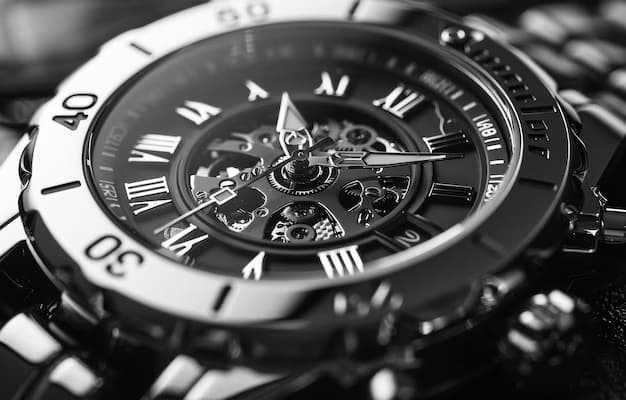
What Is a Swiss Automatic Movement?
A Swiss automatic movement is the mechanical engine inside a watch that powers the hands and any extra features, like a date window, without needing a battery.
Unlike a manual-wind movement, where you turn the crown by hand each day to store energy, an automatic movement is self-winding. Your wrist motion keeps it running. And compared to a quartz (battery-powered) movement, which ticks in one-second jumps using electricity for precise timekeeping, a Swiss automatic movement has a smoother sweeping seconds hand because it beats many more times per hour.
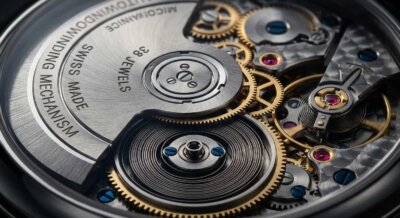
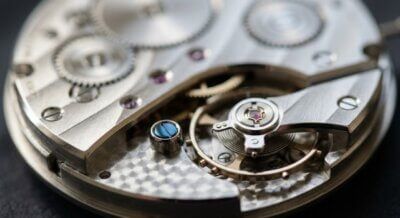
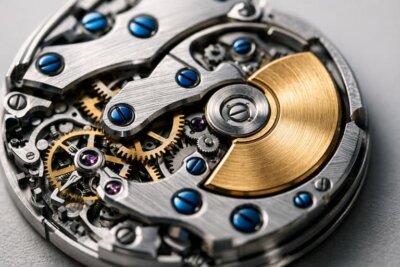
The key to self-winding is the rotor, a half-circle weighted piece that spins freely with your arm movements to wind the mainspring. The mainspring is the coiled spring that stores energy for the whole movement. This movement has over 100 tiny parts working together, including friction-reducing bearings called jewels.
As you move your wrist throughout the day, the rotor swings freely back and forth like a slow, weighted pendulum. Each swing turns a series of gears that feed into the mainspring—a long, tightly coiled ribbon of metal that acts as the movement’s energy storage tank. The mainspring tightens with every rotor swing, and when fully wound, a clutch mechanism stops the rotor from over-winding it. Once wound, the mainspring slowly unwinds, releasing stored energy in a steady stream. That energy passes through the gear train—a set of interlocking gears—and then reaches the escapement, which releases energy in precise pulses to the balance wheel, a weighted disc that oscillates thousands of times per minute. The balance wheel’s steady rhythm keeps your watch ticking at the correct speed. Finally, the gear train converts that regulated motion into the smooth, synchronized movement of your hours, minutes, and seconds hands. Throughout this chain, jewels—small synthetic rubies or sapphires—are set into the movement at high-friction pivot points to reduce wear and keep the watch running smoothly for years.
Here are those core parts defined simply:
- Rotor: Spins with wrist motion to wind the mainspring automatically.
- Mainspring: Coiled spring that holds the energy to run the watch.
- Gear train: Chain of gears that carries power from the mainspring to the hands.
- Escapement: Device that doles out energy in precise ticks to keep rhythm.
- Balance wheel: Tiny wheel that swings steadily, setting the watch’s beat.
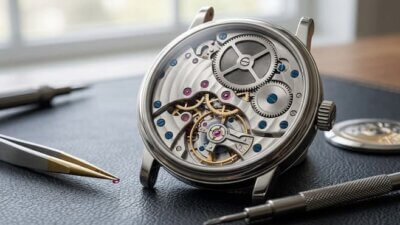
If your automatic watch has an exhibition caseback (transparent back), you can observe the rotor at work. As you move your wrist, you will see a metallic, half-moon-shaped weight leisurely swing back and forth across the back of the movement. It may spin clockwise on one wrist rotation and counterclockwise on the next—this bidirectional winding is typical of most modern Swiss automatics, and it is far more efficient than older single-direction designs. Even small, everyday arm movements—reaching for a coffee cup, typing at a desk, walking—are enough to keep it wound.
The mainspring itself is not visible without taking the movement apart, but you can infer its state by understanding power reserve. When you first receive a new automatic watch or one that has sat unwound for weeks, the mainspring is slack, nearly empty. As the rotor winds it throughout your first day of wear, the spring coils tighter and tighter, storing more and more energy. At full wind, the spring is compressed so tightly that it can release energy for approximately 38 to 48 hours—the typical power reserve for a modern Swiss automatic. If you place the watch on a shelf without wearing it, that stored energy gradually depletes as the spring slowly unwinds, and after 2 to 3 days, the watch will stop. This is normal and not a fault; you simply need to wear it (or use a watch winder) to wind it back up.
You can also manually wind a Swiss automatic watch by turning the crown (the small knob on the side of the case) clockwise about 15 to 30 times. This backup option is handy if you have just taken the watch off for a few days or prefer to ensure a full wind before an important event. The manual winding feeds energy into the mainspring via a gear train connected to the crown, bypassing the rotor. Even though the rotor will wind the watch during wear, the ability to hand-wind it gives you control and confidence.
What Makes a Movement “Swiss”? The Swiss Made Rules
Not every watch with Swiss roots earns the official Swiss Made label. This designation follows strict rules set by Swiss authorities.
To qualify for the Swiss Made label, a watch must meet these key criteria:
- Assembled in Switzerland.
- Inspected in Switzerland.
- At least 60% of production costs are Swiss.
- Technical development done in Switzerland.
You might also see “Swiss Movement” on some labels. This is a different claim—it only means the movement was made in Switzerland, without the full watch meeting all Swiss Made criteria. The distinction matters when checking specs.
Use this checklist when reading product pages or spec sheets to verify Swiss Made compliance:
- Swiss assembly (yes)
- 60% Swiss costs (yes)
- Final inspection in Switzerland (yes)
- Technical development in Switzerland (yes)
- Movement is Swiss (yes)
- Cased in Switzerland (yes)
- Manufacturer inspection (yes)
Meeting these points confirms the label is legitimate, helping you know what you’re getting.
Key Technical Specs: Power Reserve, Frequency, and Jewels
When you see specs listed for a Swiss automatic movement, three stand out: power reserve, frequency, and jewels. These numbers tell you about runtime, smoothness, and durability in everyday use. The term “Swiss automatic movement” refers to both the Swiss origin and the self-winding mechanism—understanding each helps you compare watches effectively.
Power Reserve: How Long It Runs
Power reserve measures how long the watch runs on its stored energy from the mainspring before stopping, typically 38–48 hours in Swiss automatic movements.
If you wear it daily, the rotor keeps it wound, so you won’t notice it running down. But if left unworn for a couple of days, it can stop—practical for desk workers who rotate watches.
Frequency: The Beat Rate (vph)
Frequency, measured in vibrations per hour (vph), is how often the balance wheel oscillates to regulate timekeeping; 28,800 vph is a common standard in Swiss automatic movements.
This gives the seconds hand a smoother sweep rather than a jerkier step, which you’ll see through a display caseback—making the motion feel more fluid on the wrist.
Jewels: Reducing Friction
Jewels are synthetic ruby bearings (typically 21–31 in number) that reduce friction and wear where metal parts pivot in a Swiss automatic movement.
More jewels often mean more complex designs with added functions, leading to less daily maintenance worry, though higher counts aren’t always better for basic timekeeping.
Here’s a simple table showing typical values for popular movements:
| Movement Example | Power Reserve (hrs) | Frequency (vph) | Jewels |
|---|---|---|---|
| ETA 2824-2 | ~38 | 28,800 | 25 |
| Sellita SW200-1 | ~38 | 28,800 | 25 |
COSC Certification: What It Means for Accuracy
COSC stands for the Contrôle Officiel Suisse des Chronomètres, a Swiss testing authority that certifies the precision of mechanical watch movements. Not all Swiss automatic movements carry COSC certification, but those that do have been independently tested and verified to meet strict accuracy standards.
What COSC Certification Tests
COSC certification measures how accurately a movement oscillates and releases energy over time. The test evaluates whether a movement maintains consistent timekeeping across different positions, temperatures, and wearing conditions. A COSC-certified movement must perform within a defined tolerance range, and the benchmark for most certified automatics is an average accuracy of minus 4 to plus 6 seconds per day. This means your watch might gain up to 6 seconds or lose up to 4 seconds daily, and that range is considered excellent for mechanical timekeeping.
The testing process takes 15 days and involves monitoring the movement in multiple positions—meaning the watch is tested horizontally, at various angles, and vertically—to simulate how you wear and move throughout daily life. Movements are also tested at different temperatures to ensure they perform reliably whether you are in a cold climate or a warm environment.
Understanding Positions and Regulation
When you see a movement described as regulated in one, two, three, or five positions, that refers to how the movement has been fine-tuned for consistent performance. A movement regulated in one position has been adjusted for accuracy in a single orientation, while a five-position regulation means the movement has been carefully tuned to perform well no matter how the watch is held. Higher-position regulation typically results in more consistent timekeeping throughout the day, because the movement performs well whether you have your wrist up, down, horizontal, or at various angles.
Realistic Expectations: Certification Is Not a Guarantee
COSC certification is a rigorous, third-party benchmark, but it is not a promise that your specific watch will always stay within the certified range in real life. Your actual timekeeping accuracy depends on how you wear the watch, how often you wind it, whether it experiences shocks or temperature extremes, and the individual regulation of your specific movement. A certified watch may gain a second one day and lose a second the next, and that is entirely normal. Mechanical watches are not quartz movements—perfect timekeeping is not the goal, but rather a robust, consistent mechanical performance over decades of wear.
Popular Swiss Automatic Movements
You’ll find these Swiss automatic movements powering many automatic Swiss watches from accessible to premium brands. They represent proven options with track records in everyday use.
The ETA 2824-2 stands out as a reliable workhorse automatic. It runs at 28,800 vph with about a 38-hour power reserve and 25 jewels. You see it in watches from Tissot and Tudor.
The Sellita SW200-1 serves as an ETA alternative, offering similar function for many users with comparable specifications.
The ETA 2892-A2 provides a slimmer base, suitable for thinner watch designs.
The Valjoux 7750 acts as a chronograph standard with about a 48-hour power reserve and 28,800 vph beat rate.
Here’s a comparison of these popular Swiss automatic movements:
| Movement | Frequency (vph) | Power Reserve (hrs) | Jewels | Best For |
|---|---|---|---|---|
| ETA 2824-2 | 28,800 | ~38 | 25 | Daily wear |
| Sellita SW200-1 | 28,800 | ~38 | 25 | Daily wear |
| ETA 2892-A2 | 28,800 | Dress watches | ||
| Valjoux 7750 | 28,800 | ~48 | Chronographs |
Swiss Automatic vs Other Movements
When comparing a Swiss automatic movement to others, note that origin and self-winding method are distinct factors. Each type offers trade-offs in value, reliability, accuracy, and upkeep suited to different needs.
Swiss Automatic vs Japanese Movements
Swiss automatic movements carry prestige from their heritage and refined finishing, while Japanese movements like the NH35 provide strong value and reliability at lower costs. Both deliver dependable performance for daily wear, but Swiss options often appeal for their perceived craftsmanship, whereas Japanese ones prioritize accessible quality.
Swiss Automatic vs Quartz
Quartz (battery-powered) movements excel in accuracy with minimal maintenance, often gaining just seconds per month, compared to automatic watches that require regular wear or winding and periodic servicing. Choose quartz for low-fuss precision; opt for automatic if you value the mechanical charm despite higher care needs.
ETA vs Sellita
The Sellita SW200-1 serves as a close alternative to the ETA 2824-2, offering functionally similar performance in power reserve and frequency. While ETA holds more prestige in some circles, Sellita provides comparable reliability for many users at potentially better availability.
Here are concise pros and cons of Swiss automatic movements relative to these alternatives:
- Pros: Established prestige; refined finishing visible through casebacks; proven track records across decades.
- Cons: Higher cost; requires more frequent servicing than quartz; needs regular wear to stay powered.
Choose an automatic movement if you want a daily wearer with mechanical appeal, like those powered by ETA 2824-2 for everyday robustness. For slimmer dress styles, consider the ETA 2892-A2; chronograph fans might prefer Valjoux 7750 setups.
Maintenance, Common Issues, and Realistic Expectations
You can keep your Swiss automatic movement running smoothly with basic care, though accuracy varies and service needs depend on use.
Plan for a professional service around every 5 years as a practical baseline, but note that service intervals vary depending on wearing conditions, environment, and individual movement wear.
Avoid exposing your watch to strong shocks or magnets, as these can disrupt the delicate balance wheel and other parts.
If you don’t wear your automatic daily, its power reserve will run down—typically 38–48 hours—and the watch may stop until you give it motion again.
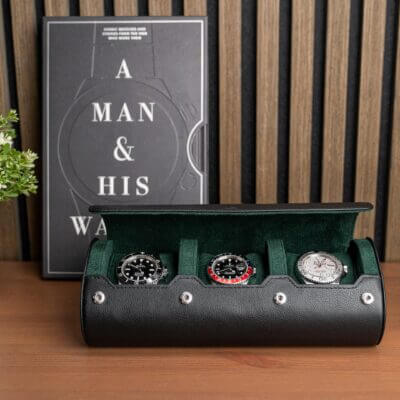
For those who rotate watches, a watch winder can simulate wrist movement to keep it powered without manual intervention each time. Expect some variability in daily accuracy, even with high-quality movements, and don’t be surprised by occasional rotor noise—a faint whirring from the self-winding part during movement.
Here is a quick-reference checklist for maintenance basics you can save and follow:
- Wear daily
- Service every ~5 years
- Avoid magnets and shocks
- Use watch winder if rotating
- Professional regulation
FAQs
What is a Swiss automatic movement?
A Swiss automatic movement is a self-winding mechanical timekeeping mechanism assembled and inspected in Switzerland that powers itself through the natural motion of your wrist. A weighted disc called a rotor swings as you move, transferring energy to a tightly coiled metal spring (the mainspring) that stores power. This stored energy is then released in controlled steps through a series of gears and a regulating mechanism to move the watch hands and keep time. Unlike manual-wind movements, which require daily hand-winding via the crown, or quartz movements, which rely on a battery and electronic oscillator, an automatic Swiss watch combines mechanical engineering with the convenience of self-winding, provided you wear the watch regularly.
What makes a movement “Swiss Made”?
A movement earns the Swiss Made label when it meets strict criteria set by Swiss law. The movement itself must be Swiss-made, at least 60 percent of the costs of manufacture must be Swiss, the movement must be assembled in Switzerland, and it must be inspected and tested in Switzerland. Additionally, the technical development of the movement must occur in Switzerland. This is distinct from a “Swiss Movement,” which may refer only to the origin of the movement itself, not necessarily the entire watch or its manufacture. The Swiss Made label is regulated and audited, so it carries real meaning for quality and origin.
What’s the difference between an ETA 2824-2 and a Sellita SW200-1?
Both the ETA 2824-2 and Sellita SW200-1 are workhorse automatic movements with nearly identical specifications: they beat at 28,800 vph, offer ~38-hour power reserve, and contain 25 jewels. Functionally, for most wearers, they perform very similarly and are found in hundreds of watch brands at entry to mid-level price points. The main difference is one of prestige and availability: the ETA 2824-2 is the industry standard and carries stronger brand recognition, while the Sellita SW200-1 emerged as an alternative after ETA restricted supply to some manufacturers. For practical purposes, a watch with either movement will keep reliable time and require similar maintenance.
How does the rotor actually power an automatic watch?
The rotor is a semicircular metal weight mounted on a pivot at the center of the movement. As you move your wrist throughout the day, gravity and inertia cause the rotor to swing back and forth freely. With each swing, the rotor engages a gear that winds the mainspring, much like turning the crown by hand does in a manual-wind watch. The rotor can swing in one direction or both directions (depending on the design), and a clutch mechanism prevents it from over-winding the mainspring once it is fully wound. This continuous, passive winding is why automatic watches are called self-winding—your everyday activity keeps the mainspring charged without any deliberate effort on your part.
What does COSC certification actually mean?
COSC (Contrôle Officiel Suisse des Chronomètres) is an independent Swiss testing organization that certifies the accuracy and reliability of mechanical movements. A COSC-certified movement is tested in multiple positions and temperature conditions over 15 consecutive days, and it must meet strict accuracy standards—typically averaging between minus 4 and plus 6 seconds per day. Certification does not guarantee your watch will always perform at this level in real-world wear (accuracy varies based on how the movement is regulated and cased), but it does mean the movement has been independently verified to a high standard. Many Swiss automatic movements can be COSC-certified, though certification is optional and adds cost.
How often do you need to service a Swiss automatic watch?
A practical baseline is to have your Swiss automatic movement serviced every 5 years if you wear it daily. However, service intervals can vary depending on the movement, your wearing habits, and the conditions it is exposed to. If you wear your watch sporadically, avoid harsh environments, and do not subject it to shocks or magnetic fields, you may extend intervals longer. A qualified watchmaker can inspect your movement and advise you on the actual condition. Regular servicing keeps the movement running accurately, prevents wear from becoming damage, and helps maintain the life of components like jewels and gears.
How do Swiss automatic movements compare to Japanese movements like the NH35?
Swiss automatic movements (such as the ETA 2824-2) and Japanese automatics (such as the Seiko NH35) are both reliable self-winding mechanical movements, but they differ in cost, finish, and availability. Swiss movements typically command higher prices because they are subject to strict manufacturing and export standards, often feature higher finishing standards, and carry the prestige of Swiss watchmaking heritage. Japanese movements like the NH35 offer excellent value for money—they are robust, accurate, and widely available—but they do not carry the Swiss Made label and may have simpler finishing. For a beginner, the choice often comes down to budget and whether you prioritize Swiss heritage or practical affordability.
Can you wear an automatic watch every day?
Yes, automatic watches are designed for daily wear. In fact, wearing your automatic watch regularly is the best way to keep it wound and functioning properly. As long as you move your wrist enough during the day, the rotor will wind the mainspring and the watch will run continuously. If you do not wear your watch for several days, the mainspring will gradually unwind and the watch will stop—this is normal and not a sign of damage. You can restart it by manually winding the crown or by putting it on and moving your wrist. If you own multiple automatics or do not wear your watch daily, a watch winder (a motorized storage box) can keep your watches wound while they are not being worn, preventing the need to reset time and date complications.