The Basics: What Makes a Watch Tick?
Ever wondered how watches work? At their core, watches track time using a movement, the internal mechanism that powers and regulates timekeeping. The movement provides a steady, repeatable way to move the hands—or update a digital display if present.
We’ll explore the three main movement types: manual-wind mechanical, automatic (self-winding) mechanical, and quartz. Each has a unique way of keeping that steady beat going.
- Manual-wind mechanical: You wind it by hand using the crown to store energy in a spring.
- Automatic (self-winding) mechanical: It winds itself from your wrist movements.
- Quartz: Runs on battery power for electronic precision.
Power sources differ too: mechanical types rely on spring energy (called a mainspring), quartz uses battery electricity, and some go further with light charging (solar). We’ll dive into the details soon.
Watches evolved from pocket watches in the 16th century—big, mechanical wind-ups carried in pockets—to sleek wristwatches by the early 1900s. Mechanical movements ruled until the 1970s quartz revolution brought battery-powered accuracy, transforming the industry.
To picture it, imagine this simple watch anatomy: A cross-section view of a wristwatch showing the crown (side knob for winding/setting), hands (hour, minute, second pointers), gear train (set of gears that transfers motion to the hands), and movement (central engine). Arrows frame the flow: energy enters, gets regulated, and displays time—setting the stage for how each type works.
Mechanical Watches: The Heartbeat of Traditional Timekeeping
Understanding how a mechanical watch works begins with one simple fact: mechanical watches store energy in a tightly coiled metal spring called the mainspring, and they release that energy in controlled, regulated bursts to move the hands. Both manual-wind and automatic watches share this core mechanical system; the key difference is how the mainspring gets wound in the first place.
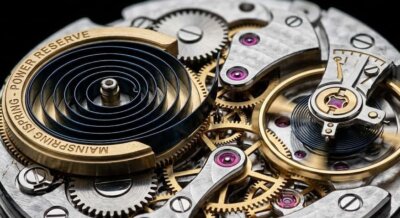
The mainspring powers the watch through a carefully orchestrated sequence. When you wind the crown (the small wheel on the side of the watch), you tighten this coiled spring, storing energy. As the mainspring slowly uncoils, it tries to release all that energy at once—but here’s where mechanical watchmaking’s genius comes in: the energy flows through the gear train, a series of small interlocking gears that transfer energy toward the hands and two critical components: the escapement and the balance wheel.
The Escapement: The Regulator
The escapement acts as a gate that meters out the energy from the mainspring in tiny, equal increments rather than all at once. Think of it like a water dam that releases water in steady pulses instead of a flood.
Here’s how it works: as energy flows from the gear train, the escapement’s teeth interact with a lever connected to the balance wheel. The escapement locks the gear train momentarily, then unlocks just enough to allow one small increment of motion, then re-locks. This lock-unlock-lock cycle repeats hundreds of times per second, creating the familiar tick-tock sound. Crucially, each cycle happens at the exact moment the balance wheel completes one half of its oscillation.
The Balance Wheel: The Oscillator
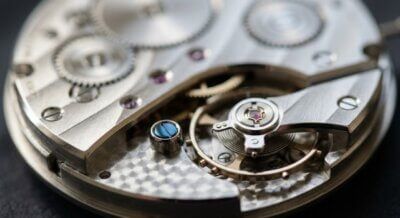
While the escapement controls energy release, the balance wheel is what creates the steady rhythm. It’s a weighted disc that oscillates (swings back and forth) at a constant rate, much like a pendulum, creating the real heartbeat of the watch.
The balance wheel is powered by the escapement. Each time the escapement unlocks, it gives the balance wheel a tiny push. The balance wheel’s momentum carries it through its swing, and when it reaches the furthest point, the escapement catches it again and pushes it back. This push-and-release pattern repeats consistently, controlled by the balance wheel’s physical properties and a hairspring—a delicate coiled spring attached to the balance wheel. A watchmaker can adjust how fast or slow the balance wheel swings by altering the hairspring’s tension, which is how a mechanical watch is fine-tuned for accuracy.
Beat Rate: The Watch’s Rhythm Measured
The balance wheel oscillates at what’s called a beat rate, often written as BPH (beats per hour). One beat is one complete oscillation of the balance wheel. Typical beat rates vary by model; higher beat rates mean the escapement unlocks more frequently, which can provide smoother motion. However, higher rates also require more energy. The beat rate is one of the key specifications a watchmaker chooses when designing a movement.
From Balance to Hands: The Final Gear Train
Once the escapement and balance wheel have regulated energy into steady pulses, that energy must be transferred to the hands. A second gear train, called the dial train, takes the regulated pulses and uses them to advance the hour hand, minute hand, and seconds hand at the correct rates. The seconds hand advances with each beat, the minute hand advances once every 60 second-hand increments, and the hour hand advances once every 12 minute-hand cycles, keeping all three hands synchronized.
Jewels and Bearings: Reducing Friction
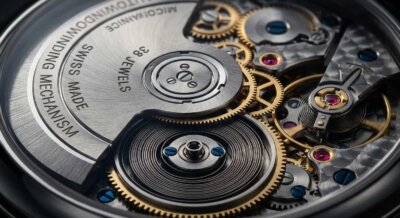
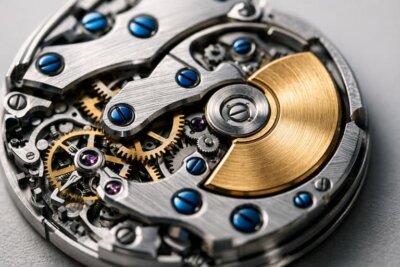
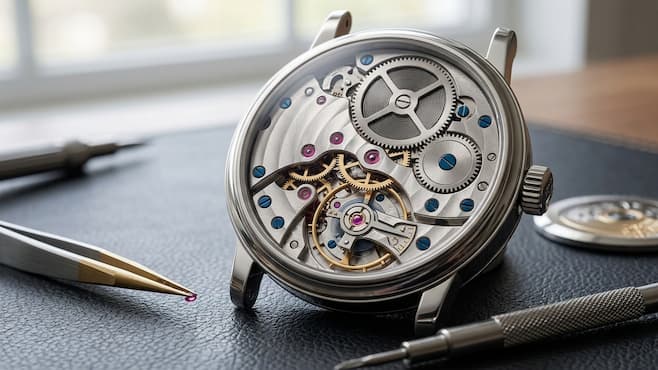
If gears rubbing against gears and the balance wheel pivoting created friction, that friction would waste energy and slow the watch. This is where jewels (also called bearings or jeweled bearings) come in. These are tiny synthetic rubies or sapphires inserted at key pivot points where one component rotates against another. The hard, smooth surface of a jewel creates a nearly frictionless bearing surface, allowing gears to spin and the balance wheel to oscillate with minimal energy loss. A watch with jewels at critical points generally indicates quality construction and longer-lasting performance.
Power Reserve: How Long Does the Energy Last?
The mainspring can only store a finite amount of energy, so eventually it uncoils completely and the watch runs out of power. The time between full wind and complete unwinding is called the power reserve, which varies by model, often lasting one to two days or longer depending on the mainspring’s size and design. For manual-wind watches, if you wind fully on Monday morning and then don’t wear or wind it again, it will continue running for the duration of its power reserve. For automatic watches, the power reserve tells you how long the watch will run if you don’t wear it—useful if you take a vacation and leave your watch at home.
Visual: Component Breakdown and Energy Flow
Imagine a diagram labeled with these components and flow: Mainspring (shown as a tightly coiled spiral in the center) → Gear Train (shown as interlocking gears with an arrow labeled “Energy transfers through gears”) → Escapement (shown as a locking mechanism) ↔ Balance Wheel (shown as a weighted disc with hairspring attached, with a double-headed arrow labeled “Unlock-push-relock cycle”) → Dial Train (shown as a smaller gear train with an arrow pointing toward the watch hands). Overall flow: Mainspring → Gears → Escapement/Balance Wheel (heartbeat) → Dial Train → Hands advance. Jewels/Bearings are shown as small dots at key pivot points.
Visual: Escapement and Balance Wheel Interaction (The Heartbeat Up Close)
Imagine a step-by-step animation showing the escapement-and-balance cycle: Frame 1: Balance wheel at the top of its swing; Escapement is locked, teeth blocked by the lever. Frame 2: The locked lever is pushed by the balance wheel’s hairspring; lever begins to move, unlocking the teeth. Frame 3: Escape wheel unlocks briefly; one tooth pushes the escapement lever and balance wheel, giving it energy and momentum. Frame 4: Balance wheel swings past center, driven by the push and its own momentum. Frame 5: Balance wheel reaches opposite extreme; the lever re-locks the escape wheel teeth. Frame 6: Cycle repeats in reverse—balance wheel swings back, escapement unlocks again, escape wheel advances one more tooth, pushing the balance wheel back. This lock-unlock-lock rhythm repeats hundreds of times per second.
Manual-Wind Watches: Hands-On Winding Explained Step-by-Step
Manual-wind watches represent the simplest form of mechanical timekeeping, where you directly power the watch by turning the crown. These watches require regular hand-winding to keep going, making them a pure expression of traditional craftsmanship. Unlike self-winding models, there’s no automatic assistance here—just your input to wind the mainspring and drive the entire system.
The process starts with the crown, the knurled wheel on the side of the watch case. Turning it clockwise winds the mainspring, a coiled spring inside the movement that stores mechanical energy as it tightens. This stored energy then releases gradually through the gear train, which transfers motion to the escapement. The escapement regulates this energy in controlled bursts, interacting with the balance wheel to create steady oscillations that advance the hands.
A manual-wind watch offers a power reserve (the amount of time it runs after a full wind) that varies by model, often lasting one to two days before it needs rewinding.
Step-by-Step: How Winding Powers Your Watch
- Twist the crown clockwise: Hold the crown gently between your thumb and forefinger, and turn it forward until it feels firm. This directly tightens the mainspring, storing potential energy inside the movement.
- Store energy in the mainspring: As you turn, the mainspring coils tighter, building up the power that will drive the watch. Think of it like compressing a spring in a toy—the more you wind, the longer it runs.
- Regulate via escapement and balance wheel: The mainspring slowly unwinds, pushing energy through the gear train to the escapement. The escapement releases energy in precise, tiny steps, while the balance wheel oscillates to maintain a consistent beat. This “heartbeat” ensures even timing.
- Hands move forward: The regulated pulses advance the gear train, turning the hour, minute, and seconds hands on the dial. Your watch is now running reliably until the power reserve depletes.
Quick Checklist: Winding Your Manual-Wind Watch
- Ensure the crown is in its normal position (pushed in fully).
- Grasp the crown and turn it clockwise gently—avoid forcing it.
- Wind until resistance builds.
- Check that the seconds hand resumes smooth motion.
- Set the time if needed by pulling the crown out to the first or second position.
- Push the crown back in securely to start normal operation.
Automatic (Self-Winding) Watches: Powered by Your Wrist
Automatic (self-winding) watches stand out from manual-wind versions because they harness your everyday wrist movements to keep themselves powered, eliminating the need for daily hand-winding. At its core: a special part called the rotor uses motion from your arm to wind the mainspring automatically.
What Makes It Self-Winding?
A rotor, a semi-circular weighted piece inside the watch, spins freely with every swing of your wrist. This rotation tightens the mainspring, storing energy just like manual winding does with the crown. Unlike quartz watches, automatics rely purely on this mechanical process—no batteries required. When worn regularly, they stay powered through your natural movements and run smoothly for daily use.
What Happens When Not Worn?
If you set the watch aside without wearing it, the stored energy in the mainspring will eventually deplete, causing it to stop. This ties directly to the power reserve—the length of time it runs when not being worn—which varies by model. A quick manual wind via the crown can restart it.
Step-by-Step: How an Automatic Watch Powers Itself
- Arm move: Your wrist swings during walking, typing, or gesturing, creating kinetic energy inside the watch.
- Rotor turns: The heavy rotor pivots, channeling that motion to wind the mainspring tighter.
- Mainspring winds: Energy builds up as the coiled spring compresses, ready for controlled release.
- Escapement regulates: It meters out the mainspring’s energy in tiny, even pulses to the balance wheel, maintaining steady rhythm.
- Hands move: The gear train transfers these regulated pulses, advancing the hands precisely across the dial.
Rotor Action Diagram Description
Imagine a top-down cutaway view of the watch movement: a curved, metallic rotor sits above the mainspring barrel. Arrows show wrist motion causing the rotor to rotate around a central pivot. A winding arrow flows from rotor edge to the barrel, illustrating energy transfer. The escapement and balance wheel sit nearby, faintly connected by a gear outline.
Concrete Example: Rotor in Action
Picture shaking your arm side-to-side like stirring a drink: each shake makes the rotor whirl, tightening the mainspring—you might hear a faint whir as it winds, building enough energy to keep the seconds hand sweeping smoothly even if you pause for a moment.
Quartz Watches: Battery-Powered Precision Step-by-Step
Quartz watches represent the most common modern timepieces, offering reliable accuracy through an electronic process that starts with a battery and ends with moving hands. To understand how a quartz watch works, follow this linear chain where electrical energy creates precise time signals.
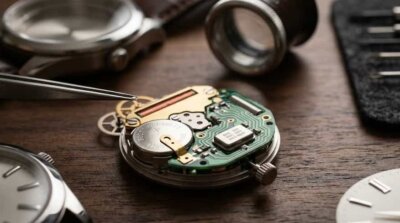
A battery serves as the power source, providing steady electrical current to the watch’s components. This current flows to a quartz crystal, a tiny piece of synthetic quartz that vibrates consistently when electrified.
Step-by-Step: From Battery to Ticking Hands
- The battery sends electrical current to the quartz crystal.
- The quartz crystal vibrates at exactly 32,768 vibrations per second, creating a highly stable frequency for timekeeping.
- A circuit counts these vibrations and divides them down into regular one-second pulses.
- These pulses drive a stepper motor, which advances in precise steps and turns the gear train, transferring motion to the hands.
- The hands move smoothly across the dial, advancing once per second.
This process repeats seamlessly, with steady, precise timekeeping throughout the battery’s life.
Visualizing the Quartz Vibration
Imagine a simple diagram showing a battery icon connected by an arrow to a quartz crystal depicted as a small rectangular slab with a wavy sine waveform emanating from it, labeled “32,768 vibrations/second.” Arrows then lead to a circuit box (showing division), a stepper motor icon with gear teeth, and finally the gear train flowing to clock hands. This visual traces the energy from electricity to mechanical motion, with a note: “Electronics convert constant vibrations into exact 1-second ticks.”
For a concrete example, picture the crystal flexing back and forth 32,768 times every second—like a tuning fork humming too fast to hear. The circuit tallies every 32,768th vibration and sends a single pulse, ensuring the seconds hand jumps precisely once per second, regardless of temperature or position.
Power Sources Compared: Mainspring, Battery, and Beyond
Understanding power sources reveals how watches generate energy for timekeeping. Mechanical watches, whether manual-wind or automatic, rely on a mainspring for stored energy, while quartz watches use a battery, and solar options add light-based power.
Manual-wind and automatic mechanical watches both draw power from the mainspring, a coiled spring that stores energy. The difference lies in winding: manual-wind watches require turning the crown by hand, while automatic watches use a rotor driven by wrist motion to wind the mainspring automatically.
Quartz watches depend on a battery to provide steady electricity. This powers the quartz crystal and circuit, creating reliable pulses for precise timekeeping.
Solar watches incorporate solar cells that convert light into electrical energy, typically to charge a battery in a quartz-based system. This keeps them running with minimal upkeep as long as they get light exposure.
The table below compares the main movement types side-by-side, highlighting power sources alongside accuracy and key pros and cons to aid your choice.
| Type | Power Source | Accuracy | Pros/Cons |
|---|---|---|---|
| Manual-wind mechanical | Mainspring (crown winding) | ~2–5 sec/day | Pros: Craftsmanship feel, no battery. Cons: Needs regular winding or stops. |
| Automatic mechanical | Mainspring (rotor/wrist motion) | ~2–5 sec/day | Pros: Self-winding convenience. Cons: Stops if not worn regularly. |
| Quartz | Battery | ~15 sec/month | Pros: High accuracy, low maintenance. Cons: Requires battery replacements. |
| Solar | Solar cells (light-charged battery) | ~15 sec/month | Pros: Eco-friendly, minimal charging. Cons: Needs light; still battery-dependent. |
Accuracy, Maintenance, and Key Features
Accuracy: Mechanical vs Quartz
Mechanical watches, including manual-wind and automatic types, typically gain or lose about 2–5 seconds per day. This means you might need to adjust them every couple of days for precise timing.
Quartz watches drift by around 15 seconds per month. That lower daily change makes them handy for set-it-and-forget-it use over weeks.
| Aspect | Mechanical | Quartz |
|---|---|---|
| Daily Drift | ~2–5 sec/day (more frequent checks needed) | ~15 sec/month (minimal adjustments) |
| Practical Implication | Satisfying “heartbeat” rhythm; set weekly | Stable for travel/work; check monthly |
| Influencing Factors | Position, temperature affect beat | Battery strength, rare crystal issues |
Key Features Revisited: Power Reserve and Beat Rate
Power reserve shows how much stored energy remains, often via a small dial indicator, helping you know when to wind before the watch stops—especially useful for automatic watches that rely on recent wear.
Beat rate (BPH) measures how many times per hour the balance wheel swings back and forth in mechanical watches, creating that steady “heartbeat” rhythm; higher beat rates often mean smoother seconds-hand motion.
Basic Maintenance Expectations
For mechanical watches, wear them regularly to keep energy flowing, avoid extreme shocks or magnets, and periodic professional service will keep them running smoothly.
Quartz watches need a battery change when needed, plus occasional cleaning and water-resistance checks if applicable.
These habits ensure long life across all types.
How to Use and Care for Your Watch
Setting the Time on Any Watch
Use the crown, the knurled knob on the side of your watch case, to set the time safely across all movement types.
- Unscrew the crown if it has a screw-down feature for water resistance, or simply pull it out gently to the first or second position (check your watch’s manual for positions).
- Rotate the crown clockwise or counterclockwise to advance the hands to the correct time and date.
- Push the crown back in firmly and screw it down if needed to secure it.
Always set the time gently to avoid stressing the movement, and adjust the date at midnight carefully if your watch has that function.
Winding and Charging by Movement Type
Manual-wind watch: Turn the crown clockwise regularly to store fresh energy in the mainspring, typically every day or two.
Automatic (self-winding) watch: Wear it regularly so wrist motion keeps it wound, or manually wind the crown if it has stopped.
Quartz watch: No winding needed; replace the battery when the seconds hand starts skipping.
Solar watch: Expose the dial to light regularly, whether natural sunlight or indoor lamps, to recharge its battery via solar cells.
Common Pitfalls to Avoid
Not wearing an automatic (self-winding) watch regularly can lead to stoppage once its power reserve runs out. Store it on a watch winder if you won’t wear it for extended periods.
Other issues include exposing any watch to strong magnets or shocks, or ignoring water resistance ratings during swims or showers. For quartz, forgetting battery changes causes sudden stops. Neglect these, and you risk inaccurate time or damage.
Comfort matters for daily wear too—ensure a good fit for all-day ease and regular wear.
Daily Use by Type Checklist
- For manual-wind: Turn crown regularly to maintain power.
- For automatic: Wear daily for consistent winding from wrist motion.
- For quartz: Monitor seconds hand for battery skips; replace as needed.
- For solar: Provide regular light exposure for charging.
- Set time/date carefully using crown positions.
- Avoid magnets, shocks, and exceeding water resistance.
- Clean with soft cloth; service mechanical watches periodically.
Watch Movements FAQs
How does a watch keep time?
A watch keeps time through its movement, the internal mechanism that regulates energy release. In mechanical watches, the escapement and balance wheel create steady oscillations, or beats, that drive the gear train to move the hands. Quartz watches use a quartz crystal vibrating at 32,768 times per second to generate precise pulses for the hands.
How does a watch work without a battery?
A mechanical watch works without a battery by storing energy in the mainspring, which you wind either manually via the crown or automatically with a rotor from wrist motion. The mainspring powers the gear train, escapement, and balance wheel to keep time until the power reserve runs out.
What’s the difference between manual and automatic?
A manual-wind watch requires you to turn the crown by hand to wind the mainspring and store energy. An automatic (self-winding) watch uses a rotor, a semi-circular weight that spins with your wrist movements to wind the mainspring automatically, though you can also wind it manually if needed.
How accurate are different movements?
Mechanical movements, including manual-wind and automatic, are typically accurate to about 2–5 seconds per day, thanks to the balance wheel’s consistent oscillations. Quartz movements gain or lose about 15 seconds per month, using the quartz crystal’s steady vibrations for higher precision.
What is a power reserve?
Power reserve is the duration a mechanical watch runs on its stored mainspring energy after winding or last wear. It varies by model, often lasting from one to two days or longer before the watch stops and requires winding again.