Understanding the Counterfeit Problem & Why Authentication Matters
Rolex watches are among the most counterfeited luxury items in the world. The combination of brand prestige, strong resale value, and global demand makes them an attractive target for counterfeiters. If you’re considering buying, selling, or insuring a Rolex, understanding the authentication landscape is essential to protect your investment and avoid legal and financial risks.
The counterfeit market has evolved significantly. Budget fakes—poorly finished watches with obvious flaws—are relatively easy to spot once you know what to look for. Authentication requires multiple checks because counterfeits vary widely in sophistication—from obvious budget fakes to super fakes engineered to fool casual inspection. A super fake is a high-quality counterfeit engineered to fool casual inspection, often using better materials and more accurate finishing than budget counterfeits. A Frankenwatch is a watch assembled from a mix of authentic and counterfeit parts, sometimes created by combining a genuine dial and hands with a counterfeit case, or vice versa. These hybrid watches can slip past basic checks but will eventually show inconsistencies when examined closely.
Why Authentication Matters
The stakes are real. Purchasing a counterfeit Rolex means losing money—often thousands of dollars—on a fake item. If you later try to sell or insure it, you face potential fraud liability and legal exposure in many jurisdictions, as knowingly trafficking in counterfeits can result in civil and criminal penalties. Beyond financial loss, wearing or owning a counterfeit damages your reputation among collectors and watch enthusiasts. Professional authentication protects you by confirming authenticity before a transaction, supporting insurance claims, and giving you confidence in your collection.
The Inspection Framework: From Easy Checks to Expert Verification
This guide is structured as a layered approach to authentication. You’ll start with tool-free, beginner-friendly checks that require nothing but your eyes and hands—weight, materials feel, and basic visual inspection of engravings. These early checks can quickly eliminate obvious budget fakes. Next, you’ll move to loupe-aided external inspections: dial printing, Cyclops lens quality, crown details, and serial number engravings. These checks require a magnifying glass and good lighting but no special equipment or case opening.
Beyond that threshold lies the movement inspection—observing the beat rate, sound, and mechanical behavior—and the micro-etched crown on the sapphire crystal, which demand magnification and careful technique. At the far end of the spectrum is professional authentication, which includes opening the caseback, examining the movement finishing, and cross-referencing with Rolex production databases.
The key principle: each check is a signal, not proof. A counterfeit might pass one or two checks but fail several others. Conversely, a super fake might pass most external checks but show inconsistencies in movement finishing or material composition. The guide will help you recognize these signals and decide when your findings warrant professional verification.
Difficulty Ranking: What to Expect
Easy checks—weight, basic visual inspection, and obvious engravings—catch most budget fakes. Moderate checks, such as dial detail inspection, Cyclops magnification, and crown finishing, catch mid-tier counterfeits. Advanced checks, including the micro-etched crown, rehaut alignment, and movement finishing, are needed to identify super fakes. Frankenwatches, assembled from mixed authentic and counterfeit parts, require professional cross-referencing of all components to reveal inconsistencies. Understanding this spectrum helps you decide how far to investigate before seeking professional help.
Why Counterfeiters Fail at Specific Features
Throughout this guide, you’ll notice a recurring theme: counterfeits struggle with certain features for repeatable, technical reasons. Materials like 904L Oystersteel are expensive and require specialized metallurgy; counterfeiters often substitute cheaper alloys, which feel noticeably different in hand. Dial printing requires precise equipment and techniques; rushed or cheap methods produce blurry text or misaligned logos. The Cyclops lens demands optical precision; fakes often use plain glass with weak magnification or incorrect curvature. The movement—the mechanical heart of the watch—is the hardest to fake convincingly; quartz movements are far cheaper to produce but immediately identifiable by their telltale once-per-second jump.
By understanding these failure points, you’ll develop an intuition for what to inspect and why. The goal is to give you the confidence to perform preliminary checks yourself and the wisdom to recognize when professional expertise is necessary.
External Inspection Basics: Weight, Feel & Materials
Before you examine engravings, dials, or anything else, pick up the watch. A genuine Rolex feels substantial, balanced, and solidly constructed in your hand. This first checkpoint requires no tools—just your sense of touch and a few seconds of attention. Counterfeiters often cut corners on materials and manufacturing, and that economy shows immediately when you feel the difference between a premium watch and a fake.
Why Weight and Heft Matter
Genuine Rolex watches use premium materials that carry real density. The most common case material is 904L Oystersteel, a corrosion-resistant alloy denser and heavier than the cheaper 316L stainless steel used in many counterfeits. When you hold an authentic Rolex, you experience the weight of precision engineering and quality metals. Fakes, built to maximize profit margins, often substitute cheaper alloys or use hollow sections to reduce manufacturing costs. The result is a watch that feels lightweight, tinny, or poorly balanced—telltale signs of a counterfeit.
This is why weight and feel rank as your easiest first check: counterfeiting the density and construction quality of genuine materials is far more expensive than faking a dial print. Most budget and mid-tier counterfeits fail this test immediately.
Genuine Rolex Materials and What to Expect
Rolex produces watches in several materials, each with distinct properties and weight characteristics. This table helps you understand what you’re feeling in hand—the density and finish expectations for each material—as a quality-check reference.
| Material Type | Typical Models | Density & Feel | Common Counterfeits Use |
|---|---|---|---|
| 904L Oystersteel | Sport models, Submariner, GMT-Master II, Daytona | Noticeably dense; cool to touch; scratch-resistant finish | 316L steel (lighter, less corrosion-resistant) |
| 18k Gold (yellow, white, rose) | Datejust, Day-Date, Sky-Dweller (full gold versions) | Significantly heavier than steel; warm feel | Gold-plated or filled cheap alloys that fade |
| Platinum | Day-Date, select limited editions | Extremely dense; heaviest precious metal option | White gold or tungsten-filled alloys (never platinum) |
| Everose (18k rose gold) | Submariner Date, GMT-Master II, Daytona, Datejust | Dense; warm rose tone; maintains color over decades | Standard rose gold or copper-heavy alloys that tarnish |
| Rolesor (two-tone: steel & gold) | Submariner Date, Datejust, GMT-Master II | Mixed density; feels balanced between steel and gold | Plated or filled combinations; weight feels off-balance |
| Rolesium (steel & platinum) | Select Day-Date and GMT models | Very dense; noticeably heavier than Rolesor | Steel with white-gold plating (much lighter) |
When you hold a genuine Rolex, match the weight expectation to the material. A steel sports watch should feel solid and substantial. A gold Datejust should feel notably heavier. A platinum piece should feel almost unexpectedly dense. If a watch claims to be gold but feels light, or claims to be steel but feels hollow, that is a major red flag.
The Feel Test: What to Notice
Run through these quick, tool-free checks while holding the watch:
- Balance and Center of Gravity: A genuine Rolex balances naturally when held by the band at 12 and 6 o’clock. The weight distribution feels even and intentional. Fakes often feel lopsided or top-heavy.
- Bracelet Link Solidity: Press gently on individual bracelet links between your thumb and forefinger. Genuine links are solid; they do not flex or feel hollow. Counterfeit links often rattle slightly or compress too easily because they are partially hollow.
- Case Density: Hold the watch by the bracelet and feel the case in your other hand. It should feel dense, not light or plasticky. Compare it mentally to a cheap watch if you can; the difference is stark.
- Finishing Smoothness: Run your finger over the case sides and lugs. Genuine Rolex cases have sharp, clean edges and a flawless matte or polished finish (depending on the model). Cheap counterfeits have rough edges, casting marks, or a finish that feels cheap.
- Clasp Action: If the watch has a Jubilee or Oyster bracelet, engage and disengage the clasp a few times. It should click firmly and lock securely without wiggle. Fake clasps are often loose or sticky.
Common Counterfeit Shortcuts and What You Will Feel
Counterfeiters save money by using cheaper materials and construction methods. These are visible and tactile:
- Lightweight Feel: The watch feels too light for its size. This is almost always due to 316L steel instead of 904L, or hollow sections instead of solid links.
- Hollow Bracelet Links: Individual links feel slightly compressed or move independently when pressed. Genuine Rolex links are solid steel or gold throughout.
- Rattle or Looseness: You hear or feel subtle movement inside the case or bracelet when you gently shake the watch. Authentic Rolex cases and links have tight tolerances with zero rattling.
- Cheap Metal Finish: The case feels rough or has casting seams visible to the eye. Genuine Rolex finishing is flawless.
- Soft or Weak Clasp: The clasp feels cheap, does not grip securely, or has excessive play. Genuine Rolex clasps are solid, crisp, and perfectly indexed.
Vintage Watches and Material Expectations
Older Rolex watches may weigh slightly less than modern equivalents if they use 18k gold (which has different alloy ratios than modern Everose) or if the case design is simpler. However, vintage watches should still feel well-crafted and substantial. A vintage Rolex that feels light and cheap is almost certainly a counterfeit, not a legitimate older piece.
If you are evaluating a vintage watch, research the specific model and era to understand what material was used and what weight you should expect. Even so, the feel should still be premium and solid, never light or hollow.
Why This Check Matters Most
Counterfeiting materials and achieving correct density is expensive. Most fake Rolex watches fail the weight and heft test immediately because manufacturers prioritize cost over authenticity. This check is your fastest triage: if a watch feels light, flimsy, or hollow, it is likely counterfeit, and this result warrants stopping further DIY checks and seeking professional verification.
If the weight and feel pass, you move forward with confidence to the next checks—serial numbers, dial details, and the Cyclops lens. A watch that feels authentic is far more likely to be authentic, and this single checkpoint eliminates most budget counterfeits before you invest time in deeper inspection.
Inspection Order Workflow
Follow this sequence, using each decision point to determine whether to continue or seek professional help:
- Weight and Feel—tool-free check; eliminates most budget fakes.
- Serial and Model Engravings—loupe required; verify engraving quality and location match production era.
- Dial Quality—loupe required; inspect text sharpness, spacing, and luminescence evenness.
- Cyclops Lens, Crown, and Caseback—loupe required; no case opening; checks construction integrity.
- Movement Observation—no tools or opening; listen for tick vs. sweep; observe date window behavior.
- Micro-Etched Crown and Rehaut Alignment—advanced loupe work; requires familiarity with specific model era.
- Professional Movement Inspection—professional only; case opening required; cross-reference caliber and finishing details.
Serial Numbers & Model Numbers: The Fingerprints of Authenticity
Every genuine Rolex carries unique serial and model numbers engraved into its case. These markings are not proof of authenticity on their own, but they are your first major checkpoint for cross-referencing the watch against its supposed production year and spotting obvious red flags. Think of them as the watch’s fingerprints: their location, engraving quality, and era-appropriate placement tell you whether you are looking at a genuine timepiece or a counterfeit.
Where Serial and Model Numbers Live
The location of these engravings depends entirely on when the watch was made. Rolex has moved these markings over the decades, and understanding the timeline is critical. Counterfeiters often get the location wrong, or they fail to account for the production year when they place the engraving—a mismatch that reveals a fake immediately.
| Production Era | Serial Location | Model Location | Visibility Notes |
|---|---|---|---|
| Vintage (pre-1960s) | Between the lugs at 6 o’clock position | Between the lugs at 12 o’clock position | Requires bracelet removal; visible only when bracelet is detached |
| Pre-2005 | Between the lugs at 6 o’clock position | Between the lugs at 12 o’clock position | Requires bracelet removal; visible only when bracelet is detached |
| 2005–2008 | Transitional: some models on lugs, some moving to rehaut | Between the lugs at 12 o’clock position | Check official documentation for your specific reference number |
| Post-2008 (2008 onward) | Rehaut (inner bezel ring at 6 o’clock position) | Between the lugs at 12 o’clock position | Visible through the crystal without bracelet removal; laser-etched and micro-detailed |
The shift to the rehaut around 2008 was a game-changer for Rolex. By moving the serial number to the inner bezel ring, Rolex made it visible without disassembly and significantly harder for counterfeiters to replicate convincingly. On modern watches, you can read the serial number by looking through the crystal at a slight angle toward the 6 o’clock position. On older models, you must carefully remove the bracelet (or have a professional do it) to view the engravings between the lugs.
Engraving Quality: Laser-Cut Crisp vs. Shallow and Sandy
This is where super fakes often stumble. Genuine Rolex engravings have a distinctive laser-cut appearance: sharp edges, consistent depth, and a subtle three-dimensional quality that catches light in a recognizable way. Counterfeit engravings frequently look shallow, sandy, blurry, or inconsistently deep across the numerals.
Under close inspection with proper lighting, authentic Rolex serial numbers display what collectors call a diamond-cut glow. The engraving has clean, perpendicular walls and a mirror-like bottom surface that reflects light crisply. Acid-etched or shallow counterfeits lack this definition and appear flat or fuzzy at the edges, especially under magnification.
The engraving should also be perfectly aligned and consistent in spacing. Misaligned numbers, uneven letter sizing, or spacing gaps are immediate red flags. On post-2008 models with the rehaut serial, the laser etching should be fine and precise, not crude or easily scratched away.
How to Inspect Serial and Model Numbers Properly
A close visual inspection requires no special tools beyond good lighting and a magnifying loupe. Follow this step-by-step approach:
- Locate the serial and model numbers according to your watch’s era (use the table above as your guide).
- Remove the bracelet or position the watch so the engravings are fully visible and unobstructed.
- Use a loupe (10x magnification is standard) and a bright light source angled at 45 degrees to the engraving surface.
- Examine the edges of each numeral for sharpness and consistency; they should be clean and defined, not blurry or rough.
- Check the depth by tilting the watch slightly and observing how light reflects from the bottom of the engraving; authentic engravings show a bright, uniform reflection.
- Verify that all numerals are evenly spaced and aligned in a straight line.
- Take a close-up photo or screenshot with your phone loupe or magnifier to compare against reference images of the same model from the official Rolex database or authorized dealers.
Close-Up Photo Guidance
When you examine the watch in person or request photos from a seller, look for these details:
- Authentic laser engraving appears sharp and crisp under magnification, with no fuzzy edges or irregular depth.
- Counterfeit acid-etched engravings often show a grainy, sandy texture and inconsistent letter heights.
- Genuine Rolex engravings maintain consistent spacing and alignment; numbers should sit on an invisible baseline.
- On post-2008 watches, the rehaut serial should be fine, delicate, and precise, not bold or crude.
- If a seller cannot provide clear, magnified photos of the serial and model numbers, that is a red flag—authentic watch owners and reputable sellers expect this request.
Using Serial Numbers for Era Cross-Reference
Once you have verified the engraving quality, you can use the serial number to approximate the watch’s production year. Rolex publishes serial number ranges tied to specific years, and this information is available through authorized dealers, independent databases, and expert resources. Serial verification is most powerful when it aligns with other checks: dial quality, movement characteristics, and materials consistency. A serial mismatch with era-appropriate features is a critical warning sign.
Red Flags in Serial and Model Number Checks
- Missing, illegible, or entirely absent serial or model numbers—a major red flag.
- Serial numbers that are repeated across multiple watches (a trick counterfeiters use to simplify production).
- Engraving location that does not match the watch’s stated production era (e.g., a serial between the lugs on a watch claimed to be from 2015).
- Shallow, sandy, or blurry engraving that lacks the laser-cut clarity of genuine Rolex markings.
- Misaligned or inconsistently spaced numerals.
- Serial numbers that do not correspond to any known Rolex production year or reference number.
Why Counterfeiters Struggle Here
Engraving serial and model numbers with the precision Rolex demands requires industrial-grade laser equipment and exacting quality control. Most counterfeit operations use cheaper acid etching or lower-resolution laser tools that cannot replicate the three-dimensional, diamond-cut appearance of genuine Rolex engravings. Even super fakes often show telltale signs under magnification: inconsistent depth, fuzzy edges, or misaligned characters.
Some advanced counterfeiters have invested in better tooling and can produce convincing-looking engravings. This is why serial verification alone is not enough. It must be combined with inspection of the dial, Cyclops lens, crown, caseback, and movement to build a complete picture of authenticity.
Serial Number Verification Steps Checklist
- Locate the serial number according to the production era (lugs vs. rehaut).
- Inspect engraving quality under magnification at a 45-degree light angle.
- Confirm all numerals are sharp, evenly spaced, and aligned.
- Cross-reference the serial against the corresponding production year.
- Verify that the serial location matches the watch’s stated era (do not expect pre-2008 placement on a post-2010 model).
- Check that the engraving does not appear laser-etched if the watch is a vintage model from an era before Rolex used laser technology.
- Ensure the model number at the 12 o’clock position also displays crisp, consistent engraving quality.
With serial and model numbers verified, you are ready to move deeper into the dial quality and optical features. Next, focus on the dial printing, lume, and crown logo alignment—areas where counterfeiters frequently cut corners.
Dial Details & Printing: Where Counterfeits Get Caught
The dial is one of the highest-yield inspection areas because counterfeits consistently fail at precision printing and alignment. Unlike weight or materials, dial defects are visible under magnification and reveal the manufacturing shortcuts that counterfeiters take. This section teaches you exactly what to look for and how magnification reveals the truth.
Font Sharpness and Printing Quality
Authentic Rolex dials feature crisp, clean printing with sharp edges on every letter and numeral. Counterfeit dials typically show blurred or wavy text, inconsistent line weight, or a slightly fuzzy appearance even under normal viewing. The difference becomes dramatic under a loupe: genuine Rolex text appears crisp with clean, defined edges; fake printing often looks slightly soft or has feathered edges where the ink or laser did not cut cleanly.
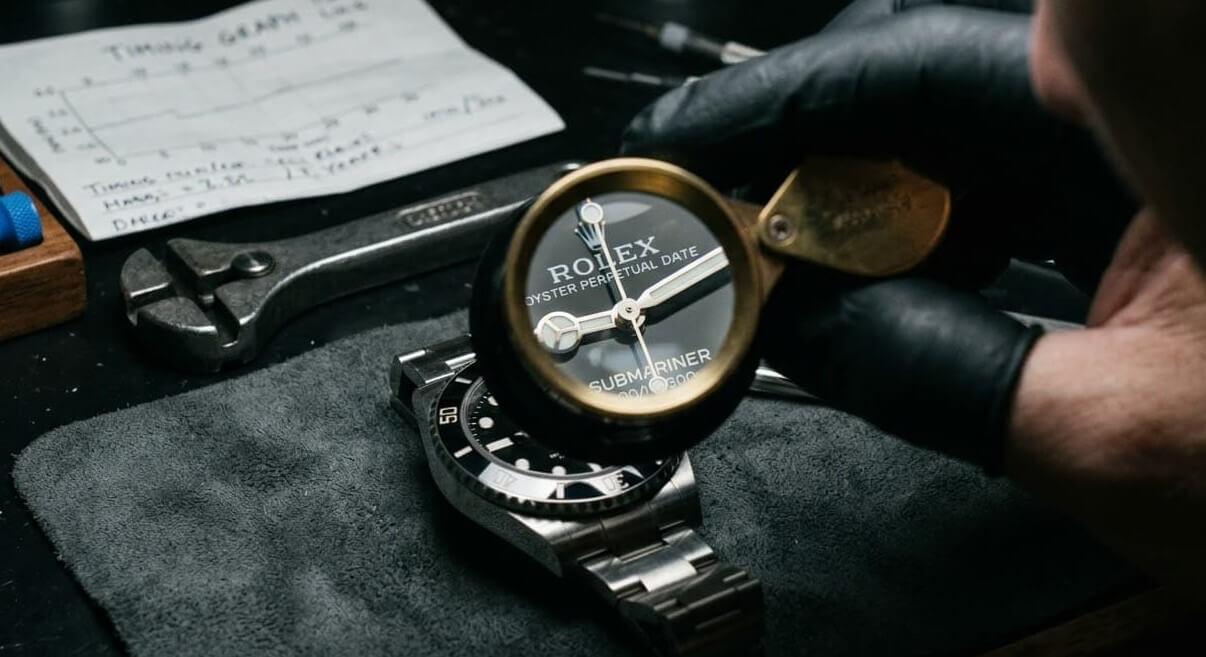
To inspect under magnification, use a 10x loupe and angle the dial under bright, consistent light (a desk lamp or daylight works well). Tilt the dial 45 degrees so light rakes across the text surface; this reveals any irregularities in the printing edge. Authentic engravings appear three-dimensional and crisp. Fake dials may show sandy or blurry edges, especially on smaller text like subdial labels or the model name.
Why counterfeiters struggle here: precision printing at Rolex’s tolerances requires specialized laser-cut engraving or high-resolution printing equipment. Many counterfeiters use acid-etching or cheaper printing methods that cannot achieve the same sharpness, especially on curved dial surfaces.
Spacing, Alignment, and Logo Placement
Every letter on an authentic Rolex dial is evenly spaced with consistent gaps between characters. The brand name “ROLEX” at 12 o’clock sits centered and level. Text like “SUBMARINER,” “DATEJUST,” or “DAYTONA” appears symmetrically positioned and properly aligned. Counterfeits often show irregular spacing, overlapping letters, or slightly tilted text because they use misaligned plates or poor alignment during printing.
The Rolex coronet logo (the crown symbol, not the winding crown) is positioned at 12 o’clock on most models, but placement and style vary by reference and era. Always compare your dial against official Rolex images for that exact model and production year. A dial that looks “off” may simply be a different variant, so reference images are essential. Misalignment becomes obvious when you compare: authentic placement looks intentional and centered; fake placement often appears slightly off-center or floating.
Check alignment by holding the dial level under a loupe and observing whether text runs parallel to the dial edge and whether the coronet sits directly above the center. Use a straight edge or the loupe itself as a visual guide.
Luminescence (Lume) Application
Evenly applied luminescence is a hallmark of authentic Rolex dials. The lume on hour markers and hands should coat smoothly and uniformly; the color should match across all markers on that dial. Counterfeits frequently show uneven lume application: patchy coverage, drips, or lume that pools at marker edges. Some fakes use overly bright or off-color lume that does not match Rolex standards.
Inspect lume in daylight and note whether all markers appear equally coated. Under a loupe, look for consistency in coverage depth and color. Uneven patches, bare spots, or lume that appears to have run or collected at one edge are red flags. Authentic dials show uniform, smooth lume application that suggests machine precision rather than hand-dripping.
Hour Markers, Applied Indices, and 3D Quality
Rolex hour markers range from applied gold indices (on some Day-Date and Datejust models) to printed markers on sport models. Authentic markers sit flush with the dial and possess a three-dimensional, integrated appearance. Counterfeit markers often look sticker-like or slightly raised, and applied markers may show uneven adhesive or gaps around the edges.
Check marker symmetry: are all markers evenly spaced around the dial? Applied indices on genuine watches should sit flush and level; gaps or lifting are red flags. Under magnification, the boundary between marker and dial should be clean and tight, not separated or bubbled.
Dust, Smudges, and Dial Cleanliness
A clean dial under the crystal is a sign of quality control. Authentic Rolex dials are assembled in controlled environments and should be free of dust, fibers, and smudges inside the crystal. Counterfeits often show visible dust particles, hairs, or smudges trapped under the crystal because they use less rigorous assembly processes.
Examine the dial from multiple angles under bright light. Dust under the crystal is particularly visible along the edge of the dial and around the coronet. If you see significant debris, it suggests either a counterfeit assembly or a watch that has had the crystal removed and replaced outside a professional service center.
Model-Specific Dial Details
Dial layout and text vary significantly by model and era. A Submariner dial differs markedly from a Daytona, which differs from a Datejust. Counterfeiters often mix dial styles or use generic layouts that do not match the specific reference. Always verify your dial against official Rolex images for your exact model and production year.
For example, a Daytona should show three subdials, a tachymeter bezel, and specific text placement; a Submariner displays a simple dial with depth rating. Comparing your watch to an incorrect model image will lead to false conclusions. Use Rolex’s official product pages or certified dealer resources to confirm the correct dial layout for your reference number.
Common Dial Defects in Fakes: Spot Them Quickly
The following table maps the most frequent dial defects found in counterfeit watches and how to identify them at a glance:
| Defect Type | How to Spot It | Why It Matters |
|---|---|---|
| Blurry or Soft Text | Text appears fuzzy or has feathered edges under a 10x loupe, especially visible at 45-degree angles under raking light. | Indicates poor-quality printing or acid-etching; authentic Rolex uses precision laser-cut or high-resolution methods. |
| Irregular Letter Spacing | Gaps between letters are uneven; some letters appear crowded while others have large spaces. | Suggests misaligned printing plates or hand-applied lettering; authentic dials show machine-perfect spacing. |
| Off-Center or Tilted Logo/Text | The coronet at 12 o’clock or model name at 6 o’clock sits off-center or at a slight angle. | Quality control failure; authentic Rolex dials center critical text precisely. |
| Uneven Luminescence (Lume) | Lume coverage on hour markers is patchy, pooled at edges, or inconsistent in color across the dial. | Indicates hand-applied or poorly controlled lume application; authentic watches show uniform coating. |
| Dust or Debris Under Crystal | Visible particles, fibers, or smudges trapped between the dial and crystal, especially noticeable at the dial edge. | Sign of poor assembly or non-professional handling; authentic Rolex dials are assembled in clean environments. |
| Sticker-Like or Raised Markers | Applied indices appear to float slightly above the dial surface or show visible gaps around edges. | Indicates poor adhesion or cheap materials; authentic applied indices sit flush and integrated. |
| Misspellings or Wrong Text | Text does not match the model (e.g., “OYSTER PERPETUAL” misspelled or wrong subdial labels). | Obvious counterfeiting; authentic dials match official specifications exactly. |
Loupe and Lighting Technique for Dial Inspection
To reveal dial defects, use proper magnification and lighting:
- Use a 10x loupe (available inexpensively online or at jewelry supply stores) and hold it about 1 inch from the dial surface.
- Position a bright, consistent light source (desk lamp, daylight through a window, or LED panel) at a 45-degree angle to the dial. This raking light reveals texture and edge quality that direct overhead light would hide.
- Inspect the coronet logo first, checking for sharpness, centering, and any irregularities in the arms of the crown.
- Move across the model name or text at 6 o’clock, focusing on letter edges and spacing.
- Examine hour markers individually, paying attention to marker edges, lume evenness, and flush fit.
- Rotate the dial to check subdial text and any signature elements (e.g., “SUPERLATIVE CHRONOMETER OFFICIALLY CERTIFIED” on the dial face) for consistency and clarity.
- Tilt the loupe slightly to view text from different angles; genuine engraving shows consistent sharpness from all directions, while poor-quality printing may appear sharper only from one angle.
What “good” looks like: Text edges appear crisp with no feathering or waviness. Spacing is mechanical and even. The coronet is centered and level. Lume coats smoothly without pools or bare spots. Hour markers align symmetrically.
What “bad” looks like: Text has blurred or soft edges that become more obvious the longer you observe. Spacing is irregular or letters appear tilted. The logo is off-center or sits at an angle. Lume patches are uneven or show obvious application marks. Markers are misaligned or appear to float.
Cyclops Lens, Caseback & Crown: Three Critical Construction Features
This stage of Rolex authentication focuses on three construction details that budget fakes almost always get wrong and even many super fakes struggle to copy: the Cyclops lens, the caseback, and the crown (winding crown).
Cyclops Lens
The Cyclops lens over the date window is one of the quickest ways to separate a real vs fake Rolex when a date display is present.
On an authentic Rolex with a Cyclops lens, you should see 2.5x magnification of the date, with the lens appearing like a small, convex “bubble” centered over the date at 3 o’clock.
The view of the date should be clear and sharp, with minimal distortion or cloudiness when you look straight on and from slight angles under good lighting.
Genuine Cyclops lenses also have AR coating on the inside surface of the crystal to reduce reflections, which helps the black printing of the date remain easy to read.
Common counterfeit shortcuts include weak magnification closer to 1.5x, a flatter-looking lens, slight misalignment so the date sits off-center under the bubble, and a hazy or wavy look to the date numbers.
Counterfeiters often fail here because achieving precise 2.5x magnification, correct curvature, and clean AR coating on the inside of the sapphire crystal requires tight manufacturing tolerances that add cost and complexity.
In a side-by-side comparison, a genuine Cyclops will make the date fill most of the window with crisp edges, while a fake Rolex often shows smaller numbers with more surrounding background and noticeable blur at the edges of the digits.
- Cyclops lens looks clearly convex and “bubble-like” when you tilt the watch in the light.
- Date appears at true 2.5x magnification, filling most of the window when viewed straight on.
- Lens is centered precisely over the date at 3 o’clock, with no “lean” to one side.
- Date digits are sharp and readable with minimal distortion or cloudiness.
- Reflections are controlled, suggesting AR coating on the inside surface rather than a bare, overly reflective crystal.
- Beware weak magnification, a flat or barely raised bump, and crooked alignment, which are all strong counterfeit indicators.
Caseback
The caseback is a powerful quick filter when you know the default rule and the few exceptions.
For most Rolex models, the caseback is solid, smooth, and unmarked: no exhibition window, no decorative engravings, and no large logos or designs.
A transparent or exhibition caseback showing the movement is a major red flag on modern Rolex, as are big external logos, patterns, or marketing text engraved directly into the outside of the caseback.
There are rare, important exceptions that you must keep in mind: certain 1930s vintage pieces, specific Sea-Dweller models, some military-issued watches, and lady Datejust references 6917, 69173, and 69174 can have different caseback markings or formats. These references were issued with specialized dials or case markings that differ from standard models.
The caseback works together with the screw-down system and the crown’s Twinlock or Triplock seals to provide water resistance, so genuine pieces usually show a clean, functional design rather than flashy decoration.
Counterfeiters often add exhibition backs or bold engravings because they assume buyers want to see the movement or because it is cheaper to reuse generic decorated casebacks.
In a side-by-side comparison, an authentic Rolex will show a plain metal back that feels solid and well finished, while a fake Rolex often has a glass window, etched logos, or busy patterns that immediately break the solid/smooth/unmarked rule for most references.
- Confirm the caseback is solid, smooth, and unmarked on the outside for most modern models.
- Treat any transparent/exhibition caseback as a strong red flag on a supposed Rolex.
- Be cautious if you see large decorative engravings, logos, or patterns on the outer caseback surface.
- Remember the specific exceptions: 1930s vintage, Sea-Dweller, military models, and lady Datejust 6917, 69173, 69174.
- Check that the screw-down caseback appears well machined, consistent with a robust sealing system.
- If the caseback design does not match what is known for that exact model and era, seek professional verification.
Crown
The crown (winding crown) is small, but its construction, finishing, and markings can quickly reveal a fake Rolex.
On a genuine piece, the sides of the crown are fluted or grooved, with sharp, even cuts and no rough edges, matching the overall high finishing of the case.
The Rolex coronet logo on the end of the crown should be centered and properly raised or embossed, with each “spike” of the coronet clearly defined rather than mushy or uneven.
On newer models from roughly the post-2010s era, dots/bars beneath the coronet provide an era and sealing cue, and these shapes should be cleanly formed and consistently sized.
The crown should present as a single-piece construction integrated into the stem system, not a crude, multi-part assembly where the coronet cap looks obviously soldered on or separate.
On some vintage pieces, especially pre-1960, you may see a cross-inside-crown detail that aligns with older construction styles; this should still appear sharply executed rather than roughly cut.
Counterfeit crowns often show soft or shallow coronet details, off-center logos, uneven fluting, and a visible seam or solder line between the main crown body and the logo cap.
Viewed side by side, a genuine crown will look crisp and purposeful, with the coronet and any dots/bars appearing like miniature, perfectly formed reliefs, while a fake Rolex crown often looks slightly swollen, lopsided, or carelessly engraved when examined up close.
- Inspect the crown’s fluted or grooved sides for sharp, even cuts and smooth finishing.
- Check that the Rolex coronet logo on the crown end is centered, clearly defined, and properly raised or embossed.
- On newer post-2010s models, look for cleanly executed dots/bars beneath the coronet, not blobs or misshapen marks.
- Ensure the crown appears to be a single-piece construction rather than a cap crudely soldered to a base.
- On pre-1960 vintage pieces, note any cross-inside-crown detail, which should still show precise lines.
- Be wary of sloppy engraving, shallow or fuzzy coronet outlines, and crowns that seem loosely attached or inconsistent with the rest of the case finishing.
Once you have reviewed the Cyclops lens, caseback, and crown, the next logical step is to pay close attention to the movement behavior and what you can learn without opening the caseback.
The Movement: Mechanical vs. Quartz & What to Listen For
The movement is where authentic Rolex separates decisively from counterfeits—and where most fakes reveal themselves through observable differences, even without opening the case. Understanding what to listen for and watch for will immediately flag many lower-quality counterfeits, though super fakes require professional confirmation.
The 28,800 BPH Standard: What It Means in Practice
Authentic Rolex automatic watches use mechanical movements that oscillate at 28,800 beats per hour, or BPH. This translates to 8 ticks per second. Rolex technically ticks 8 times per second but this appears as a smooth sweep to the eye, NOT a jerky once-per-second jump. The critical point: this high beat rate creates a smooth, gliding appearance of the second hand as it sweeps across the dial.
Think of it this way: a mechanical Rolex hand moves in small increments eight times per second, but your eye perceives it as continuous motion—almost like watching smooth, flowing movement rather than discrete jumps. This smooth sweep is one of the hallmarks of genuine Rolex craftsmanship and is immediately noticeable once you know what to look for.
Counterfeiters often use cheap quartz movements because they are affordable, widely available, and require no precision finishing work. This is where they stumble: quartz beats only once per second, creating a distinctly visible jump of the second hand—tick, tick, tick—rather than a flowing glide.
Mechanical vs. Quartz: The Visual Difference
| Characteristic | Mechanical (Rolex Standard) | Quartz (Red Flag) |
|---|---|---|
| Beat Rate | 28,800 BPH (8 ticks per second) | 32,768 Hz (1 tick per second) |
| Second Hand Motion | Smooth, continuous sweep across dial | Jerky, visible jump every second |
| Power Source | Automatic self-winding; kinetic energy | Battery-powered (quartz crystal oscillation) |
| Sound | Nearly silent; high-frequency ticking not perceptible | Audible tick-tock rhythm, especially in quiet environments |
| Example Models | Submariner, GMT-Master II, Datejust, Daytona | Not authentic Rolex (except Oysterquartz exception) |
| Red Flag for Fakes | Super fakes can mimic sweep; requires multi-check validation | Once-per-second jump is strong counterfeit indicator |
Important: This table shows the standard Rolex automatic (28,800 BPH). Genuine Oysterquartz models (1977–2001) are rare exceptions with quartz movements; verify model number before concluding a watch is counterfeit based on quartz-like hand motion.
Sound: What Authentic Rolex Sounds Like
An authentic mechanical Rolex is nearly silent when held to the ear. You may hear a very faint, high-frequency whir or whisper—the natural sound of the balance wheel oscillating at 28,800 BPH—but it does not sound like a clock. A loud, distinct, rhythmic tick-tock is a strong red flag. Many counterfeits with cheap quartz movements produce a pronounced ticking sound, especially in quiet environments, because the quartz oscillator beats at a much slower, audible frequency.
Important caveat: vintage Rolex models, recently serviced watches, and some older automatics may sound slightly different due to age, wear, or service history. The key is to listen for the tick-tock pattern of quartz, not the near-silent whisper of a mechanical movement.
The Oysterquartz Exception: Know the Rare Case
Rolex did produce genuine quartz watches called Oysterquartz models from 1977 to 2001. These are legitimate Rolex quartz watches, not counterfeits. They have a slower beat rate and will exhibit quartz-like hand motion. If you are evaluating a watch claimed to be an Oysterquartz, verify the model number and reference against Rolex production records; these are collectible and rare, but they will not have the smooth sweep of a standard automatic Rolex. Do not dismiss a claimed Oysterquartz as fake based on tick-tock alone—verify the model number first in the serial/reference number section of your inspection.
Rolex Movement Types & Indicators
| Movement Type | Beat Rate | Hand Motion | Sound | Example Models | Red Flag (Fakes) |
|---|---|---|---|---|---|
| Rolex Automatic (3135, 3186, 3255, etc.) | 28,800 BPH (8 ticks/sec) | Smooth sweep | Nearly silent | Submariner, GMT-Master II, Datejust, Daytona | Visible once-per-second jump; loud tick-tock |
| Oysterquartz (5035, 5055) | 32,768 Hz (1 tick/sec) | Jerky, visible jumps | Faint tick; battery-powered | Oysterquartz Date, Oysterquartz Datejust | Mismatched caliber number; poor quality quartz movement |
Date Window Behavior: Another Movement Indicator
Observe the date window over several days and especially around midnight. An authentic Rolex date mechanism changes nearly instantaneously, within 1 to 2 seconds of midnight. Many counterfeit movements, especially quartz models, change the date gradually over minutes as the mechanism advances slowly. This is a practical, non-invasive test you can conduct over time without opening the case.
Movement Verification Without Opening the Caseback
You can safely assess movement authenticity from the outside. Use this checklist to gather evidence before considering professional inspection:
- Observe the second hand for at least 30 seconds in quiet lighting. Does it sweep smoothly or jump once per second?
- Hold the watch to your ear in a quiet room. Is it nearly silent, or does it produce a loud, rhythmic tick-tock?
- Note the date window over three consecutive days, watching the exact moment and speed of the date change at midnight.
- Wind the watch (if manually wound) and observe if it winds smoothly without grinding sounds or resistance.
- Check whether the watch loses time dramatically (more than a few seconds per day suggests either mechanical damage or a low-quality quartz movement).
If the second hand jumps once per second, the sound is a loud tick-tock, or the date changes gradually over minutes, you have strong evidence of a counterfeit quartz movement. These results warrant professional authentication before proceeding with purchase or ownership.
Why Super Fakes Can Still Mimic Sweep
High-end counterfeits—super fakes—sometimes use legitimate or salvaged mechanical movements to mimic the authentic sweep. This is why tick vs. sweep alone is not definitive. A smooth-sweeping second hand is consistent with authenticity, but it does not prove authenticity in isolation. Combine this observation with checks of serial numbers, dial quality, weight, and caseback construction for a complete picture. Professional verification of movement finishing details is the only way to rule out a Frankenwatch or super fake with a swapped movement.
Why Counterfeits Fail at Movement Quality
Creating a high-precision mechanical movement requires expensive tooling, extensive quality control, and master watchmaking expertise. Quartz movements cost a fraction of the price and require zero finishing work. Counterfeiters opt for quartz because the savings are enormous. When super fakes do invest in mechanical movements, they often source used or salvaged parts rather than engineer original movements, leading to mismatched calibers, poor finishing, or serial number inconsistencies that professional inspection immediately reveals.
Movement Finishing: Professional Verification Only
Rolex movements display distinctive finishing details that separate genuine from counterfeit—but these require opening the caseback and expert examination:
| Professional Indicators (Movement Finishing) | |||||
|---|---|---|---|---|---|
| Red reversing wheels, perlage graining on plates, precise Rolex caliber engraving, and perfect alignment of components are hallmarks of authentic Rolex movements. All require loupe and professional assessment. Super fakes often show poor perlage, incorrect logos, or salvaged and mismatched calibers. Details like red reversing wheels, perlage (fine graining on the movement plates), caliber number engravings, and component alignment are hallmarks of authentic Rolex movements. These cannot be reliably assessed without professional tools, expertise, and access to the movement. Attempting to open the caseback yourself risks damaging the watch and introducing water and dust. If your external checks suggest authenticity but you want final confirmation—or if you suspect a Frankenwatch with a mismatched movement—defer to a professional watchmaker or authorized Rolex dealer for movement inspection. |
Next, focus on advanced security features that protect the crystal and dial from counterfeiting.
Advanced Security Features: Micro-Etched Crown & Hidden Details
Once you’ve verified the external basics—weight, dial quality, Cyclops lens, and caseback construction—you’re ready to examine the features that separate authentic Rolex watches from even the most convincing counterfeits. These advanced checks require a loupe, controlled lighting, and patience, but they reveal details that counterfeiters struggle to replicate with precision.
The Micro-Etched Crown: Rolex’s Anti-Counterfeiting Innovation
In 2002, Rolex introduced a subtle but revolutionary anti-counterfeiting feature: a micro-etched Rolex coronet logo laser-etched directly onto the sapphire crystal. This tiny crown is positioned at the 6 o’clock position on the crystal face, invisible to the naked eye under normal lighting but unmistakable under magnification.
Why this feature matters: Counterfeiters find it nearly impossible to replicate because it requires precision laser-etching technology and the exact dot-pattern formation that defines authentic Rolex work. Budget fakes omit it entirely; super fakes often botch the execution by making it too visible, using a crude scratched line instead of discrete dots, or placing it in the wrong location. The micro-etched crown is like a tiny watermark on the crystal—visible only under magnification and nearly impossible for counterfeiters to replicate.
Locating and Inspecting the Micro-Etched Crown: Step-by-Step Loupe & Lighting Guide
Finding the micro-etched crown takes practice, but following this structured approach will help you spot it reliably.
- Position the watch with the 6 o’clock position directly facing you. Remove any protective film or protective case.
- Hold the watch under bright, controlled light—ideally a loupe light or desk lamp positioned at a 45-degree angle to the crystal face.
- Place your loupe (minimum 10x magnification) over the 6 o’clock area of the crystal, just below the date window.
- Look for a tiny, perfectly formed coronet made of laser-etched dots. The pattern should be precise and consistent, appearing almost like a faint stippled image.
- Rotate the watch slightly and adjust your light angle. The dots should remain visible as you shift perspective; this is a hallmark of authentic laser-etching.
- Real micro-etched crowns appear as a faint, refined dot-pattern coronet. The dots are uniform in size, evenly spaced, and subtle enough that they vanish in ordinary light. The entire crown fits within a space smaller than a grain of sand.
Counterfeit versions typically fail in one of these ways: the etching is too coarse or scratchy (a solid line rather than dots); the crown is positioned off-center or too high/low; the dots are irregular or oversized; or the pattern is so crude it looks like careless damage rather than intentional detail.
Service Crystals and the “S” Mark
If a watch has been serviced or the crystal replaced at an authorized Rolex service center, the replacement crystal may include a small “S” laser-etched inside the coronet logo at the 6 o’clock position. This mark indicates a genuine Rolex service replacement crystal. If you see an “S,” it does not diminish authenticity; it simply documents the watch’s service history. Counterfeit watches rarely include this detail because it requires access to Rolex’s specific tooling and processes.
Rehaut Engraving Alignment: A Secondary Advanced Check
The rehaut is the inner ring of the bezel, where newer Rolex models (post-2005) display the serial number. On many authentic watches, the repeating engraving around the rehaut aligns cleanly with the hour markers visible on the dial when viewed from certain angles.
On genuine Rolex watches, the rehaut text is crisp, evenly spaced, and positioned so that the alignment looks intentional and balanced. The engraving depth is consistent, and the letters do not appear to drift or become irregular around the circumference.
Counterfeit watches often show misaligned rehaut engraving: text may be unevenly spaced, may drift toward one side, or may appear shallow and inconsistent. Because rehaut alignment is model and production-era dependent, compare your watch directly to high-resolution images of the exact reference model for its year of production. This check is subtle and requires familiarity with the specific model; when in doubt, defer to professional verification.
Why Counterfeiters Fail at These Details
Micro-etched crown technology and precision rehaut engraving demand equipment and expertise that counterfeit manufacturers lack. Creating a believable micro-etched crown requires a laser capable of forming discrete dots at microscopic scale without damaging the crystal—a step that only adds cost and difficulty for illegal operations. Most super fakes skip this step entirely or produce a version so crude that magnification instantly reveals it as fraudulent. Rehaut alignment, meanwhile, requires precise tooling and quality control that budget manufacturing simply cannot achieve consistently.