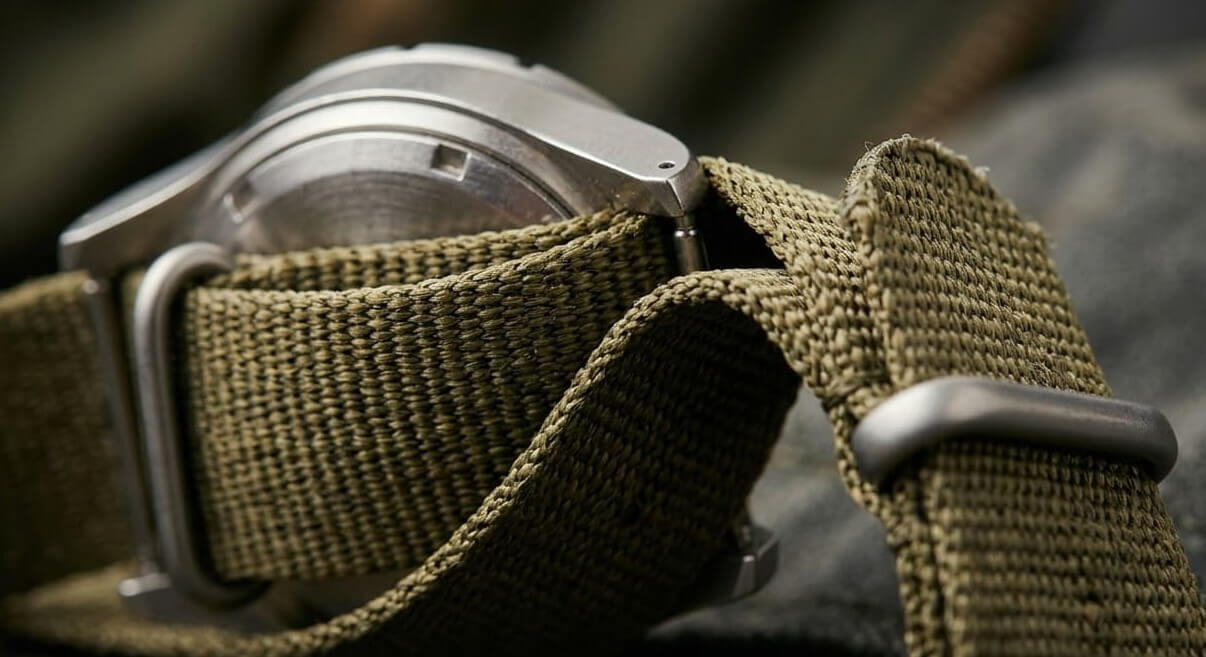
What Are NATO and Zulu Straps? A Brief History
NATO and Zulu straps are single-piece watch bands made from nylon or other durable materials, designed to thread under your watch case and wrap around your wrist. Both originated from military requirements for rugged, secure watch retention and have become popular among civilians for their practicality and versatility.
The story of these straps begins with the British Ministry of Defence. In 1973, the MoD standardized a watch strap design to meet military durability and security needs, formalizing what became known as the G10 form—a specification document that defined the construction, materials, and hardware for military-issue straps. This standardization prioritized two things: keeping watches secure during combat or diving operations, and ensuring straps could withstand extreme conditions without failing. The admiralty grey color became the iconic military standard, though modern versions come in dozens of colors.
Before 1973, the RAF (Royal Air Force) had already developed single-piece pass-through strap designs for pilots and personnel, establishing the core idea that a watch strap could thread under the case rather than using traditional spring bars alone. This design innovation meant a broken strap wouldn’t mean a lost watch—a critical concern in field operations. When Sean Connery wore a NATO strap in the 1964 film Goldfinger, the style gained mainstream visibility decades before most civilians even knew they existed.
Here’s a simple timeline of how these straps evolved into modern watch culture:
- 1960s: RAF single-piece straps emerge for military pilots; Goldfinger brings early mainstream attention.
- 1973: British Ministry of Defence standardizes the G10 form, establishing official military specifications.
- 1980s–1990s: Civilian watch brands begin offering NATO and Zulu straps as aftermarket options.
- 2000s–2010s: Strap customization becomes a hobby; nylon weaves, hardware finishes, and color options proliferate.
- 2020s: NATO and Zulu straps are mainstream options for divers, soldiers, outdoor enthusiasts, and everyday watch wearers.
Today, NATO and Zulu straps exist alongside Perlon straps, leather straps, canvas options, and traditional metal bracelets. Each serves a different aesthetic and functional need, but NATO and Zulu remain the go-to choice for anyone seeking durability, security, and quick swappability without tools.
Material Thickness: NATO vs. Zulu
The most immediate physical difference between NATO and Zulu straps is how they feel on your wrist. NATO straps use thin, lightweight nylon that flexes easily and sits comfortably, while Zulu straps feature noticeably thicker, heavier-duty nylon that feels more substantial and rugged. This single difference shapes nearly everything else about how each strap performs, fits, and looks.
NATO: Thin and Flexible
NATO straps are typically made from a single layer of thin nylon fabric, usually between 1.5 and 2 millimeters thick. This thinness makes them lightweight and flexible, allowing the strap to conform naturally to your wrist. The flexibility also means NATO straps work well across a wide range of watch sizes, from smaller dress watches to larger sport watches. Because the material is so light, wearing a NATO strap feels almost unnoticeable, which appeals to people who want comfort throughout the day.
Zulu: Thick and Heavy-Duty
Zulu straps are built from thicker nylon materials, often ranging from 2.5 to 3.5 millimeters or more, with a noticeably denser weave. This thickness gives the strap a more substantial, solid feel on your wrist. Some Zulu straps are made from heavy-duty ballistic nylon or even rubber, further emphasizing their tough construction. The rigidity of a Zulu strap means it holds its shape and doesn’t flex as readily as a NATO, which contributes to its utilitarian, no-nonsense appearance.
The trade-off is clear: while this thickness makes Zulu straps more resistant to abrasion and wear, it also makes them bulkier and less comfortable for extended wear, especially on smaller wrists or thin watches.
Why Thickness Matters: Comfort, Fit, and Appearance
Thickness affects three critical factors: comfort, watch compatibility, and visual bulk.
Comfort is straightforward. A thin NATO strap distributes its weight evenly and moves with your wrist, making it pleasant to wear for eight or ten hours without fatigue. A thick Zulu strap, especially one made from ballistic nylon or rubber, presses more firmly against your skin and doesn’t flex as much. For people with smaller wrists or those wearing the strap all day, this rigidity can feel restrictive or uncomfortable.
Watch compatibility is important and often overlooked. Thin NATO straps work well on smaller watches and thin cases because the strap doesn’t visually overwhelm the watch head. Thick Zulu straps require more space between the watch lugs and your wrist; on a thin or delicate watch, a Zulu strap can look disproportionately chunky and overpower the watch’s original design. On larger, more rugged watches, however, a thick Zulu strap balances the watch’s mass and looks at home.
Visual appearance is the third factor. A NATO strap’s thinness allows it to recede visually and complement the watch rather than compete with it. A Zulu strap’s bulk makes it a design statement—it declares the watch is built for work, not decoration.
Material Comparison: At a Glance
The table below shows the typical material profiles for NATO and Zulu straps across common fabric choices.
| Material | Typical Thickness | Feel | Best For |
|---|---|---|---|
| NATO Nylon | 1.5–2.0 mm | Lightweight, flexible, soft | All-day comfort, smaller watches, formal settings |
| Zulu Nylon | 2.5–3.5+ mm | Substantial, rigid, structured | Rugged activities, larger watches, extreme conditions |
| NATO Leather | 1.5–2.0 mm | Soft, refined, breaks in over time | Dress watches, business settings |
| Zulu Ballistic Nylon | 3.0+ mm | Very rigid, abrasion-resistant, dense | Military, diving, extreme durability needs |
| Zulu Rubber | Variable | Waterproof, flexible yet rugged | Water sports, diving, wet environments |
Real-World Example: The Same Watch, Two Different Feelings
Imagine a mid-sized stainless steel dress watch with a classic dial. On a thin NATO strap in black nylon, the watch looks refined and balanced—the strap doesn’t distract from the dial, and the overall package feels elegant enough for a boardroom. Put the same watch on a thick Zulu strap in the same color, and the visual story changes. The Zulu’s bulk and structured hardware give the watch an adventure-ready, no-fuss appearance. The watch still tells time perfectly well, but it now looks like it belongs on a hiking trail, not a conference table. Neither is “wrong,” but the thickness of the material has shifted the watch’s entire personality.
Consider a sports chronograph on a thin NATO versus the same watch on a thick Zulu. The NATO’s light fabric lets the dial’s complexity shine through; the Zulu’s bulk makes the watch look expedition-grade. Again, both are perfectly functional—the material thickness has simply shifted the vibe.
Material Grades and Durability Notes
When shopping, you may encounter terms like ballistic nylon, mil-spec nylon, and cordura. These refer to higher-grade nylon weaves with tighter, more durable fibers. Ballistic nylon, for example, is thicker and more abrasion-resistant than standard nylon, making it popular in Zulu straps designed for extreme use. Mil-spec nylon (military specification) meets official durability standards. These upgrades do improve longevity, but they also increase cost and bulk. For casual to moderate use, standard thick nylon Zulu straps are sufficient; for frequent harsh conditions (salt water, rocky terrain), ballistic or mil-spec options offer better protection.
Next, we’ll examine the hardware—the metal buckles, keepers, and rings—which create the second major visual and functional difference between NATO and Zulu straps.
Hardware Design: The Visual Difference
The most immediate way to tell NATO and Zulu straps apart is their hardware—the metal components that buckle, loop, and hold the strap together. Hardware not only defines the visual character of each strap but also affects how they fit on your wrist and interact with your watch case.
Hardware Anatomy: What to Look For
Every watch strap includes the same basic hardware elements. A keeper is the metal loop that holds the loose end of the strap after you buckle it. The buckle itself (in both styles, typically a tang-style buckle—a flat metal piece you thread through the keeper) is the fastening point where you secure the strap. Finally, the metal hoops or rings are the larger loops that thread under the watch lugs—the small arms on either side of your watch case that hold the strap in place.
On a NATO strap, you will see slender, rectangular keepers and a relatively thin tang-style buckle. The metal hoops are narrow and graceful. On a Zulu strap, the keepers are rounder and more substantial, the buckle is noticeably thicker, and the hoops are chunky and oval-shaped. This difference in proportions is not accidental; it reflects the different purposes each strap was designed for.
Hardware Details Comparison
The following table breaks down the specific hardware traits of each strap style:
| Hardware Element | NATO | Zulu |
|---|---|---|
| Keepers | Rectangular, slimmer profile, rounded corners | Rounded or oval shape, thicker gauge, more rigid |
| Buckle | Tang-style, relatively thin, refined appearance | Tang-style, noticeably chunky, robust appearance |
| Metal Hoops | Narrow and slender, subtle on the wrist | Wide and thick, prominent visual element |
| Material | Stainless steel (some premium options use 316L) | Stainless steel (some premium options use 316L) |
| Design Philosophy | Slim, elegant, minimalist | Heavy-duty, tool-like, utilitarian |
What Hardware Does
Hardware is more than decoration. The thickness and shape of keepers and hoops directly affect how the strap loops around your wrist. Thinner NATO hardware sits flatter and creates less bulk under your wrist, which is why NATO straps feel more comfortable for all-day wear and fit more easily under shirt cuffs. Thicker Zulu hardware, by contrast, creates more pronounced loops and a firmer seat on the wrist. This extra heft also means Zulu buckles and keepers resist wear and deformation when exposed to sand, salt water, or rough handling—a real advantage in extreme conditions.
The tang-style buckle in both straps works identically: you thread the loose end of the strap through the buckle and then tuck it back through a keeper to hold it in place. The difference is visual and tactile. A thinner NATO buckle feels refined; a thicker Zulu buckle feels tool-like and reassuring in your hand.
Spotting the Difference at a Glance
Imagine two straps laid flat side by side on a table. The NATO strap looks slender and streamlined; the metal components appear understated and blend with the strap body. The Zulu strap, by contrast, announces itself immediately. The metal hoops are wider and stand out visually from the strap. The buckle and keepers are unmistakably chunky. If you pick up a Zulu strap, it feels heavier and more substantial. A NATO strap feels lighter and more nimble in your hand.
On the wrist, a NATO strap’s slender hardware creates a neat, almost invisible appearance. A Zulu’s chunky hardware is visible from above and makes a statement—it is equipment, not jewelry. Neither approach is wrong; they simply serve different aesthetics and use cases.
Next, we will explore how NATO’s extra security loop sets it apart functionally and why this matters for durability.
The Extra Security Loop: NATO’s Signature Feature
The most distinctive difference between NATO and Zulu straps lies in a single piece of fabric: NATO straps include an extra nylon loop that runs under your watch case, while standard Zulu straps do not. This extra loop transforms how the strap behaves when something goes wrong, making it NATO’s defining security feature.
Understanding the Spring Bar and Why It Matters
Before diving into the extra loop, you need to understand what a spring bar is. A spring bar is the small spring-loaded bar that holds the strap between the lugs (the two arms extending from the watch case). When functioning normally, it keeps the strap firmly in place. If a spring bar breaks or comes loose—which can happen due to wear, impact, or defects—the strap can separate from the watch entirely, causing you to lose it.
How NATO’s Extra Loop Creates a Failsafe
A NATO strap threads through your watch in a specific pattern. The main strap passes under the watch case between the lugs, just like any other strap. But then a second piece of nylon—the extra loop—runs alongside it under the case as well. Here is how the path works:
- One end of the strap threads up through one lug and back down through the other lug (standard pass-through).
- The extra loop follows the same path, running underneath the watch case in parallel with the main strap.
- Both pieces then meet at the opposite end, where a single buckle holds everything together.
This dual-path design means that even if one spring bar fails and releases the main strap, the second loop remains threaded through the other lug. Your watch stays attached to your wrist instead of falling off.
This failsafe behavior was born from military necessity. Soldiers in the field could not afford to lose their watches, so the extra loop became standard on NATO straps issued by the British Ministry of Defence. It is purely a security feature—it does not prevent spring bar failure itself, but it prevents the catastrophic outcome of losing your watch when a failure occurs.
The Real-World Scenario: Diving with a Broken Spring Bar
Imagine you are a diver and one of your watch’s spring bars cracks underwater. With a NATO strap, the extra loop keeps the watch secured to your wrist throughout the dive and beyond. You discover the broken spring bar later when you inspect the strap ashore, but your watch was never at risk. With a standard Zulu strap, the same broken spring bar would mean your watch falls off mid-dive, lost to the ocean floor. This scenario is why the extra loop matters most in high-stakes environments where watch loss is dangerous or costly.
Zulu Straps: Standard (3-Ring) vs. Extra Loop (5-Ring)
Standard Zulu straps, also called 3-ring Zulus, use a simpler single-path pass-through design. The strap threads under the watch case once, with no extra loop, making them lighter and less bulky under the case. This is intentional: the simpler design reduces material and cost while still providing secure attachment through the spring bars—just without the secondary failsafe if a spring bar fails. This approach reflects Zulu’s core design philosophy: straightforward durability without unnecessary complexity.
However, Zulu straps come in a variant called 5-ring Zulus that include an extra loop, mirroring NATO’s security approach. The 5-ring Zulu trades some of Zulu’s simplicity for NATO-like reliability. If you want Zulu’s rugged aesthetic and thicker material but need the extra security layer, a 5-ring Zulu bridges both needs.
Is the Extra Loop Worth It?
This is a pragmatic question with a context-dependent answer. If you wear your watch in calm, everyday environments and replace a spring bar before it fails, the extra loop adds minimal value—just extra bulk under your case. If you dive, work in harsh conditions, wear your watch during contact sports, or simply want maximum reassurance against spring bar failure, the extra loop is invaluable. Many beginners find that the peace of mind outweighs the slight added thickness, especially for watches they rely on or treasure.
One trade-off to keep in mind: the extra loop can create noticeable bulk under thicker watches or with thicker straps, sometimes limiting comfort on smaller wrists. We will address this in detail when we compare material thickness.
Installation & Ease of Use
One of the most practical differences between NATO and Zulu straps lies in how you put them on your watch. If you swap straps frequently or travel often, installation speed and tool requirements matter significantly.
NATO Installation: No Tools Needed
NATO straps are designed for speed. Because they thread under the watch case rather than attaching to the spring bars, you do not need to remove anything or use tools. Here is how to install a NATO strap in four simple steps:
- Slide one end of the strap under the watch case, threading it between the two lugs (the metal arms on either side of the case).
- Pull the strap across the underside of the watch.
- Pull the first end back over the top of the watch case.
- Thread the same end back down through the keeper loop below, then adjust the strap for fit and secure the buckle.
The entire process takes less than one minute, even for first-time users. No spring bar tool, no experience required. This is why NATO straps are popular for frequent strap changes and emergency swaps.
Zulu Installation: Spring Bar Removal Required
Zulu straps, by contrast, typically require you to remove the spring bars from your watch case. A spring bar is the small spring-loaded bar that holds the strap between the lugs. To install a Zulu strap, you will need a standard spring bar tool (a small, inexpensive device available at any watch retailer). The installation process usually takes between 2 and 5 minutes, depending on your familiarity with the tool and the tightness of the spring bars on your particular watch.
This is not complicated, but it is an extra step. If you do not own a spring bar tool, you will need to purchase one before you can change Zulu straps yourself. Some watch retailers will perform the swap for you if you prefer not to handle it.
Time and Convenience Comparison
The speed advantage of NATO is real and measurable. A quick reference:
- NATO strap: Less than 1 minute, zero tools
- Zulu strap: 2 to 5 minutes, requires a spring bar tool
If you change straps multiple times a week or travel with several watches, NATO straps save significant time and frustration. If you change straps once a month or less, the difference is negligible.
Real-World Scenario: Changing Straps Before a Dive
Imagine you are at the beach with a diver’s watch and a fresh Zulu strap in your gear bag. You want to swap it out before entering the water. With a NATO strap, you can make the change in under a minute without tools. With a Zulu strap, you would need to locate your spring bar tool, carefully remove the bars, and spend several minutes on the adjustment—all while your dive window closes. In this scenario, NATO is the clear winner for convenience.
Beginner-Friendliness
If you have never changed a watch strap before, NATO is significantly less intimidating. There is no risk of dropping a tiny spring bar, no need to learn a new tool, and no chance of damaging the watch case. Zulu straps demand a bit more care and equipment, but they are not difficult once you understand the process. Many beginners find that after one or two successful Zulu installations, the process becomes second nature.
Next, we will explore how the visual design and color options of each strap type affect which watch and outfit combinations work best.
Style & Aesthetics: Formal vs. Casual
Beyond hardware and construction, NATO and Zulu straps create distinctly different visual impressions. The materials, colors, and design language of each strap can transform how formal or casual your watch appears—and where it will feel at home.
NATO Straps: Versatile and Patterned
NATO straps offer far greater color and pattern variety than their Zulu counterparts. The iconic regimental stripes—the most recognizable NATO aesthetic—come in dozens of colorways, from classic military green to navy and grey. This pattern variety extends beyond stripes; solid colors, two-tone combinations, and even textured weaves are common. The slimmer hardware and single-layer fabric create a sleeker visual profile, allowing the strap pattern to take center stage.
This versatility means NATO straps can work in surprisingly formal settings. A solid black, navy, or grey NATO on a dress watch reads as professional and refined. NATO straps are equally at home on field watches and even dive watches, where their military heritage feels authentic. The association with Sean Connery’s Omega in Goldfinger (1964) cemented the NATO’s appeal across both formal and casual contexts—proof that a strap can be both utilitarian and stylish.
Zulu Straps: Utilitarian and Solid
Zulu straps embrace a function-first aesthetic. Colors are typically solid and understated—matte blacks, olive greens, navy, tan, and grey—with minimal pattern or embellishment. The thicker nylon and chunky hardware give Zulus a more robust, heavy-duty appearance. This visual weight signals durability and outdoor readiness rather than refinement.
Zulus excel at making a watch look ready for adventure. Paired with a sports watch, tool watch, or outdoor chronograph, the thick strap and rounded metal hardware reinforce the “built to last” message. The minimalist color palette ensures the strap will not compete visually with the watch dial, keeping focus on function. On a dress watch, however, a Zulu strap tends to dress the watch down rather than up, shifting its tone from boardroom to basecamp.
The Same Watch, Two Moods
To see the difference clearly, imagine the same field watch on a NATO regimental stripe versus a Zulu solid black strap. With the NATO, the striped pattern and slimmer hardware make it look polished enough for business casual or weekend wear. With the Zulu, the same watch suddenly feels more rugged and expedition-ready, better suited to outdoor activities or workwear. The watch itself has not changed; the strap has transformed its personality.
Aesthetic Comparison by Watch Type
The following table shows how each strap type pairs with common watch categories:
| Watch Type | NATO Aesthetic | Zulu Aesthetic | Better Choice |
|---|---|---|---|
| Dress Watch | Elegant, refined, professional | Too casual, overdressed for style | NATO |
| Field Watch | Military heritage, versatile, approachable | Authentic, rugged, utilitarian | Either; depends on context |
| Dive Watch | Technical, sporty, dressy-casual hybrid | Expedition-ready, heavy-duty feel | Either; depends on intended use |
| Sports Watch | Modern, casual, pattern-focused | Built-for-purpose, minimalist | Zulu |
| Tool Watch | Sporty-casual, adds color | Function-first match, understated | Zulu |
| Chronograph | Casual to business-casual | Adventure or workwear ready | Either; context-dependent |
Color Variety and Pattern Impact
NATO straps dominate the color and pattern market. Manufacturers offer regimental stripes, solid colors in 20+ shades, two-tone combinations, and even jacquard weaves. This range lets you match a strap to an outfit, occasion, or mood. A striped NATO can work as a conversation piece; a solid NATO blends seamlessly into formal or casual wear. Zulu color choices are narrower—typically limited to solid matte finishes in neutral military tones—but this constraint serves a purpose: simplicity and no-nonsense durability.
The color differences also reflect their design philosophies. NATO’s pattern variety suggests adaptability and style; Zulu’s solid palette suggests reliability and toughness. For wearers who prioritize function over fashion, Zulu’s lack of flashy colors is a feature, not a limitation.
Key Takeaway
Choose a NATO strap if you want a strap that can work across multiple occasions and outfits, including professional or semi-formal settings. Choose a Zulu strap if your primary focus is outdoor durability and casual wear, and you prefer a minimalist aesthetic that prioritizes toughness over visual variety. The hardware differences and thickness we explored earlier reinforce these aesthetic signals—thinner NATO hardware signals refinement, while chunky Zulu hardware signals ruggedness.
Next, we’ll examine how durable each strap actually is and what that durability means in real-world use.
Durability & Longevity: Which Lasts Longer?
The answer depends on what you mean by “durable.” Zulu straps tend to resist physical wear and tear better due to their thicker nylon, while NATO straps offer better functional security because the extra loop prevents your watch from falling off if a spring bar fails. Both are different kinds of durability, and both matter.
Material Durability vs. Functional Security
Material durability refers to how well the strap itself resists damage from friction, salt water, mud, and repeated flexing. Zulu straps, made from thicker nylon, handle these stresses better than thinner NATO straps. If you dive regularly, work outdoors in harsh conditions, or swap straps frequently, the Zulu’s heavier-duty construction will show fewer signs of wear.
Functional security, by contrast, means the strap keeps your watch on your wrist. Here, NATO wins because the extra security loop acts as a failsafe if a spring bar breaks or loosens. A Zulu strap with no extra loop offers no such backup—your watch simply slides off. A 5-ring Zulu adds that same failsafe feature, so it matches NATO in this regard.
In practice, most people never experience spring bar failure, so the extra loop feels like insurance you may never need. However, for divers and adventurers, that insurance is worth the trade-off.
Care and Maintenance
Preventive care extends lifespan significantly. Rinse with fresh water after salt water exposure, air dry completely in shade (never use heat), and store in a cool, dry place. Check stitching and hardware quarterly for loose threads or rust. The one quirk: NATO’s extra loop can trap lint and salt crystals, so inspect underneath the watch when cleaning, especially after diving or beach use. Both NATO and Zulu straps are forgiving and require minimal attention—the key is consistent, gentle care rather than intensive maintenance.
Real-World Lifespan
With normal care—regular rinsing, air drying, and avoiding direct heat—both NATO and Zulu straps often last several years. Actual lifespan varies significantly by brand, nylon grade, and stitching quality; some premium straps last 5–10 years or longer, while budget options may show wear within 18–24 months. This estimate assumes mid-to-good quality hardware and stitching. However, brand variance is significant. A cheap Zulu strap may fray or lose its shape within 18 months; a premium NATO from a reputable maker can outlast five years of heavy use.
Durability depends far more on stitching quality, hardware material (stainless steel vs. plated brass), and nylon weave consistency than on NATO versus Zulu alone. A well-made NATO will outlast a poorly made Zulu every time.
Durability by Scenario
The table below shows how each strap type performs in common real-world situations.
| Scenario | NATO Durability | Zulu Durability | Winner |
|---|---|---|---|
| Salt water diving | Good; quick-dry nylon resists corrosion; extra loop provides failsafe if spring bar loosens | Good; thicker nylon resists salt erosion well | Tie; both excel; choose NATO for security, Zulu for pure material durability |
| Heavy daily wear (office + gym) | Very good; lighter nylon shows less creasing; extra loop prevents accidental loss | Excellent; thicker material resists flex creases and fraying | Zulu edges ahead on material; NATO edges ahead on security |
| Mud, outdoor work, extreme conditions | Good; fast-dry; extra loop adds confidence in rough handling | Excellent; thick, rugged nylon built for abuse | Zulu |
| Formal occasional wear | Excellent; minimal flex, minimal wear; extra loop rarely tested | Excellent; minimal stress on thick material | Tie |
| Frequent strap swapping | Good; lightweight reduces hand fatigue; tool-free swap minimizes friction on spring bars | Good if 5-ring; acceptable if 3-ring; heavier material may show handling marks faster | NATO for ease and spring bar care |
NATO vs. Zulu: Quick Comparison Table
Use this feature grid to see how NATO and Zulu straps stack up across the most important differences. Each row highlights a key distinction to help you narrow your choice.
| Feature | NATO | Zulu |
|---|---|---|
| Material | Thin, lightweight nylon (single layer) | Thick, heavy-duty nylon or rubber |
| Hardware | Rectangular, slimmer keepers and rings; tang-style buckle | Rounded/oval, chunkier keepers and rings; robust buckle |
| Extra Security Loop | Yes—failsafe if spring bar breaks | Only on 5-ring variant (3-ring lacks it) |
| Installation | Tool-free; no spring bar removal needed | Requires spring bar removal and tool |
| Comfort | Lighter, less bulk under wrist | Heavier, more substantial feel |
| Style | Versatile; solid colors, regimental stripes, formal-friendly | Utilitarian; solid colors, rugged aesthetic |
| Material Durability | Good abrasion resistance | Excellent abrasion resistance (thicker nylon) |
| Best For | Dress watches, divers, everyday casual, tool-free swaps | Extreme conditions, heavy wear, sports watches |
| Price Tier | Mid-range ($20–$40 typical) | Budget-friendly ($15–$30 typical) |
Which Should You Choose? Decision Guide
Choosing between NATO and Zulu straps comes down to your lifestyle, watch habits, and priorities. The decision tree below will help you narrow it down quickly.
Decision Tree
Start with the question most relevant to you and follow the path:
- Do you want to swap straps without tools? Yes → NATO. No → Continue.
- Do you expect extreme conditions, mud, salt water, or heavy impact? Yes → Zulu. No → Continue.
- Do you prefer a lighter, slimmer feel on your wrist? Yes → NATO. No → Continue.
- Do you value the failsafe security loop in case a spring bar breaks? Yes → NATO. No → Continue.
- Are you comfortable using a spring bar tool and prefer a more substantial, minimalist look? Yes → Zulu. No → NATO is likely the safer choice.
Choose NATO If…
- You like to swap straps frequently to match different outfits or occasions.
- You want versatility for both formal and casual wear without buying multiple straps.
- You value the extra security loop as a failsafe if a spring bar fails or loosens.
- You prefer a lightweight, thinner strap that feels less bulky on smaller wrists or dress watches.
- You want color variety and pattern options like regimental stripes or solid shades.
- You are new to fabric straps and want an easier, tool-free installation experience.
- You plan to use your watch for diving or water sports and want maximum security against loss.
Choose Zulu If…
- You expect your watch to endure extreme conditions, rough terrain, saltwater exposure, or heavy daily wear.
- You prefer a more substantial, utilitarian aesthetic with minimalist styling.
- You are comfortable using a spring bar tool and do not mind a 2–5 minute installation process.
- You want thicker, more durable nylon that resists abrasion and stretching over time.
- You plan to wear the same strap on the same watch for extended periods.
- Budget is a priority; Zulu straps are typically less expensive than comparable NATO options.
- You prefer a single layer of fabric under the watch case for a slimmer profile on very thick watches.
Both Are Fine If…
You wear your watch daily for casual activities with no extreme conditions, use a mid-range watch, and do not need rapid strap swaps. Either will serve reliably for years with basic care. Your choice then becomes aesthetic: prefer the slimmer, more versatile NATO, or the bolder, minimalist Zulu?
A Special Case: 5-Ring Zulu
If you like the idea of a Zulu’s thicker material and minimalist look but want the extra security of a failsafe loop, consider a 5-ring Zulu (extra loop variant). It bridges both designs, offering the durability and aesthetic of a Zulu with NATO-style security—though it will feel slightly bulkier under the case and is less common in retail than 3-ring or NATO options. Cost is typically between standard Zulu and NATO prices.
No wrong choice exists between NATO and Zulu; your decision depends on your lifestyle, priorities, and how you use your watch. Once you have identified which aligns with your needs, the next step is evaluating quality and fit—topics we will cover in the final section.
Understanding Zulu Variants: 3-Ring vs. 5-Ring
Zulu straps come in two main configurations that confuse many beginners: the 3-ring Zulu and the 5-ring Zulu. While both are genuinely Zulu straps with the same rugged hardware and thicker nylon, the extra loop in the 5-ring variant creates a meaningful functional difference. Understanding which version you are looking at helps you choose the right security level and comfort for your needs.
What the Ring Count Means
A 3-ring Zulu features three main attachment or ring points where the strap loops and secures. The nylon passes through one ring under the watch case and is held in place by the buckle and keepers. This is the original, simpler Zulu design with a single layer of material under your watch. It is straightforward, cost-effective, and maintains the utilitarian aesthetic that defines the Zulu family.
A 5-ring Zulu adds two extra rings and introduces an additional loop of nylon that runs under the watch case, similar to the NATO strap’s security feature. This extra loop sits between the spring bars and acts as a failsafe if one spring bar fails or loosens, keeping the watch on your wrist. The 5-ring configuration uses five attachment points to accommodate this second layer, which is why you will see the designation “5-ring” in product listings.
When shopping, you can identify the variant by examining the strap directly or looking at product photos. A 3-ring Zulu shows a single, straightforward pass-through path under the case with three visible ring or anchor points. A 5-ring Zulu has two layers of nylon visible from underneath, with an extra loop visible between the lugs, and five distinct ring or attachment zones. The extra loop on a 5-ring looks similar to the NATO’s security loop in function but is integrated into the heavier Zulu construction.
| Feature | 3-Ring Zulu | 5-Ring Zulu |
|---|---|---|
| Ring/Attachment Points | Three main points | Five main points |
| Extra Security Loop | No | Yes |
| Layers Under Watch | One | Two |
| Failsafe if Spring Bar Breaks | No | Yes |
| Bulk on Wrist | Minimal | Slightly more |
| Cost Typical Range | Lower | Slightly higher |
| Best For | Simplicity and affordability | Extra security plus Zulu ruggedness |
Is a 5-Ring Zulu Just a NATO Clone?
A common beginner question is whether a 5-ring Zulu is essentially a NATO strap in disguise. The answer is no, but the similarity is worth understanding. Both the NATO and the 5-ring Zulu add an extra loop for security, making them functionally similar in that one critical respect. However, the overall design, hardware, and construction philosophy remain distinctly different. A 5-ring Zulu still features the chunky, rounded hardware typical of Zulu straps, the thicker nylon material, and the more utilitarian aesthetic. It is not trying to be a NATO; it is a Zulu that borrowed NATO’s security feature to offer a best-of-both option for users who want ruggedness plus failsafe protection.
Which Variant Should You Choose?
Choose a 3-ring Zulu if simplicity and cost are your priorities. You accept single-layer construction as a fair trade for lighter bulk and lower price. Choose a 5-ring Zulu if you want Zulu’s rugged hardware and durability plus NATO-like failsafe security—ideal for diving or extreme environments. Both variants use the same spring bar compatibility, so sizing is identical; the difference is security and material bulk.
Common Beginner Mistakes & Myths
Understanding what NATO and Zulu straps actually are—and what they are not—will help you avoid costly missteps and wasted returns. Here are the most common misconceptions and purchasing pitfalls beginners encounter.
- Naming Myths: In watch strap terminology, “NATO” does not refer to the North Atlantic Treaty Organization, and “G10” is not a separate strap category. NATO straps descend from British military standardization; G10 is the form specification the MoD established in 1973. Both terms refer to the same essential strap family, and you will see both used interchangeably by sellers and collectors. When someone says “G10 specs,” they mean the strap meets the original MoD durability and construction standards.
- Mistake: Buying a standard NATO or Zulu for a thick or large watch without checking lug width and strap thickness. A thin NATO on a chunky diver watch can look visually undersized and may not wrap comfortably around your wrist. Conversely, a thick Zulu on a slim dress watch can create bulky gaps and feel unbalanced. Always verify your watch’s lug width and case thickness before ordering.
- Zulu Configuration Confusion: Do not confuse 3-ring and 5-ring variants without understanding the difference. A 3-ring Zulu is a simple pass-through with no extra security loop; a 5-ring Zulu adds an extra loop similar to NATO. If security is your priority, check which variant you are buying rather than assuming all Zulus lack the failsafe feature. Also, note that a spring bar tool (under ten dollars) is all you need for Zulu installation—do not let this common fear hold you back.
- Mistake: Expecting NATO straps to prevent spring bars from breaking or coming loose. The extra security loop prevents your watch from falling off your wrist if a spring bar fails—it does not prevent the failure itself. This distinction matters: NATO gives you a safety net, but it does not extend the lifespan of the hardware holding the strap to your case.
- Mistake: Prioritizing price over hardware and stitching quality. A five-dollar Zulu with weak stitching and soft metal hardware will fray and corrode far faster than the nylon material itself. Spend a little extra on reputable brands with reinforced stitching and stainless steel hardware; you will get years of use instead of months of disappointment.
Both NATO and Zulu straps have genuine military-grade origins, but quality varies significantly by manufacturer. Avoiding these beginner pitfalls will help you make a confident choice and get the most from your strap investment.
How to Choose a Quality NATO or Zulu Strap
Buying a quality NATO or Zulu strap comes down to inspecting five key areas: stitching, hardware material, nylon consistency, keeper rigidity, and correct sizing. A well-made strap should feel solid in hand, show no loose threads, and fit your watch without gaps or excess bulk. This section walks you through what to look for before you buy, then answers the most common questions beginners have.
Quality Indicators to Check
Before purchasing, examine these measurable signs of construction quality:
Stitching is your first visual clue. Look for seams that are straight, evenly spaced, and consistent in tension. Thread color should match or complement the nylon—mismatched or fraying thread is a red flag. Poor stitching will unravel over time, especially on straps subject to friction at the keepers or edges.
Hardware material matters for longevity. Most quality straps use stainless steel for buckles, keepers, and rings. If a seller mentions 316L steel specifically, that is a corrosion-resistant marine-grade material often found in higher-end straps. Cheap hardware may rust or degrade quickly, especially after exposure to salt water or sweat. Check that buckles are smooth with no sharp edges, and keepers should be rigid and not flimsy.
Nylon weave consistency means the fabric has an even texture throughout, with no loose fibers, thin spots, or obvious irregularities. Run your hand over the strap; it should feel uniform. A loose or uneven weave degrades faster under sun and moisture.
Keeper rigidity refers to how firmly the metal loops hold the loose end of the strap. Weak or bent keepers will not grip properly, causing the strap to slip during wear. A quality keeper should snap into place with slight resistance and hold the loose nylon without sagging.
Sizing and Fit
Incorrect sizing is one of the most common beginner mistakes. Before you buy, confirm two things:
Lug width is the distance between the two attachment points on your watch case (measured in millimeters, typically 18 mm, 20 mm, or 22 mm). Your strap lug width must match your watch exactly. If your watch is 20 mm and you order a 22 mm strap, it will not fit.
Strap length must accommodate your wrist and watch case thickness. NATO and Zulu straps come in standard and long sizes. If you have a smaller wrist or a thick watch case, a standard-length strap may be too loose or too tight after threading. Check the seller’s length specifications and compare them to your wrist circumference. If in doubt, choose the longer option.
Material Choices and Best Uses
Different materials suit different scenarios. Standard nylon is breathable, lightweight, and works for everyday wear, casual offices, and mixed conditions. Ballistic nylon is thicker and more abrasion-resistant, ideal for extreme outdoor use, diving, or military-style work. Leather NATO and Zulu straps offer a formal aesthetic and are better for dress watches or business settings, though they require more care and dry faster than nylon. Rubber straps are waterproof and best for water sports and diving, though less versatile for formal wear.
Brand Reputation and Shopping Cues
Look for sellers who provide customer reviews, detailed product photos, and clear specifications. A good warranty or hassle-free return policy is a sign of confidence in the product. Brands that encourage returns typically stand behind quality. Read reviews specifically for durability complaints, color accuracy, and whether the hardware is prone to rust. Watch forums and diving communities often have trusted vendor lists.
Price and Value
NATO and Zulu strap prices vary widely depending on material, hardware, and brand. Entry-level options start under $20, while premium straps can exceed $50. Higher price generally reflects better stitching, thicker nylon, superior hardware, and longer lifespan—but research and reviews are your best tools to assess value. Factor in durability: a $30 strap that lasts five years is better value than a $10 strap that frays in six months.
Before You Buy: Checklist
- Confirm your watch’s lug width (18 mm, 20 mm, 22 mm, etc.) and verify the strap matches.
- Measure your wrist circumference and compare it to the strap’s length specs (standard vs. long).
- Decide your primary use case: formal, diving, casual, or extreme conditions—this guides material choice.
- Check if the seller offers your preferred colors and if reviews confirm color accuracy.
- Verify that the strap’s spring bar compatibility matches your watch (most universal NATO and Zulu straps work with standard spring bars).
- Confirm the strap is made of nylon (or your preferred material); avoid poor descriptions like “synthetic” without specifics.
- Check if the seller specifies stainless steel or 316L hardware; this is a quality signal.
- Review the return policy and warranty before committing.
Frequently Asked Questions
What is G10? G10 is a form specification used by the British Ministry of Defence in 1973 when standardizing watch straps. Both NATO and Zulu straps descend from this standard, but G10 is not a separate strap category—it is a historical reference. When someone says “G10 specs,” they mean the strap meets the original MoD durability and construction standards.
Do I have to remove spring bars to install a NATO strap? No. One of NATO’s main advantages is that you can thread it onto your watch without removing the spring bars. Simply open the strap loop, pass it under the lugs, and thread the free end back through the keeper. This takes less than one minute.
Can I convert a Zulu to NATO or vice versa? No. A NATO strap’s extra security loop and different construction cannot be retrofitted to a Zulu, and a Zulu cannot become a NATO without completely re-engineering the strap. However, you can own both and swap them on the same watch.
Are 3-ring and 5-ring Zulus interchangeable? Yes, they fit the same lug width. The difference is internal: a 3-ring Zulu has a standard pass-through with no extra security loop, while a 5-ring Zulu includes a small extra loop similar to NATO’s failsafe feature. You can swap between them on the same watch, but they offer different security levels.
Which is better for swimming or diving? Both can work, but context matters. A NATO strap offers the extra security loop, which is valuable if you are diving and a spring bar fails. A thick Zulu or rubber strap is more durable in saltwater and less likely to degrade. For serious diving, a rubber or heavy-duty ballistic nylon Zulu or NATO, combined with regular rinsing, is ideal. For casual swimming, either material is fine if rinsed immediately after.
Can I wear a NATO strap to a formal event? Yes, but choose carefully. A NATO strap in solid black, navy, or charcoal nylon with slim hardware can look dressy, especially on a dress watch. Avoid bold colors or regimental stripes for formal settings. A leather NATO strap is the most formal option. A thick Zulu strap or one in bright colors is better suited to casual or outdoor wear.
Why are NATO straps more expensive than Zulu? NATO straps typically cost more because they include an extra loop and more complex construction. This means more nylon, more stitching, and more labor. Zulu straps are simpler: a single pass-through with no extra fabric underneath. The price difference is usually $5 to $15 USD for equivalent materials and hardware quality.
Do NATO straps fit all watch sizes? NATO straps fit any watch that has standard spring bars and a lug width of 18 mm to 24 mm (the common range). The strap length varies by standard and long sizes, so you must confirm the seller’s length specs match your wrist. Very small watches (under 32 mm case diameter) may look awkward with a standard NATO, but technically it still fits.
How do I know if my watch is compatible with these straps? Check your watch’s lug width (look at the space between the two attachment points on the case) and confirm your spring bars are intact and removable or accessible. Almost all mechanical and automatic watches use standard spring bars, so NATO and Zulu straps are compatible. Digital watches and some fashion watches may have integrated lugs that do not accept changeable straps. When in doubt, ask the watch manufacturer or a watch retailer.
What if my spring bar breaks—which strap is safer? NATO is safer because of its extra security loop. If a spring bar fails while wearing a NATO strap, the watch will not fall off your wrist; it will hang from the secondary loop underneath. A 3-ring Zulu lacks this feature, so a broken spring bar could result in watch loss. A 5-ring Zulu (which includes the extra loop) offers the same failsafe protection as NATO. If you are concerned about spring bar failure, choose NATO or a 5-ring Zulu.