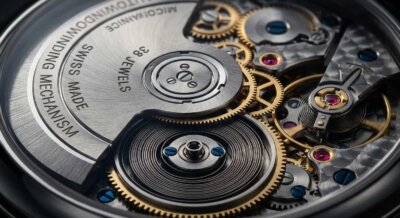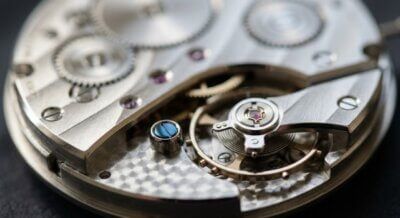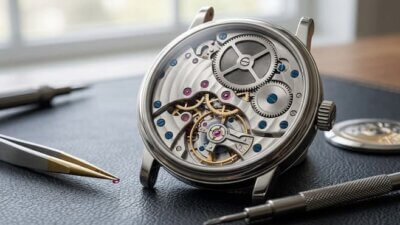
What Is a Mechanical Watch?
A mechanical watch is a spring-driven timepiece powered by a wound metal spring called the mainspring, with no battery or electronic components. Instead of electronics, it uses a purely mechanical movement of gears and a balance wheel to keep time.
You can think of a mechanical watch as a very sophisticated wind-up toy: you give it energy by winding it, that energy is stored in the mainspring like a tightly coiled metal ribbon, then released through tiny gears and a vibrating balance wheel so the hands move steadily around the dial. In simple terms, mechanical energy goes into the mainspring when you wind the watch, flows through a train of gears that slow and shape that energy, and is regulated by the balance wheel so the watch can measure seconds, minutes, and hours predictably.
The inner mechanism that does all of this is called the mechanical movement. It is a compact assembly of the mainspring, gears, and the balance wheel (plus supporting parts) that together turn stored mechanical energy into controlled, regular motion of the hands.
To put mechanical watches in context, it helps to compare them briefly with other common types:
- Mechanical watch: spring-driven by a wound mainspring and regulated by gears and a balance wheel; no battery or electronics involved.
- Quartz (battery-powered) watch: uses a battery and an electronic circuit to drive a quartz crystal, which controls a small motor that moves the hands.
- Smartwatch: a wearable computer with apps and sensors; not relevant to this guide.
The rest of the guide follows how energy moves through a mechanical movement, so you can see how that simple wound spring becomes the smooth motion of the hands on your wrist.
A Brief History: Why Mechanical Watches Still Matter
The mechanical watch is not a relic of the past—it is a living artifact of human ingenuity that has survived centuries of disruption and emerged stronger. Understanding where mechanical watches came from helps explain why they remain relevant today and why people choose them intentionally over simpler, cheaper alternatives.
From Church Bells to Personal Timekeeping
The story of mechanical timekeeping begins in the 13th century, when mechanical clocks first appeared in European churches and cathedrals. These were monumental achievements—intricate assemblies of gears and springs designed to ring bells and mark the hours for entire communities. For the first time, time could be measured and shared with precision, independent of the sun or human judgment.
Over the next few centuries, craftsmen refined mechanical design, and by the 15th to 18th centuries, pocket watches emerged as personal timepieces for the wealthy. Pocket watches were status symbols and engineering marvels in equal measure. Owning one meant owning a piece of portable precision—a luxury that few could afford. During this era, watchmaking became a celebrated craft, with master craftsmen from Switzerland, France, and England earning international reputations.
The Wristwatch Revolution and World War I
The transition from pocket watches to wristwatches happened gradually in the early 1900s, but it accelerated dramatically during World War I. Soldiers needed hands-free timekeeping on the battlefield, and wristwatches proved far more practical than pocket watches. Military supply chains began issuing wristwatches to officers and pilots, legitimizing them as serious instruments rather than fashion accessories. By the 1920s, wristwatches had become the dominant form of personal timekeeping, and mechanical watch design flourished with innovations tailored to precision, durability, and reliability.
The Quartz Crisis and the Near-Extinction of Mechanical Watches
In the 1970s and 1980s, the mechanical watch faced an existential threat. Quartz watches—powered by a battery and regulated by a vibrating quartz crystal—offered accuracy, affordability, and simplicity that mechanical watches could not match. A quartz watch cost a fraction of a mechanical watch and required virtually no maintenance. The shift was sudden and devastating for traditional watchmakers. Entire factories closed, and master craftsmen were laid off by the thousands. Switzerland’s mechanical watch industry, once the global standard, contracted sharply. For a moment, it seemed mechanical watches would become obsolete—museum pieces rather than functional instruments.
The Modern Comeback: Craftsmanship Over Convenience
Beginning in the 1990s and accelerating through the 2000s and 2010s, mechanical watches experienced an unexpected renaissance. This revival was not driven by superiority in timekeeping—quartz watches were simply more accurate—but by a cultural shift. Consumers and collectors began to value mechanical watches for what they represented: centuries of refined engineering, human craftsmanship, sustainability, and a tactile connection to time itself. The luxury watch market rebounded, and independent watchmakers emerged alongside revived heritage brands.
Today, mechanical watches occupy a unique position. They are not the most convenient option—a smartphone tells better time and requires no winding. They are not the cheapest option—a basic quartz watch costs far less. Instead, mechanical watches have become cultural objects: expressions of personal taste, markers of appreciation for craftsmanship, and heirlooms meant to outlast their owners. This shift reflects broader consumer interests in sustainability (no battery waste), longevity, and the desire for objects that reward attention and care.
Mechanical watches have survived four centuries by combining precision engineering and artisanal skill. Their modern revival reflects consumer interest in sustainability, longevity, and craftsmanship—values that a smartphone cannot replicate. For these reasons, mechanical watches remain cultural objects and functional heirlooms today.
How a Mechanical Watch Works: The Core Mechanism
A mechanical watch is, at its heart, a sophisticated wind-up toy. When you turn the crown (the knob on the side of the watch), you are not powering a circuit or charging a battery. Instead, you are tightening a coiled metal spring inside the watch called the mainspring. As this spring slowly unwinds over hours or days, it releases energy in a carefully controlled way, driving a series of gears, a regulating mechanism, and finally the watch hands. The result is timekeeping powered entirely by mechanics and physics, with no electricity required.
The Power Flow: Step by Step
To understand how a mechanical watch works, follow the path that energy takes as it moves through the movement:
- You turn the crown, winding the mainspring tighter around its arbor (the central rod inside the barrel, the cylindrical housing that contains the spring).
- The tightened mainspring stores mechanical energy, much like a stretched rubber band that is ready to snap back.
- As the mainspring unwinds, it rotates the barrel slowly and steadily.
- The barrel connects to the gear train (also called the wheel train), a series of interconnected gears and pinions (smaller gears) that reduce the barrel’s slow rotation into the faster rotations needed for the watch hands.
- Before reaching the hands, the energy must pass through the escapement and balance wheel, two components that work together to regulate the energy release and ensure precise timekeeping.
- Once regulated, the energy drives the dial train, the final set of gears that move the hour, minute, and second hands at the correct speeds.
Now we will explore how the mainspring stores and releases this energy in detail.
Energy Storage: The Mainspring as a Reservoir
When you wind the crown, you are tightening the mainspring, storing mechanical energy. Think of it as pulling back a slingshot and holding it in place. The tighter the spring, the more energy is stored, and the longer the watch can run before needing to be wound again. A fully wound mainspring in a typical mechanical watch often provides a power reserve of 40 to 50 hours or more, though this varies based on movement design and how fully the spring is wound.
For example, imagine you wind your watch’s crown 30 times on a Monday morning. The mainspring is now fully charged. Over the next two days, as the spring slowly uncoils, it provides a steady trickle of energy to keep the gears turning. By Wednesday, if you have not wound it again, the spring will be nearly depleted and the watch will slow and stop. This window of time is called the power reserve.
Gear Ratios: Converting Slow Into Fast
The barrel rotates very slowly as the mainspring unwinds, roughly once per hour. If the hands were connected directly to the barrel, the watch would be useless—the hour hand would race around the dial, and the minute hand would complete one full rotation in 60 hours. Instead, the gear train steps down (reduces) the barrel’s slow speed into the faster speeds needed by the hands.
Here is a concrete example of the power flow in action: the crown is wound, the mainspring stores energy, the barrel begins to rotate once per hour, the gear train receives this slow rotation and multiplies it through a series of gears, the fourth wheel (the final wheel before the hands) rotates once per minute, and the minute hand, which is attached to the fourth wheel, also rotates once per minute. Meanwhile, other gears in the train send energy to the hour hand and second hand at their own correct speeds. All of this happens because small gears (pinions) drive large gears, and large gears drive small gears, creating a cascading speed increase.
Regulation: The Escapement and Balance Wheel
Energy flowing through gears alone would cause the hands to move erratically. The watch needs a regulator—a mechanism that releases energy in precise, rhythmic pulses. This is where the escapement and balance wheel come in, and they are the most ingenious part of a mechanical watch.
The balance wheel is a weighted disc that oscillates back and forth at a constant frequency, much like the beating of a heart. A hairspring (balance spring) attached to the balance wheel causes it to swing in and out with mechanical precision. The escapement is a locking mechanism with a component called the pallet fork that works in sync with the balance wheel. As the balance wheel swings, the pallet fork alternately locks and releases the escapement, which is connected to the gear train. This lock-release-lock cycle happens hundreds of times per second.
Here is the regulation in action: the balance wheel oscillates 4 to 8 times per second (depending on the movement design), the escapement releases a tiny increment of the gear train’s energy with each oscillation, the gears advance one notch at a time in sync with the balance’s rhythm, the hands move smoothly and steadily forward, and the distinctive tick-tock sound you hear is the escapement locking and releasing. Without this regulation, the hands would race ahead; with it, timekeeping becomes possible.
Why Mechanical Watches Tick
The ticking sound is not a side effect. It is the escapement at work. Each time the pallet fork locks and unlocks the gear train, the gears make a small but audible click. Multiply this by hundreds of times per second, and you get the characteristic tick-tock rhythm that many people find appealing. This sound is a direct result of the mechanical regulation that keeps time.
The Mainspring: The Heart of a Mechanical Watch
The mainspring is the core energy source of a mechanical watch, and understanding it makes the whole idea of a spring-driven timepiece much easier to grasp.
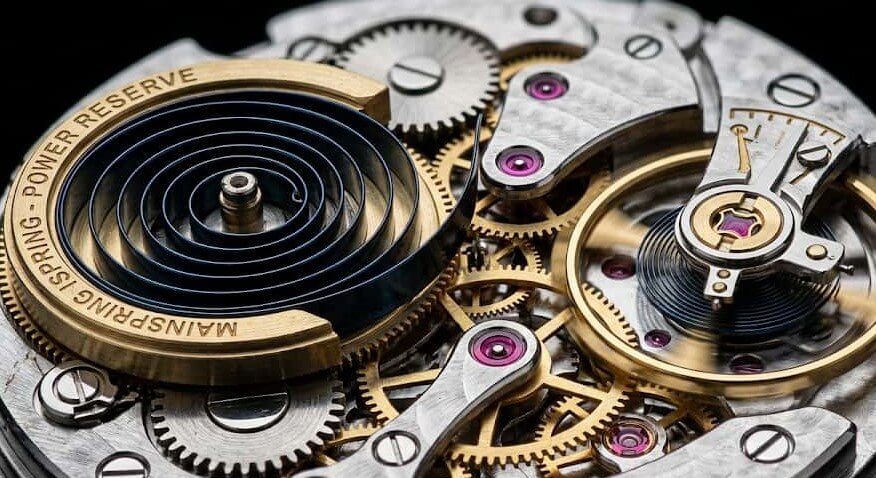
At its simplest, the mainspring is a very thin, flexible strip of metal, tightly coiled into a spiral. When you wind the watch, this spiral is tightened; as it slowly relaxes, it releases the stored energy that keeps the movement running.
Most mainsprings are made from steel or modern steel-based alloys. These materials are chosen because they can bend and unbend thousands of times without breaking, and they hold their shape well over years of use. You do not need to know the exact alloy names to understand how it works; the key idea is that it is a tough, springy metal ribbon that behaves predictably when wound and unwound.
To picture the mainspring, imagine a long, thin strip of metal rolled up like a carpet. When the watch is fully wound, that “carpet” is rolled very tightly. As the watch runs, it very slowly unrolls, feeding energy into the rest of the mechanical movement. This slow, controlled unrolling is what allows a mechanical watch to run for many hours from a relatively short winding session.
The mainspring does not sit loose inside the watch. It is contained in a round metal housing called the barrel. The barrel keeps the mainspring in the right shape, supports it as it coils and uncoils, and helps protect it from dust and debris that could interfere with smooth operation. From the outside, the barrel looks like a simple metal drum-shaped part, but inside it holds that tightly coiled strip of metal under tension.
Inside the barrel there is a central shaft called the arbor. The inner end of the mainspring is fixed to this arbor, while the outer end hooks to the inside wall of the barrel. When you wind the watch, the arbor turns and tightens the inner end of the spring, increasing the tension. As the spring later relaxes, it tries to turn the barrel, which passes energy into the gear train that eventually moves the hands.
Winding starts at the crown, the small control on the side of the watch case that you turn with your fingers. When you rotate the crown, it turns a stem that runs into the movement and connects through a set of small gears to the arbor inside the barrel. Turning the crown therefore turns the arbor, which tightens the mainspring and stores energy. In this way, the energy from your hand movement is transferred, via the crown and stem, into the mainspring inside the barrel.
Because the mainspring is the only real energy store in a mechanical watch, it is fair to say that without mainspring energy, the watch cannot run at all. If the mainspring is completely unwound (sometimes called “run down”), there is no tension left to turn the barrel and the gear train, so the hands stop moving. Likewise, if the mainspring were broken, there would be no way to deliver energy to the rest of the mechanical movement.
The length, thickness, and material of the mainspring determine how much energy it can store and how long the watch can run between windings. This running time is called the power reserve. Power reserve is typically expressed as the number of hours a mechanical watch can run on a full wind under normal conditions, though actual duration depends on movement design, how fully the spring is wound, and wear pattern. In many common modern watches, a full wind typically gives more than 40 hours of power reserve, so the watch can often run for about two days or a little longer before needing to be wound again.
However, power reserve is not the same for every mechanical watch. It varies based on the movement design (for example, some have larger barrels or longer mainsprings), how easily the movement uses energy, and how completely the mainspring has been wound. If you only wind the watch partway, you are only using part of the mainspring’s potential, so the power reserve will be shorter than the maximum the movement is capable of. Some advanced designs offer much longer power reserves, while small or compact movements may offer less than the common 40-plus-hour figure.
Not only the design but also the state of the mainspring and its lubricant affect how smoothly the energy is released. A clean, properly lubricated mainspring can uncoil in a controlled way, while an old, dirty, or dry mainspring may stick slightly and release energy less evenly. That is one reason regular servicing, covered later in the guide, can make a noticeable difference in how consistently a mechanical watch runs.
From the wearer’s side, the connection between your hand and the mainspring is very direct. Each turn of the crown adds a little more tension to the mainspring. As you approach a full wind, you typically feel the resistance increase. Inside the barrel, the spring is getting tighter and tighter, much like that rolled carpet being wound tighter around its center. Once it reaches its intended limit, modern designs prevent you from safely forcing it further, helping protect the spring and the winding parts.
As the watch runs through its power reserve, the mainspring gradually relaxes, turning the barrel. The barrel then feeds this rotation into the gear train, which reduces and shapes that motion into the very slow, precise movement of the hands on the dial. In other words, the mainspring turns your brief winding action into a long, steady supply of energy that the watch can “sip” over many hours.
For a more advanced note, some modern mainsprings are designed to take on a gentle S-like curve inside the barrel as they wind and unwind. This S-shaped behavior helps the spring deliver a more even amount of torque over time, instead of being much stronger when fully wound and much weaker when almost empty. You do not need to understand this detail to enjoy a mechanical watch, but it is one example of how much engineering goes into refining the simple idea of a coiled strip of metal.
The Gear Train: Translating Slow Into Fast
The mainspring unwinds at a predictable but gradual pace—far too slow on its own to drive the watch hands at the speeds needed to display hours, minutes, and seconds. The gear train (also called the wheel train) solves this problem by converting the slow rotational energy from the barrel into progressively faster rotations at each stage, ultimately delivering the correct speed to each hand. Think of it like shifting gears on a bicycle: a small chainring driving a large sprocket slows you down, while a large chainring driving a small sprocket speeds you up. A gear train does the same—it takes slow input and speeds it up through a series of stages.
Here is how the energy travels through the gear train, step by step:
- The barrel (which houses the mainspring) rotates slowly as the spring unwinds.
- The barrel drives the first wheel, which is fitted with a smaller gear called a pinion.
- That pinion drives the next wheel, which rotates faster than the first because it has fewer teeth than the wheel driving it.
- This process repeats through a series of stages, typically three to four in total, with each stage spinning faster than the one before.
- The final stages deliver power to the second hand (fastest), the minute hand (moderate), and the hour hand (slowest).
The key principle behind this speed multiplication is the gear ratio. When a large wheel with many teeth meshes with a small pinion with fewer teeth, the pinion must rotate multiple times for every single rotation of the large wheel. If a wheel has 60 teeth and its pinion has 10 teeth, the pinion rotates 6 times for each rotation of the wheel. By stacking multiple gear stages with different tooth counts, the gear train can achieve the precise ratios needed: the second hand must rotate once per minute, the minute hand once per hour, and the hour hand once per 12 hours.
A helpful reference point in many mechanical watches is the fourth wheel, which completes one full rotation per minute. Note that the fourth wheel drives the minute hand directly; other gears in the same train branch off to power the hour and second hands at different ratios. Regardless of the specific configuration, the result is the same: the gear train ensures that each hand rotates at exactly the right speed to display the correct time.
The Escapement and Balance Wheel: The Timekeeping Duo
The escapement and balance wheel sit at the heart of a mechanical movement’s timekeeping, turning the mainspring’s steady push into the even, musical ticking you hear from the watch.
To understand this duo, imagine the gear train trying to spin freely under the mainspring’s force. Without a brake, it would race ahead and the hands would whirl around the dial. The escapement is that brake, and the balance wheel is the rhythm maker that tells the brake exactly when to let go and when to hold.
What the Escapement Does
The escapement is a small mechanism that releases the gear train’s energy in controlled pulses instead of letting it spin all at once.
In simple terms, the escapement:
- Receives turning force from the gear train.
- Locks the gears so they cannot spin freely.
- Releases the gears step by step in tiny jumps, one “tick” at a time.
Without the escapement, the stored energy from the mainspring would rush through the gear train in seconds, and the watch would empty its power almost instantly instead of keeping time steadily over many hours.
The Balance Wheel: The Watch’s Heartbeat
The balance wheel is a small, weighted wheel that rocks back and forth in a regular rhythm, acting like a tiny horizontal pendulum for the watch.
Think of the balance wheel as the watch’s heartbeat. It swings back and forth in repeated movements called oscillations, typically about 4–8 times per second in many modern mechanical watches. Each oscillation is like one beat of that heart, and it sets the tempo for the entire movement.
The frequency of this oscillation (how many times per second it swings) helps determine the potential accuracy of the watch. A higher, stable frequency gives more “checks” per second and can make it easier for the watchmaker to adjust the watch to keep time within a reasonable range, though it never guarantees perfect accuracy.
The Balance Spring (Hairspring): Controlling the Rhythm
Attached to the balance wheel is a very fine metal coil called the balance spring (hairspring). It acts like a tiny, perfectly shaped spring that pulls the balance wheel back toward its center position each time it swings.
Here is how it works, step by step:
- When the balance wheel swings in one direction, the balance spring coils or uncoils slightly, storing a bit of energy.
- The spring then pulls the balance wheel back, causing it to swing through its center and out to the other side.
- This back-and-forth motion repeats many times per second as a smooth, regular oscillation.
The balance spring is what keeps the oscillations of the balance wheel evenly timed, just like a metronome in music. Its shape, material, and how tightly or loosely it is adjusted all influence how quickly the balance wheel completes each oscillation and therefore how fast or slow the watch runs.
How the Escapement and Balance Wheel Work Together
The magic of mechanical timekeeping comes from the way the balance wheel and escapement constantly interact, forming a feedback loop that turns continuous pressure from the mainspring into neat, equal steps of time. The balance wheel swings in a steady rhythm while the escapement locks and unlocks the gear train at precisely timed intervals, allowing the gears to advance one step with each swing of the balance. This lock-release-lock cycle repeats many times per second, translating the balance wheel’s rhythm into the forward motion of the watch hands.
The Pallet Fork’s Role in the Escapement
A key part of the escapement is a small lever called the pallet fork. Although it is tiny, its job is central to the timekeeping rhythm.
The pallet fork:
- Sits between the escape wheel (the last wheel in the gear train) and the balance wheel.
- Has two small surfaces (pallets) that alternately catch and release the teeth of the escape wheel.
- Rocks back and forth, pushed on one side by the escape wheel and on the other side by the balance wheel.
When the balance wheel swings, it nudges the pallet fork, which then unlocks one tooth of the escape wheel and lets it move forward by one step. The escape wheel, in turn, gives a tiny impulse back through the pallet fork to keep the balance wheel moving. This push-and-release action is what keeps both the gear train and the balance wheel working together in a steady rhythm.
Where the Ticking Sound Comes From
The familiar ticking sound of a mechanical watch does not come mainly from the gears turning. It is created by the escapement locking and unlocking the escape wheel.
Each time the pallet fork catches a tooth of the escape wheel, there is a small “lock” sound; when it releases that tooth and the next one jumps forward, there is a matching “unlock” sound. Together, these quick locking and releasing sounds blend into the tick-tock you hear when you hold a mechanical watch to your ear.
Since the balance wheel usually oscillates several times per second, these tiny clicks are very close together, giving the ticking a smooth, steady character rather than a slow, single once-per-second tick.
How This Duo Affects Accuracy
Because the escapement and balance wheel set the pace for the entire mechanical movement, they play a huge role in the watch’s accuracy.
Key factors include:
- Oscillation frequency: A balance wheel that oscillates steadily at a design frequency (often corresponding to about 4–8 oscillations per second) gives the movement many evenly spaced “samples” of time. More frequent, stable oscillations can help a watchmaker adjust the movement to keep time within a reasonable daily range.
- Consistency of the balance spring: If the balance spring breathes (coils and uncoils) smoothly and symmetrically, the balance wheel’s swings stay regular. Any change in the spring’s shape or elasticity can cause the watch to run faster or slower.
- Quality of the escapement surfaces: Smooth, well-finished contact points on the escape wheel and pallet fork reduce friction and wear, helping the timing remain more stable between servicing.
- External influences: Position on the wrist or on a table, shocks, and environmental factors like temperature or magnetism can slightly change how the balance wheel and balance spring move, and therefore how fast or slow the watch runs.
Even with a well-designed escapement and balance system, mechanical watches are usually expected to vary by some seconds per day rather than being perfectly exact. The goal is a stable, predictable rate that stays within a realistic accuracy range for everyday use.
Once you understand this timekeeping duo, it becomes easier to appreciate how the rest of the mechanical movement supports that steady “heartbeat” and translates it into the smooth motion of the hands you see on the dial.
Manual Winding: The Hand-Wound Mechanical Watch
A hand-wound mechanical watch requires you to turn the crown (the small knob on the side of the case) to wind the mainspring manually. Unlike automatic watches, which harness wrist motion to keep themselves powered, manual-winding watches depend entirely on your deliberate action to store energy in the mainspring. This simplicity is part of their appeal: the mechanism contains no rotor, leaving the movement cleaner and often more visible through a display caseback.
How to Wind Your Manual Watch
Winding a hand-wound mechanical watch is straightforward and becomes a pleasant ritual with practice. Follow these steps:
- Position the crown in its normal state (not pulled out). The crown is connected to a winding stem that reaches down into the movement and engages the mainspring arbor (the axle around which the mainspring is wound).
- Turn the crown clockwise slowly and gently. Rotate about 30 to 40 times, or until you feel noticeable resistance.
- Stop when resistance becomes firm. You will feel the resistance increase as the mainspring tightens; this is normal and is your signal that the watch is fully wound.
- Do not force the crown if it stops turning easily. Modern watches include a clutch mechanism that prevents over-winding, but respect the natural stopping point to avoid unnecessary wear on the crown.
The tactile feedback of winding is one reason people treasure hand-wound watches. You feel the energy being stored; there is a sense of control and connection to the mechanism that no battery-powered watch can replicate. Many owners wind their watch each morning as a mindful moment, setting an intention for the day ahead before strapping it on.
How Often Should You Wind?
The answer depends on your watch’s power reserve and how consistently you wear it. Most hand-wound watches have a power reserve of 40 to 48 hours, meaning they can run for roughly two to three days on a single full wind. However, this varies by movement design and how thoroughly you wind the mainspring.
For best accuracy and peace of mind, wind your watch daily, preferably at the same time each morning. This ensures the mainspring is always near full capacity and that the watch receives consistent power throughout the day. If you only wear your watch occasionally or prefer to wind less frequently, you can typically go two to three days between winds, but be aware that power reserve decreases as the mainspring slowly uncoils. A watch running on low power may lose accuracy or stop unexpectedly, so daily winding is the safest habit.
The Over-Winding Misconception
Many beginners worry about over-winding a mechanical watch and breaking the mainspring. This is a common concern, but modern hand-wound watches are engineered to prevent damage from over-winding. Inside the barrel (the housing that contains the mainspring), a slipping clutch allows the mainspring arbor to disengage once the spring reaches maximum tension. If you continue turning the crown after the watch is fully wound, the clutch will slip silently, and no extra energy will be stored. You will simply feel the resistance level out.
That said, there is no benefit to forcing the crown once you feel resistance. Avoid twisting forcefully or turning the crown in the counterclockwise direction (which can damage the winding stem). Wind gently, stop when resistance builds, and you will never encounter a problem. The clutch mechanism exists as a safety net, not a license to abuse the crown.
Pros and Cons of Manual Winding
Hand-wound watches appeal to a distinct group of enthusiasts, and understanding the trade-offs will help you decide if manual winding suits your lifestyle.
Advantages of manual-winding watches include a simpler mechanical design (no rotor means fewer moving parts and potentially greater reliability), a cleaner and more visually interesting movement (the mainplate and bridges are fully visible without a rotor obscuring the view), and often a lower price point compared to automatic equivalents. Some hand-wound watches are also thinner and lighter because they do not require the extra space and weight of a rotor. The ritual of winding also creates a deeper tactile connection to timekeeping, transforming a simple act into a moment of mindfulness.
Disadvantages include the need for daily attention. If you forget to wind your watch, it will stop, and you will lose time. Over several days of neglect, the mainspring will fully unwind, and the watch will require re-winding and possible time-setting before it is reliable again. The crown also experiences more wear in a hand-wound watch because it is used every day, whereas an automatic crown is only turned occasionally for setting the time. Over many years, the stem connection may loosen or the crown may develop play (wobbling), though this is not a catastrophic failure and can be serviced.
Automatic (Self-Winding): The Convenience Option
An automatic mechanical watch winds itself through your everyday wrist motion, eliminating the need for daily manual winding. Instead of turning the crown each morning, the watch harnesses the natural movement of your arm to keep the mainspring wound and ready to power your timepiece throughout the day.
How Automatic Winding Works
At the heart of an automatic watch is a component called a rotor (also known as an oscillating weight). This rotor is a semi-circular metal weight mounted on a pivot inside the watch case, positioned so it swings freely as your wrist moves in any direction. When you wear the watch and go about your day, your arm’s motion causes the rotor to rotate continuously.
As the rotor swings, it is connected to the winding system through a series of small gears. These gears translate the rotor’s rotational motion into winding action on the barrel and mainspring. Imagine your arm motion swinging the rotor in a semicircle, which in turn winds a gear, which then winds the arbor connected to the mainspring. The result is that the mainspring gradually tightens throughout the day as you move, keeping the watch constantly topped up with stored energy.
Modern automatic watches include a built-in safety mechanism called a clutch. Once the mainspring reaches full wind, this clutch prevents the rotor from over-winding the spring, so you don’t have to worry about the mechanism becoming damaged through excessive winding.
What to Expect: Power Reserve and Regular Wear
A typical automatic watch has a power reserve of 40 hours or more, meaning it can continue running for that duration on a single full wind without any additional winding or movement. However, power reserve varies depending on the movement design, how large the barrel is, and how fully wound the mainspring is at the moment you stop wearing the watch.
If you wear your automatic watch every day—especially if you are fairly active—it will stay wound continuously and rarely (if ever) stop. The regular motion of your wrist supplies just enough energy to keep the mainspring in a state of consistent wind. This is the primary convenience advantage: you wake up, put on the watch, and it is already running.
If you don’t wear the watch for a day or longer, it will eventually wind down and stop once its power reserve is exhausted. This is normal and not a sign of damage. To restart a stopped automatic watch, you can either manually wind it by turning the crown 20–30 times (similar to winding a manual watch), or you can simply wear it for an hour or two of regular arm movement, during which the rotor will wind the mainspring back up to operational status.
Pros and Cons of Automatic Watches
The main advantage of an automatic watch is convenience. There is no daily ritual of winding; the watch takes care of itself as long as you wear it regularly. This also means less repeated stress on the crown from daily winding, which can extend the lifespan of that component.
The trade-offs are worth considering. Because a rotor occupies physical space inside the case, automatic watches tend to be slightly thicker than their manual-winding counterparts. For some people, this thickness is negligible; for others seeking a very slim profile, it may be a consideration. Additionally, some watch enthusiasts prefer the tactile ritual of manual winding and find that an automatic watch removes that meditative aspect of ownership. Finally, the rotor’s presence means the caseback view of the movement is partially obstructed by the rotor itself, which some owners find less aesthetically pleasing than the symmetrical, cleaner appearance of a manual movement.
Rotor Types: A Brief Note for Beginners
Automatic watches use different rotor designs. The most common is a center-mounted rotor, a semi-circular weight that pivots at the center of the movement. Some watches use a micro-rotor, which is a smaller weight positioned off to one side, allowing for a thinner case. Others employ a peripheral rotor, which winds around the edge of the movement like a ring. For most beginners, these distinctions are not critical to understanding or enjoying an automatic watch. The fundamental principle remains the same: wrist motion winds the mainspring. Which rotor design a watch uses is more relevant when you are comparing specific models or prioritizing certain features like thinness or case size.
When to Consider an Automatic Watch
An automatic watch is ideal if you plan to wear your mechanical watch daily or nearly every day, and you want the simplicity of never manually winding. It is also a good choice if you value the engineering elegance of the rotor mechanism or if you prefer a lower-maintenance ownership experience once the watch is on your wrist. Automatic watches work especially well for active people whose natural movement keeps the rotor constantly engaged.
Manual vs. Automatic: Which Should You Choose?
Both manual and automatic mechanical watches use the same core mechanism—a mainspring, gears, escapement, and balance wheel—to keep time without a battery. The difference is in how the mainspring gets wound. A manual mechanical watch requires you to turn the crown by hand, typically once a day. An automatic mechanical watch has an added component called a rotor (an oscillating weight) that winds the mainspring as you move your wrist throughout the day. Despite this difference, both are genuine mechanical watches and share the same timekeeping precision, craftsmanship, and longevity when properly maintained.
Choosing between them comes down to your lifestyle, preferences, and how much ritual you want as part of wearing the watch.
Comparison: Manual vs. Automatic at a Glance
The table below summarizes the key differences across practical and experiential dimensions.
| Aspect | Manual Winding | Automatic |
|---|---|---|
| Winding Method | Turn the crown by hand | Wrist motion winds the rotor, which winds the mainspring |
| Winding Frequency | Daily (ideally) or every 1–3 days depending on power reserve | Continuous during wear; no manual winding needed if worn regularly |
| Mechanism Complexity | Simpler; no rotor or rotor-related gears | More complex; includes rotor, rotor gears, and clutch mechanism |
| Power Reserve | Typically 40+ hours (varies by movement design and wind state) | Typically 40+ hours (varies; rotor keeps it wound during wear) |
| Movement Visibility | Clean, unobstructed view through a display caseback | Rotor visible through caseback; some prefer this aesthetic, others find it visually busy |
| Cost | Generally slightly less expensive due to simpler mechanism | Generally slightly more expensive due to rotor assembly |
| Ritual & Convenience | Daily winding ritual; requires mindfulness; some find this meditative or tedious | No daily winding task; set and forget (mostly); suits busy schedules |
| Best For Whom | Collectors, traditionalists, those who value simplicity and ritual, people who don’t wear a watch every day | Daily wearers, those who prefer convenience, people with active lifestyles, those who wear a watch 8+ hours per day |
Choose Manual If…
- You enjoy the ritual of winding your watch each morning or evening—it becomes a moment of connection with the mechanism.
- You wear your watch occasionally or skip days; you don’t mind the responsibility of keeping it wound.
- You prefer a thinner case and a cleaner, simpler movement visible through the display caseback.
- You are drawn to traditional watchmaking and the purity of a hand-wound design.
- You value simplicity; fewer moving parts can mean fewer things to service in some cases.
Choose Automatic If…
- You wear your watch most or all days and prefer not to think about winding it.
- You have an active lifestyle and want the rotor to keep the mainspring wound passively throughout the day.
- You want convenience and minimal fuss; the watch winds itself as long as you wear it.
- You appreciate the aesthetic of a visible rotor in the movement, or you don’t mind its presence.
- You wear the watch 8+ hours per day on average; an automatic is optimized for this use case.
Accuracy, Maintenance & Cost Expectations
Both types, when well-maintained and regulated at servicing, can achieve similar levels of timekeeping precision within the typical range of ±10–30 seconds per day under consistent wear conditions. Actual accuracy depends on movement design, regulation quality, and external factors like position and temperature. Accuracy also varies with the watch’s position (worn vs. resting), temperature, and the state of the mainspring winding (fully wound watches keep better time than partially wound ones).
Maintenance intervals for both types are similar. If you wear your watch daily, plan on professional servicing every 2–3 years. If you wear it occasionally, extend the interval to 3–5 years. During servicing, the movement is disassembled, cleaned, lubricated, and regulated to ensure accuracy. Expect to budget USD 200–500 or more for a full service, depending on the movement’s complexity and your location. Both manual and automatic movements require the same level of care; the automatic’s rotor does not add significant servicing costs.
Cost at purchase: manual watches are often slightly less expensive due to their simpler mechanism, but this is a general trend, not a guarantee. The price difference is usually modest (5–10% or less) and depends far more on the brand, case material, and movement quality than on the winding system alone.
What to Expect When Buying a Mechanical Watch
Use this checklist to prepare yourself before making your purchase.
- Understand whether manual or automatic suits your lifestyle and commit to winding (manual) or regular wear (automatic).
- Check the power reserve specification so you know how long the watch will run if unwound or unworn; understand that this figure depends on how fully the mainspring is wound.
- Confirm that servicing is available in your region or through the manufacturer; some independent watchmakers service mechanical watches, and others specialize in specific brands.
- Budget for maintenance: plan on USD 200–500 or more every 2–5 years for professional servicing, depending on movement complexity and your wear pattern.
- Recognize that mechanical watch accuracy varies with position, temperature, and mainspring state; expect ±10–30 seconds per day as a realistic range rather than an absolute standard.
- Appreciate craftsmanship and longevity over pure timekeeping; if you value a mechanical watch only for its ability to tell time, a battery-powered watch may better suit your needs.
- Consider heirloom potential: a well-maintained mechanical watch can run reliably for decades or generations, making it a meaningful long-term investment in both function and memory.
Why People Choose Mechanical Watches Today
While mechanical watches have been around for centuries, their appeal today goes far beyond simple timekeeping. In an age of smartphones and smartwatches, people are drawn to mechanical timepieces for reasons that blend practicality, tradition, and personal values. Understanding these motivations can help you decide whether a mechanical watch aligns with what matters most to you.
Craftsmanship and Engineering Marvel
A mechanical watch is fundamentally a feat of precision engineering. Hundreds of tiny, hand-finished parts—wheels, springs, jewel bearings, and screws—work in concert to keep time without any battery or electronic circuit. Each component is machined to tolerances measured in fractions of a millimeter. For many enthusiasts, owning a mechanical watch means appreciating human skill and attention to detail that manufacturing alone cannot replicate. This craftsmanship appeals to people who value quality objects and the artistry behind them.
Longevity and Heirloom Potential
With proper care and regular servicing, many mechanical watches can run reliably for 50 years or longer, making them suitable for heirloom ownership. Unlike smartphones or quartz watches that may become obsolete or difficult to repair, a well-maintained mechanical movement can be serviced indefinitely by a competent watchmaker. This longevity makes mechanical watches natural candidates for heirlooms—watches passed down through generations and still keeping time. A grandfather’s mechanical watch, restored and worn by a grandchild decades later, embodies continuity and memory in a way few modern objects do. This potential is conditional on maintenance, but for those who commit to care, the reward is a timepiece with genuine staying power.
No Battery, Less Waste
Mechanical watches require no battery. This simple fact has grown more appealing as environmental awareness increases. Batteries are a source of electronic waste and toxic materials; disposing of them responsibly requires effort, and many end up in landfills. A mechanical watch eliminates this concern entirely. You wind it by hand or let wrist motion power it, and it runs for decades. For environmentally conscious buyers, this autonomy from battery cycles aligns with sustainability values. Additionally, the absence of electronics means no software updates, no connection to the internet, and no reliance on charging—a form of freedom that resonates with people fatigued by constant digital maintenance.
Emotional Connection and Mindfulness
Winding a mechanical watch is a tactile ritual. Holding the crown and turning it gently until you feel the spring resist, then placing the watch on your wrist, creates a moment of intentional interaction. This small ceremony can anchor your morning routine and remind you that you are caring for a precision instrument. For many owners, this ritual connection—to the watch, to its history, and to the tradition of mechanical timekeeping—is as valuable as the time it tells. A mechanical watch demands attention in a way that a smartphone does not, and for some, that demand is exactly the point.
Aesthetic Beauty
Many mechanical watches feature a transparent caseback, revealing the movement beneath. Watching the gears rotate, the balance wheel oscillate, and the mainspring unwind is visually mesmerizing. The movement itself is designed and finished with care—sometimes polished or engraved—making it an art form. The watch becomes both a functional tool and a wearable sculpture, combining engineering and design in one object. This visual appeal extends to the dial and case as well, where mechanical watches often emphasize timeless design over fleeting trends.
Reliability Without Complexity
A mechanical watch relies on springs and gears, not circuits and software. This mechanical simplicity can be reassuring. There are fewer electronic failure points, no need for firmware updates, and no risk of a software glitch stopping the watch. In some ways, a mechanical movement is more transparent and understandable than an electronic one—you can, in theory, see how it works. This tangibility appeals to people who value understanding and trust in their tools. It is worth noting that mechanical movements are not immune to problems and do require professional service, but the absence of proprietary electronics can mean longer serviceable lifespans and more repair options.
Investment and Collectibility
Some collectors pursue certain vintage or limited-edition mechanical watches as potential collectibles, though investment performance varies widely and is not a reliable reason to purchase. Certain brands, models, and vintage pieces become sought-after by collectors, and a well-maintained mechanical watch can be sold or traded. However, this should not be your primary reason for buying one. Investment potential varies widely depending on brand, rarity, condition, and market trends, and many mechanical watches are purchased simply as personal keepsakes, not as financial instruments. If you find a watch you genuinely love and it happens to hold value, that is a pleasant secondary benefit—not a guarantee.
The reasons people choose mechanical watches are deeply personal. For some, it is the engineering fascination; for others, it is the promise of an heirloom, the ritual of winding, or the environmental peace of mind. Whatever draws you to mechanical watches, understanding your own motivation will help you select one that truly fits your life.
Caring for Your Mechanical Watch: Maintenance & Servicing
A mechanical watch is a precision instrument, and like any fine machine, it benefits from regular care and professional attention. The good news is that with proper handling and timely servicing, your mechanical watch can run reliably for decades—even become a family heirloom. This section covers what you need to know about day-to-day care, when to seek professional help, and what to expect from the servicing process.
Understanding Servicing: Frequency and What It Involves
Servicing is professional maintenance performed by a trained watchmaker. It is not a quick fix; it is a complete overhaul of your movement. During a full service, the watchmaker disassembles the entire movement, cleans each component, replaces or refreshes the lubricating oils, adjusts the escapement and balance wheel for optimal performance, and reassembles everything with precision. This process restores accuracy, smoothness, and reliability to your watch.
How often you need servicing depends on how you wear your watch:
- Worn daily: Service every 2 to 3 years. Daily wear subjects the movement to constant motion, friction, and gradual oil degradation.
- Worn occasionally or stored much of the time: Service every 3 to 5 years. Less frequent use means slower oil breakdown, but lubrication still ages over time.
- Rarely worn or in storage: Even unworn watches benefit from a service every 5 to 7 years, as oils can solidify and components can corrode in storage.
These intervals are guidelines; your specific movement design, environmental conditions, and how gently you treat the watch all influence the ideal timing. If your watch begins to run noticeably fast or slow, loses time suddenly, or feels rough when winding, these are signs that servicing is overdue.
A full service typically costs between USD 200 and USD 500 or more, depending on movement complexity, location, and whether parts require replacement. Vintage or high-complication movements may cost more. When choosing a service provider, seek out certified watchmakers or authorized service centers for your brand if possible; they will have the correct parts and expertise for your specific movement.
Daily Care: Gentle Handling and Storage
Most of what keeps a mechanical watch healthy happens in your hands. The following practices will minimize wear and extend the interval between services:
Winding your mechanical watch: Whether manual or automatic, wind gently and slowly. For a hand-wound watch, aim for 1 to 2 crown rotations per second; this takes 30 to 40 seconds total and should feel smooth and easy. If you feel strong resistance or grinding, stop immediately—over-winding is rare in modern watches due to ratchet wheel safeguards, but forcing the crown can damage internal components. Imagine you are winding an old music box; steady and gentle pressure works best.
Temperature and humidity: Store your watch in a cool, dry place, ideally between 15 and 25 degrees Celsius. Extreme heat can thin the lubricating oils and damage the balance spring; extreme cold makes oils stiff and sluggish, which is why watches run fast in winter and slow in summer. Avoid leaving your watch on a hot dashboard or in a freezer. If you notice your watch running consistently faster in winter or slower in summer, temperature is likely the cause; this is normal behavior for mechanical watches and does not indicate a service is needed. Servicing will not fully eliminate this effect—it is just how mechanical watches behave.
Magnetism hazard: Keep your mechanical watch at least 5 centimeters away from smartphones, laptop chargers, wireless chargers, and any strong magnets. Magnetism can disrupt the balance wheel and cause significant accuracy loss. If your watch suddenly runs much faster or slower after being near a magnet, it may be magnetized. This requires professional demagnetization—a watchmaker uses a demagnetizing tool to restore the balance wheel to its neutral state. After demagnetization, the watch typically returns to normal accuracy.
Impact and shock: Remove your watch before high-impact activities such as golf, tennis, martial arts, or contact sports. Sudden shocks can damage the balance wheel pivots, the hairspring, or the escapement. Even though modern watches have some shock resistance, impacts remain the leading cause of damage to delicate internal components.
Moisture and water resistance: Know your watch’s water resistance rating. Most mechanical watches are splash-resistant but not designed for swimming or submersion. Moisture can corrode the movement and degrade the oils. If your watch gets wet, dry the case and have it checked by a watchmaker to ensure water has not entered the movement. Even small amounts of moisture inside can cause rust and require immediate servicing.
Regular winding and checks: If you are not wearing your watch for weeks or months, wind it gently once every month and wear it for an hour or two to keep the lubricant distributed evenly. Stagnant oil can thicken and cause sluggish operation. A quick wind and wear every few weeks—even in storage—keeps everything supple.
Cleaning the case and band: Wipe the case and band with a soft, dry cloth after wearing. If the watch is exposed to salt water, sweat, or dirt, gently rinse with fresh water (only the outside; do not submerge unless the watch is rated for it) and dry thoroughly. A clean case not only looks better but also prevents corrosion of the metal.
Troubleshooting: Simple Checks Before Calling a Watchmaker
If something seems wrong with your mechanical watch, try these basic checks before assuming it needs servicing:
Watch has stopped: First, check the power reserve. If you have not worn it for more than its stated power reserve (typically 40 to 60 hours for manuals, 40 to 48 hours for automatics), the mainspring has unwound. For a manual watch, wind the crown 30 to 40 times; it should restart. For an automatic watch, gently rotate the case side to side or wear it for 10 to 15 minutes to let the rotor wind the mainspring. If the watch still does not start after winding or wearing, seek servicing. If it has been stored for months with no winding or wearing, the old lubricant may have solidified; this requires professional service to clean and re-lubricate.
Watch runs fast or slow: Deviations of up to roughly ±10–30 seconds per day are typical and normal for mechanical watches, and do not automatically indicate a need for servicing. However, sudden changes in rate (e.g., the watch switches from +5 sec/day to +1 min/day) may suggest a service is due. Also, the position you wear the watch in matters slightly; mechanical watches behave differently when held vertically, horizontally, or at an angle. Temperature changes, as mentioned, affect accuracy; this is normal behavior for mechanical watches and does not indicate a need for servicing. If the watch gains or loses more than one minute per day, or if accuracy suddenly changes, servicing may be needed. This is also a sign to confirm the watch is not magnetized by keeping it away from magnetic sources for a few days and observing whether accuracy improves.
Watch is hard to wind or feels rough: This suggests that the lubricant inside the movement has become stiff or that debris has accumulated. Do not force the crown. This is a good indication that servicing is overdue. A professional service will clean the movement and apply fresh oil, restoring smooth operation.
How to Care for Your Mechanical Watch: Checklist
Use this checklist to ensure you are caring for your mechanical watch properly:
- Wind gently and slowly: 1 to 2 rotations per second, with smooth, steady pressure; avoid forcing the crown.
- Avoid over-winding: Modern watches have safeguards, but know when resistance means the mainspring is fully wound and stop.
- Store in moderate temperature: Keep the watch in a cool, dry place between 15 and 25 degrees Celsius; avoid heat and extreme cold.
- Keep away from magnetic fields: Maintain at least 5 centimeters distance from smartphones, chargers, and magnets; consider professional demagnetization if magnetized.
- Remove before impact sports: Take off your watch for high-impact activities like golf, tennis, or martial arts to protect internal components.
- Service every 2 to 3 years if worn daily: Professional servicing includes disassembly, cleaning, lubrication, adjustment, and reassembly; budget USD 200–500 or more depending on complexity.
- Wipe the case and band regularly: Clean with a soft, dry cloth after wearing; rinse gently with fresh water if exposed to salt, sweat, or heavy dirt, then dry thoroughly.
- Wind and wear periodically if in storage: Wind the crown gently and wear the watch for an hour every month to keep lubricant distributed evenly and prevent oil stagnation.
- Keep the crown dry: Ensure the crown is fully screwed down (if screw-down type) to prevent moisture from entering the movement; have the watch checked after any water exposure.
- Know your watch’s water resistance: Do not exceed its rating; even splash-resistant watches are not safe for swimming or submersion without a specific diving rating.
The Servicing Reality: What to Expect
When you take your mechanical watch to a watchmaker for servicing, here is what typically happens:
- Inspection: The watchmaker examines the movement under magnification, notes any visible damage or wear, and tests accuracy and power reserve.
- Disassembly: The movement is carefully disassembled into individual components—wheels, springs, pivots, and escapement parts.
- Cleaning: Each component is cleaned in a specialized solvent to remove old oil, dust, and any corrosion.
- Examination of parts: Damaged or worn pivots, springs, or jewel bearings may need replacement; this is when additional costs can arise.
- Lubrication: Fresh, high-grade oils are applied to the gear train, escapement, and other friction points in precise amounts.
- Adjustment: The escapement is regulated, and the balance wheel is adjusted for optimal timing. This is where the watchmaker’s skill directly impacts accuracy.
- Testing: The movement is tested for accuracy, power reserve, and smooth operation across different positions.
- Reassembly: The movement is reassembled, cased, and run for final verification.
Turnaround time varies from two weeks to two months depending on the watchmaker’s queue and whether parts must be ordered. Budget time accordingly, especially if you rely on your watch daily.
One common scenario illustrates the benefit of servicing: An old watch inherited from a parent runs but feels sluggish, gaining or losing several minutes per day, and the crown feels stiff. The owner is tempted to give up on it. After a professional service—cleaning, fresh lubrication, and balance adjustment—the watch suddenly runs smoothly, keeps accurate time, and feels like new. This transformation is typical and shows why mechanical watches can genuinely last generations with proper care.
Common Questions & Misconceptions
Is a mechanical watch the same as an automatic watch?
No, an automatic watch is a type of mechanical watch that uses a rotor to wind itself as you move. A mechanical watch is any spring-driven watch with a mechanical movement and no battery. An automatic mechanical watch has an added weighted piece inside that swings with your wrist and keeps the mainspring wound. A manual mechanical watch, by contrast, relies only on manual winding with the crown.
Why does a mechanical watch tick?
A mechanical watch ticks because its escapement is stopping and releasing the gear train in tiny, regular steps. Inside the movement, the escapement and pallet fork lock and unlock a wheel several times per second, instead of letting the gears spin freely. Each lock-and-release is one small jump forward for the gears and hands, and you hear that as ticking. The balance wheel’s steady oscillation controls this rhythm so the watch keeps time instead of just spinning down.
How long will a mechanical watch run after I wind it?
Most modern mechanical watches run for around 40 hours or more on a full wind, but the exact power reserve depends on the specific movement. Some simple models may stop a little under two days, while others can run three days or longer. How fully you wind the mainspring and how you wear the watch also affect how long it runs. If you want consistent accuracy, it is safer to treat it as a roughly daily-wind or daily-wear item, even if it can run longer.
Can I wind a mechanical watch too much?
With most modern mechanical watches, you are unlikely to damage them by normal daily winding. Manual mechanical movements usually reach a clear point of resistance when the mainspring is fully wound, and you should stop turning the crown when you feel that firm stop. Automatic watches have a built-in slipping clutch on the mainspring, so when fully wound the inner end slides instead of over-tightening. Forcefully cranking past obvious resistance, however, can still strain the crown or internal parts, so wind gently and stop when it feels full.
Why are mechanical watches more expensive than quartz watches?
Mechanical watches are usually more expensive because their movements are built from many small parts that are designed, manufactured, and assembled with fine tolerances. A mechanical movement typically contains dozens to hundreds of components that must be aligned and adjusted by skilled technicians, which takes time and expertise. Case finishing, decoration, and options like display casebacks add further cost. By contrast, a quartz (battery-powered) movement is simpler and cheaper to mass-produce, even if it is often more accurate.
Do mechanical watches need batteries?
No, mechanical watches do not need batteries because they are powered by a wound mainspring, not electronics. Energy is stored in the mainspring when you wind the crown or when the rotor in an automatic watch moves. That stored energy is released slowly through the gear train and escapement to drive the hands. You may need periodic servicing over the years, but you will not be replacing batteries.
How often should I wind my manual mechanical watch?
For most manual mechanical watches, winding once a day is a good habit for both running time and accuracy. Many movements have a power reserve of 40 hours or more, so the watch can often run for two days or longer on a full wind. However, the timekeeping is usually most stable when the mainspring is in its middle range rather than nearly empty. Winding at about the same time every day keeps the watch running and helps you avoid it stopping unexpectedly.
What happens if I don’t wear my automatic watch for a week?
If you do not wear your automatic watch for a week, it will almost certainly stop once its power reserve runs out. When the watch sits still, the rotor no longer moves, so it stops adding energy to the mainspring. After roughly 40 or more hours off your wrist, the mainspring will unwind and the hands will stop. When you pick it up again, you simply give it a few turns of the crown, set the time (and date if needed), and normal wrist wear will keep it running.
How accurate is a mechanical watch compared to my phone?
A mechanical watch is generally less accurate than your phone, which uses highly precise electronic timekeeping. Many everyday mechanical watches keep time within the typical range of ±10–30 seconds per day, depending on design, quality, and condition. Factors like how fully the mainspring is wound, the position you leave the watch in overnight, temperature, and magnetic fields can all shift accuracy slightly. Your phone, synced to internet time, will typically be off by only a fraction of a second over long periods.
Can I service a mechanical watch at home?
Most beginners should not try to fully service a mechanical watch at home because the parts are tiny and easy to damage. Proper servicing involves disassembling the movement, cleaning every component, replacing worn parts, adding the correct oils in tiny amounts, and then reassembling and adjusting the movement. This requires specialized tools, training, and timing equipment. At home, it is safer to limit yourself to gentle cleaning of the exterior and basic winding and setting, and leave internal servicing to a professional.
Why do people still buy mechanical watches?
People still buy mechanical watches because they value the craftsmanship, mechanical ingenuity, and emotional connection those watches offer. A mechanical movement is a miniature machine that runs for years using only stored spring energy, which many find fascinating. Owners often appreciate the tradition, the potential to pass a well-cared-for watch down as an heirloom, and the beauty of the moving parts, especially through a transparent caseback. For many, a mechanical watch is less about perfect timekeeping and more about wearing a piece of art and engineering.
Myth: All mechanical watches are Swiss.
No, mechanical watches are made in many countries, not only Switzerland. Switzerland is famous for its watchmaking history and many respected brands, which is why people often associate mechanical watches with being Swiss. However, Germany has a strong watchmaking tradition (e.g., movements from Glashütte), and Japan has produced high-quality mechanical movements for decades (e.g., Seiko, Orient). Watchmaking skill and tradition exist in multiple countries. When you shop, it is more useful to focus on build quality, servicing options, and style than on assuming only one country makes “real” mechanical watches.
Myth: Mechanical watches are always more accurate than quartz.
No, a typical quartz (battery-powered) watch is usually more accurate than a mechanical watch. Quartz movements often drift by only a few seconds per month, while mechanical movements typically vary by ±10–30 seconds per day or more depending on conditions. High-quality mechanical watches can be very consistent within their normal range, but they usually cannot match the raw accuracy of a good quartz watch.
Do I need to wind an automatic watch?
You usually do not need to wind an automatic watch if you wear it daily and keep it moving, but you do if it has been sitting and stopped. Normal wrist motion lets the rotor turn and keep the mainspring topped up during the day. If your automatic watch has stopped after being off the wrist for a while, giving the crown a short manual wind and then setting the time helps it start cleanly. It will not stay wound indefinitely on its own if you do not wear or move it for a couple of days.