What Is a Battery-Free Watch?
A battery-free watch is a mechanical watch, which runs entirely on stored mechanical energy without any electricity or batteries. This guide focuses on mechanical watches, which come in two main types: manual (hand-wound) and automatic (self-winding).
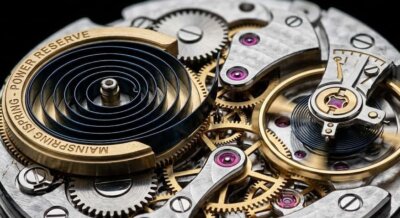
Mechanical watches correct a common misconception: they do not need electricity to keep time. Instead, they rely on a coiled metal spring called the mainspring as the internal energy store, releasing that energy gradually through a series of gears and other parts.
In contrast, a quartz (battery-powered) watch uses electrical current from a battery to make a quartz crystal vibrate at a precise frequency, driving the hands electronically. Solar (hybrid) watches also depend on light-charged batteries, so they are not truly battery-free in the mechanical sense.
Being battery-free means no battery replacements, which adds to their longevity and sustainability—mechanical watches can last generations with proper care. Later sections explain how the mainspring stores energy and how manual watches use hand-winding while automatic watches use wrist movement via a rotor.
Here’s a quick comparison to orient you:
| Feature | Mechanical (No Battery) | Quartz (Battery) |
|---|---|---|
| Energy source | Mainspring (stored mechanical energy) | Battery electrical current |
| Needs winding | Yes (manual or automatic) | No |
| Battery replacement | Never | Every 1–5 years |
| General lifespan/maintenance | Generations with service | Decades, battery-focused |
Next, we’ll dive deeper into how mechanical watches differ from quartz in practice.
How Do Mechanical Watches Differ from Quartz?
The fundamental difference between mechanical and quartz watches comes down to their power source and how they keep time. A mechanical watch relies entirely on wound spring energy and moving parts—gears, springs, and oscillating wheels—to function. A quartz watch, by contrast, uses a battery to send electrical current through a quartz crystal, which vibrates at an extremely precise frequency to regulate timekeeping. This single distinction explains why mechanical watches never need a battery replacement, while quartz watches require periodic battery changes.
To understand why this matters in everyday use, consider how each system actually keeps time. In a mechanical watch, the mainspring releases energy gradually through a series of gears and a regulating mechanism (the escapement and balance wheel) that work together to control the hand movement at a steady, predictable pace. In a quartz watch, the battery powers a quartz crystal to oscillate at a fixed rate, and an electronic circuit counts these vibrations to advance the hands in precise steps. Both approaches work, but they represent entirely different engineering philosophies: one mechanical and visible, one electrical and microscopic.
The most practical difference is the battery question. A mechanical watch needs no battery because it stores and uses mechanical energy directly from the wound mainspring. Once wound (either by hand or by wrist movement in an automatic), it runs on that stored spring energy until the spring unwinds—typically 24–48 hours if left unwound, or continuously if worn regularly (in an automatic) or rewound periodically (in a manual). A quartz watch, by contrast, depends on a battery to power the electrical circuit that regulates the quartz crystal. That battery will eventually deplete and require replacement, usually every 2 to 5 years depending on the watch model and usage.
For many owners, the absence of battery maintenance is one of the main appeals of mechanical watches. You will never need to visit a jeweler for a battery swap; instead, you keep your watch wound and running through wear or manual winding.
Quartz watches are generally more accurate than mechanical watches. A well-maintained quartz watch typically loses or gains around 5–10 seconds per month, while a mechanical watch typically loses or gains around 5–20 seconds per day under normal wear, depending on how carefully it is regulated and maintained. This does not mean mechanical watches are unreliable for daily life; such a variance is imperceptible for most practical purposes. However, if you need to set your watch to the exact minute multiple times per week, quartz will feel more stable.
Mechanical watches, by design, are more affected by position, temperature, and wear. A mechanical watchmaker can regulate a movement to minimize variance, but unlike a quartz crystal’s electronic precision, a mechanical regulator cannot eliminate drift entirely. This trade-off is by design: mechanical watches prioritize the visible, tangible engagement of their mechanisms over metronomic precision.
If you want to identify whether a watch is mechanical or quartz at a glance, watch the seconds hand. In a mechanical watch, the seconds hand appears to move smoothly and continuously across the dial, sweeping from second to second in a fluid motion. In a quartz watch, the seconds hand visibly ticks or steps forward at discrete intervals, often with an audible tick sound. This difference reflects how each system advances the hands: mechanical watches move the hand continuously as gears rotate, while quartz watches move the hand in small jumps synchronized to the crystal’s vibration cycle. This visual cue is one of the easiest ways to tell the two systems apart without opening the case.
Note that some quartz watches are designed with a sweeping seconds hand to mimic the mechanical look, and some mechanical watches have a seconds subdial that ticks—so this cue is helpful but not foolproof. However, for most everyday watches, the smooth vs. stepped seconds hand motion is a reliable way to distinguish the two technologies at first glance.
The table below outlines the key practical differences between mechanical and quartz watches:
| Aspect | Mechanical (No Battery) | Quartz (Battery-Powered) |
|---|---|---|
| Energy Source | Wound mainspring (mechanical energy) | Battery (electrical current) |
| Requires Winding? | Manual: yes, by hand. Automatic: no, via wrist movement (when worn). | No; battery powers the circuit automatically. |
| Battery Replacement? | Never | Every 2–5 years, depending on the model |
| Typical Accuracy | ±5–20 seconds per day (varies by regulation and wear) | ±5–10 seconds per month (much more stable) |
| Ticking Sound | Audible tick from escapement releasing energy in pulses | Quiet or inaudible; electronic regulation produces no mechanical tick |
| Lifespan with Care | Generations with periodic professional maintenance | 10–20 years before internal components may require service (battery aside) |
Mechanical watches appeal to people who enjoy the craftsmanship and the visible motion of gears, and they are free from the need to replace batteries, making them a one-time investment. Quartz watches suit anyone prioritizing accuracy, low maintenance, and affordability. For practical daily use, either works—the choice often reflects personal preference rather than necessity. Understanding the difference simply helps you know what to expect from your watch and how to care for it.
The Basics of Mechanical Watch Movement
A mechanical watch is powered by stored mechanical energy, not by a battery or electrical current. Here’s how it works at the highest level: you wind up a coiled metal spring (called the mainspring), which stores energy as it tightens. As the spring slowly unwinds, it releases that energy in a controlled way through a series of gears. These gears transfer the energy to the watch hands, making them move at precise intervals. To ensure the hands move at exactly the right speed—not too fast, not too slow—two special components work together: the escapement (a mechanical gate that releases energy in tiny pulses) and the balance wheel (an oscillating weight that sets the rhythm, like a pendulum). The result is a watch that keeps accurate time without ever needing a battery.
Think of it like a toy car you wind up as a child. When you wind the toy, you’re tightening an internal spring. Once you let it go, the spring unwinds and powers the wheels. But a mechanical watch is far more sophisticated: instead of spinning out of control, the escapement and balance wheel act as a traffic cop, metering out the energy in steady, measurable doses so that the hands advance at the correct rate—hour by hour, minute by minute, second by second.
There are two main types of mechanical watches, distinguished by how the mainspring gets wound in the first place:
- Manual (hand-wound) mechanical watches: You wind the mainspring by turning the crown (the small knob on the side of the watch). Each turn stores energy. Once fully wound, the watch will run for roughly 24–48 hours before the spring is depleted and the watch stops.
- Automatic (self-winding) mechanical watches: As you wear the watch and move your wrist, a weighted component called a rotor swings back and forth, automatically winding the mainspring. This means the watch rewinds itself throughout the day as long as you’re wearing it. If you set it down for an extended period without wearing it, it will eventually stop after 24–48 hours at rest.
The fundamental principle is identical in both types: mechanical energy stored in a spring, released gradually, regulated by an oscillating balance wheel, and transmitted to the hands via gears. No electricity required.
Terminology Quick Reference
To help you follow along as we dive deeper into each component, here are the key terms you’ll encounter:
- Mainspring: The coiled metal ribbon inside the watch that stores mechanical energy when wound and releases it gradually as it unwinds.
- Crown: The small knob on the outside of the watch case used to wind the mainspring (in manual watches) and to set the time and date.
- Rotor: A weighted semicircular disc found in automatic watches that swings with your wrist movement to wind the mainspring automatically.
- Gear train: The series of interconnected gears that transfer energy from the unwinding mainspring to the watch hands.
- Escapement: The mechanical gate that controls the release of energy from the gear train, sending it in precise pulses to the balance wheel and creating the ticking sound.
- Balance wheel: The oscillating wheel (regulated by a hairspring) that beats back and forth at a constant rate, acting as the timekeeping heart of the watch and determining how fast or slow the escapement releases energy.
- Power reserve: The length of time a watch will run after it has been fully wound, before the mainspring is completely depleted. Typically 24–48 hours at rest.
In the sections that follow, we’ll walk through each of these components in detail, showing you exactly how energy flows from the mainspring through the entire system to keep your wrist synchronized with time.
The Mainspring: Your Watch’s Power Storage
At the heart of every mechanical watch sits a single power source: the mainspring. Unlike a battery that provides continuous electrical current, a mainspring is a tightly coiled ribbon of metal that stores mechanical energy. Think of it like the spring inside a toy car—when you wind it up, the coils tighten and hold potential energy. As the spring unwinds, that stored energy is gradually released to turn the gears and move your watch hands.
Where the Mainspring Lives and How It Works
The mainspring is housed inside a cylindrical container called the barrel, tucked deep within the movement where you typically cannot see it without opening the case. This is completely normal and expected. When you wind a manual watch by turning the crown, or when an automatic watch’s rotor spins from your wrist movement, you are tightening the coils of the mainspring around its central shaft. Each turn winds the spring tighter, storing more potential energy—just like winding a toy car’s spring multiple times makes it go farther.
As the mainspring gradually unwinds, it rotates the barrel, which is connected to a series of gears. These gears—called the gear train—transfer that energy forward through the movement, eventually reaching the escapement, balance wheel, and ultimately the hands on your dial. The entire system depends on this slow, steady release of energy from one tightly coiled piece of metal.
How Long Does a Full Wind Last?
When a mainspring is fully wound, a mechanical watch typically has a power reserve of 24–48 hours at rest. Power reserve is the term for how long your watch will continue to run after winding stops, assuming it sits still and unwound. This does not mean your watch stops after a day—it means that if you fully wound it and set it aside without wearing it, it would run for roughly one to two days before the mainspring fully unwound and the watch stopped.
However, this timeline changes depending on how you use your watch. If you wear an automatic watch daily, the rotor constantly rewinds the mainspring as your wrist moves, so the power reserve figure is largely irrelevant to daily life—your watch stays wound as long as you wear it regularly. If you have a manual watch, you simply wind it again when you feel it losing power or on a regular daily routine. The 24–48 hour power reserve is most relevant if you set a wound watch aside without wearing it or winding it further.
Why No Battery Needed
The mainspring is why a mechanical watch needs no battery, no electrical current, and no circuit board. The energy comes entirely from the physical act of winding—either your hand turning the crown or the weight of your moving wrist through the rotor. Once wound, the spring’s coils hold that energy until friction and the escapement’s regulated release gradually deplete it. This is pure mechanical energy, stored and released by shaped metal, gears, and springs. No electricity required.
Manual Watches: Winding by Hand
A manual watch is a mechanical watch that you power yourself by turning the crown, rather than relying on any kind of battery.
In a manual mechanical watch, turning the crown winds the movement: your fingers provide energy, the crown passes that energy into the winding system, and this tightens the mainspring deep inside the watch. As the mainspring slowly relaxes, it sends stored mechanical energy through the gears, into the escapement and balance wheel, and finally to the hands so they can track time.
Most modern manual watches are designed so that a fully wound mainspring gives roughly 24–48 hours of power before the watch comes to a stop. Once that stored energy (the power reserve) runs down, the watch simply stops until you wind it again.
How a manual watch is powered
When you wind a manual watch by hand, the energy flow looks like this:
- You turn the crown, the knob used to wind and set the time.
- The winding system tightens the mainspring, a coiled metal spring that stores mechanical energy.
- The mainspring steadily releases that energy into the gear train.
- The escapement and balance wheel use that energy in tiny pulses to keep a steady rhythm.
- The gears driving the hands move at controlled speeds, so the seconds, minutes, and hours advance in order.
From the outside, all you see is the crown turning and the hands moving, but inside the same chain is always at work: crown turns, mainspring stores energy, energy flows through gears, the timekeeping parts regulate it, and the hands respond.
When and how often to wind
Because a manual watch does not wind itself, you decide when to keep it powered:
- If you wear it daily, many people choose to wind it once a day, often in the morning, so it runs comfortably within its 24–48 hour power reserve.
- If the watch has been sitting still and stops, simply wind it again before you put it on; you are refilling that power reserve from empty.
- If you skip winding for long enough, the mainspring’s stored energy is used up and the watch stops, which is normal and not harmful.
The key is consistency: regular gentle winding keeps the mainspring in its working range so the watch stays running and easy to set.
Safe winding technique
Beginner owners often worry about overwinding a manual watch. Most modern designs are sturdy, but you can still damage the mainspring or gears by forcing the crown too hard, so proper technique matters.
Use this safe approach:
- Hold the watch in one hand and grip the crown lightly with the other.
- Turn the crown slowly in the clockwise direction (away from you when looking at the dial in most watches).
- Make smooth, small turns rather than quick, jerky motions.
- Feel for gentle resistance building in the crown as you wind.
- Use a simple rule of thumb: stop when you clearly feel the resistance increase, or after about 30 turns if you are unsure.
The most common beginner mistake is to keep forcing the crown after the mainspring is already tight. If you push past that clear resistance, you risk straining or breaking the mainspring or other small parts in the winding system. When in doubt, stop a little early; you can always add a few turns later.
Step-by-step: winding a manual watch by hand
Here is a practical mini-procedure you can follow each time:
- Gently pull the crown to the winding position if your watch has more than one position; if it only has a single position, leave it pushed in.
- Turn the crown slowly clockwise, one small turn at a time.
- Notice the feel: at first the crown turns easily, and then you will feel gentle resistance building as the mainspring tightens.
- Stop as soon as that resistance becomes clear, or after roughly 30 turns if you do not feel a strong change.
- Pull the crown to the time-setting position, set the time carefully, then push the crown back in fully.
- Put the watch on your wrist and wear it as normal; the mainspring is now supplying energy to the movement.
Following this same calm routine each day quickly becomes familiar, and it sets up the rest of the energy chain that drives the hands.
Pros and cons of a manual watch
Manual mechanical watches have a character and rhythm that many owners enjoy, but they also require a bit of attention. In plain terms:
- Advantage: You have direct control over when the watch is powered, because you decide when to wind. That makes it easy to know the watch is fully charged after a good winding session.
- Advantage: The winding ritual can be enjoyable, especially if you like feeling connected to the mechanics and watching the hands come back to life.
- Disadvantage: A manual watch demands discipline. If you forget to wind it for long enough, the power reserve runs out and the watch stops, so you must reset the time.
- Disadvantage: If you rush and wind too hard, you can stress small internal parts, so it rewards a gentle, patient touch.
Manual watches tend to appeal to collectors, to people who enjoy a small daily ritual, and to those who wear different watches on different days and are comfortable winding whichever one they pick up.
Daily routine checklist for a manual watch
A short, consistent routine helps keep a manual watch running smoothly:
- Wind gently once a day at roughly the same time, using slow clockwise turns until you feel resistance.
- After winding, check and set the time so the hands match a reliable reference.
- Never force the crown; if it will not turn or feels unusually stiff, stop and have the watch checked by a professional.
- If the watch stops because you skipped a day or two, simply repeat the winding and setting routine before wearing it again.
Automatic Watches: Self-Winding via the Rotor
An automatic watch is a mechanical watch that winds itself through everyday wrist movement, eliminating the need for daily hand-winding.
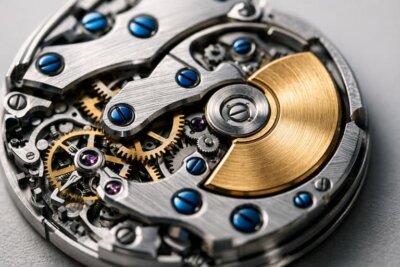
At the heart of this self-winding process is the rotor, a semicircular weighted metal disc that sits freely inside the watch case and swings back and forth, or oscillates, with the natural motion of your arm. Picture it like a pendulum swinging gently within the watch: as you walk, gesture, or simply move through your day, the rotor pivots freely on its axis, driven by the force of gravity and inertia.
This oscillation powers a series of gears and ratchets that translate the rotor’s kinetic energy into the rotational force needed to wind the mainspring. Each swing tightens the coiled metal spring a tiny bit more, storing fresh mechanical energy to keep the watch running. This creates a continuous feedback loop: your wrist movement spins the rotor, the rotor rewinds the mainspring, and the mainspring powers the movement, ensuring the watch stays wound as long as you wear it regularly.
Visually, imagine a heavy half-disc balanced on a central pivot, arcing left and right inside the sealed case back—often visible through a transparent window on many automatic watches. The rotor’s weighted edge ensures it keeps moving efficiently with even subtle motions.
In practice, this loop means an automatic watch thrives on daily wear. If you take it off, it draws from the mainspring’s stored energy and typically runs for 24–48 hours at rest before stopping. If you go several days without wearing it or if your activity level is very low, the rotor may not generate enough motion to keep up, and the watch can stop. In that case, simply turn the crown a few times to give it a quick manual boost before putting it on again.
Advantages include true hands-off operation for active daily routines, while the main drawback is reliance on movement—ideal for those who wear their watch most days but less convenient for occasional use.
Practical tips for keeping your automatic watch running smoothly:
- Wear it daily or most days to let wrist movement keep the rotor active and the mainspring wound.
- If not worn for several days, give the crown 15–20 gentle turns before setting the time and wearing it.
- Store it dial-up or on a watch winder if keeping it off-wrist for longer periods.
| Feature | Manual | Automatic |
|---|---|---|
| How it’s powered | Hand-winding via crown | Wrist movement via rotor (self-winding) |
| Winding method | Turn crown gently, stop at resistance | Daily wear; optional crown boost if stopped |
| Power reserve | 24–48 hours at rest | 24–48 hours at rest; continuous with wear |
| Convenience | Requires deliberate routine | Hands-off for active users |
| Best for whom | Watch enthusiasts, occasional wearers | Daily wearers, active lifestyles |
Next, we’ll look at the gear train.
The Gear Train: Transferring Energy to the Hands
Once the mainspring begins to unwind and release its stored energy, that energy needs to find its way to the watch hands so you can actually see the time. That is the job of the gear train—a system of interconnected gears that act like a mechanical relay, passing energy from one gear to the next in a carefully designed sequence.
Think of a bicycle chain and sprockets. When you pedal, the large chainring drives the chain, which moves the rear sprocket, which turns the wheel. A watch gear train works the same way. As the mainspring unwinds, it causes the barrel (the container holding the spring) to rotate. This rotation drives the first gear, which meshes with and drives the next gear, which drives the next, and so on. Each gear is sized and positioned so that it transfers energy smoothly while also controlling the speed at which each hand moves.
How Ratios Control Hand Speeds
The magic of the gear train lies in its ratios. A gear ratio is simply the size relationship between two meshing gears. If one gear is twice as large as the gear it drives, the smaller gear will spin twice as fast. Watch designers use this principle to divide the energy flow so that the second hand completes one rotation per second, the minute hand completes one rotation per minute, and the hour hand completes one rotation per 12 hours.
This is how ratios divide time into seconds, minutes, and hours. A small gear drives a larger gear to slow it down; a large gear drives a small gear to speed it up. The gear train uses this stacked system to create three different speeds from a single source of energy. Without precise ratios, all three hands would move at the same speed and the watch would be useless.
Steady Motion Through Precision
The reason the hands move smoothly and predictably is that the gears are manufactured to tight tolerances. They must mesh cleanly with each other, with minimal play or wobble. The teeth are evenly spaced and shaped so energy transfers efficiently from one gear to the next without stuttering or slipping. This is why a well-made mechanical watch can keep time reliably for decades—the gear train is a precision system.
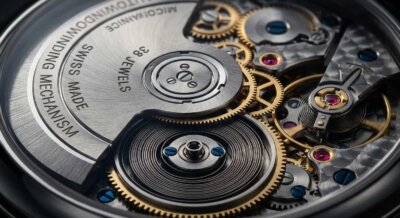
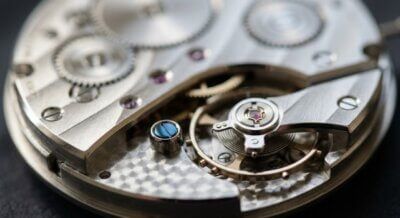
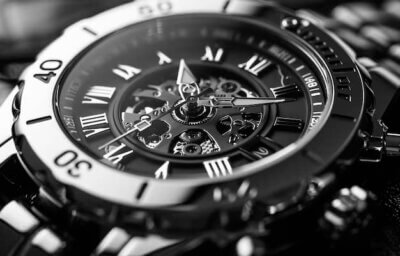
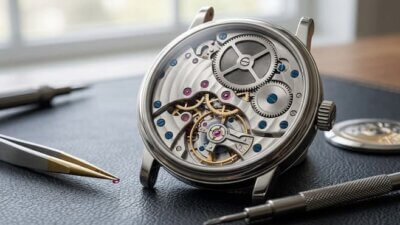
If you own a watch with a transparent case back or a skeleton-style dial, you can actually see the gear train at work. You will notice small circular wheels with teeth rotating at different speeds behind the hands. If your watch has a traditional opaque case back, the gear train remains hidden, but it is always there, silently doing its job. The energy passes through these gears and then reaches the escapement and balance wheel, which regulate how quickly the gears advance the hands.
The Escapement & Balance Wheel: The Timekeeping Heart
Without regulation, a mechanical watch would have a serious problem: the mainspring would unwind too quickly, causing the hands to spin wildly out of control instead of marking time accurately. The solution is an elegant mechanical system made up of the escapement and the balance wheel working together, acting like the watch’s timekeeping heartbeat.
The Regulation Problem and Solution
Imagine a dam holding back water. If you simply opened a gate and let all the water flow out at once, you would get a destructive flood. But if you opened and closed that gate in a controlled rhythm, releasing small amounts of water at precise intervals, you could power a steady stream. A mechanical watch faces the same challenge: the mainspring contains a large amount of stored energy that must be released gradually and evenly to keep accurate time.
The escapement and balance wheel solve this problem by working as a regulated pair. The escapement acts as the gate, opening and closing repeatedly to release energy in tiny, controlled pulses. The balance wheel acts as the metronome, oscillating back and forth at a fixed, constant frequency. Together, they ensure that energy flows to the gear train at a steady, measurable rate.
The Escapement: The Mechanical Gate
The escapement is a mechanical gate that controls the release of energy from the mainspring. Instead of allowing energy to flow continuously, it opens and closes in sync with the balance wheel’s oscillation, releasing one small pulse of energy with each opening. Think of the escapement as a traffic cop directing energy flow: it says go for a fraction of a second, then stop, then go again, hundreds of times per second.
The escapement consists of several parts working in concert. The escape wheel (a toothed gear) wants to rotate freely as the mainspring pushes it. The pallet fork, a small lever, blocks the escape wheel’s teeth and then releases them one at a time in a precise rhythm. Each time the pallet fork moves, it lets one tooth of the escape wheel advance by a small amount, sending a regulated pulse of energy forward.
Most modern mechanical watches use an anchor escapement (also called a lever escapement), which is a reliable and widely adopted design. As you listen to a mechanical watch, you may hear a distinctive ticking sound. This ticking often comes from the escapement’s repeated opening and closing, the sound of energy being released in controlled increments.
The Balance Wheel and Hairspring: The Rhythm Keeper
At the heart of regulation is the balance wheel, a small weighted wheel that oscillates back and forth at a constant frequency. Picture a pendulum swinging steadily side to side, or a tuning fork vibrating at a fixed pitch: the balance wheel works the same way. Unlike a pendulum, which swings freely, the balance wheel is controlled by a thin spiral spring called the hairspring (also known as the balance spring).
The hairspring is attached to the balance wheel and acts like a governor, setting and maintaining the frequency of oscillation. As the balance wheel moves in one direction, the hairspring winds tighter; as it moves the other way, the hairspring unwinds. This back-and-forth tension keeps the oscillation regular and steady, much like a metronome keeping a constant beat. The hairspring’s stiffness and the balance wheel’s weight together determine how fast the wheel oscillates, which in turn determines how fast the watch ticks.
This regulated oscillation is what makes timekeeping possible. Because the balance wheel swings at a known, constant frequency, the escapement can release energy in predictable intervals. The gear train translates those intervals into hand movement on the dial.
How Escapement and Balance Wheel Work Together
Here is how the regulation system keeps a mechanical watch running at a steady pace:
- The balance wheel oscillates back and forth at its natural frequency, driven by the hairspring.
- As the balance wheel swings, it pushes the pallet fork, which blocks and releases the escape wheel’s teeth in rhythm.
- Each time the pallet fork releases a tooth, a pulse of energy flows from the escapement to the gear train.
- The balance wheel receives a small impulse of energy with each pulse, replenishing what it loses to friction and keeping its oscillation going.
- The gear train translates these regular pulses into smooth, measured hand movement.
This closed loop repeats hundreds of times per second. The escapement cannot release energy faster than the balance wheel allows, and the balance wheel cannot swing faster than the hairspring permits. The result is a self-regulating system that converts the chaotic unwinding of the mainspring into precise, measurable time.
Accuracy and Daily Performance
Because mechanical watches rely on the balance wheel and hairspring to regulate timekeeping, their accuracy depends on how consistently those parts oscillate. A mechanical watch typically keeps time within a range of ±5–20 seconds per day, which is accurate enough for daily wear and activities. This is notably different from quartz watches, which use an electrical current to drive a quartz crystal vibrating at a very stable frequency. Quartz watches typically keep time to within ±5–10 seconds per month, making them significantly more accurate. However, for everyday purposes, a mechanical watch’s accuracy is reliable and precise enough for telling time, scheduling, and general timekeeping needs.
Power reserve: how long do they run?
Power reserve is how long a mechanical watch keeps running on its stored energy after winding stops, before the mainspring is fully unwound and the movement comes to a halt.
When the mainspring is fully wound, it holds a limited amount of stored energy. As that energy is released to drive the hands, the power reserve is gradually used up until there is no more energy available and the watch stops.
For many everyday mechanical watches, a full wind typically gives around 24–48 hours at rest. Power reserve is most relevant when a watch is not being worn or wound; when you are actively wearing an automatic or regularly winding a manual, the power reserve window resets regularly.
At rest vs worn: what changes?
The answer to how long a watch runs depends on whether it is resting or being worn, and on whether it is manual or automatic.
- At rest (any mechanical watch): once fully wound and then left on a table, the mainspring simply runs down. When its stored energy is gone, the watch stops, often after about 24–48 hours at rest.
- Worn regularly (automatic): an automatic mechanical watch uses wrist movement to keep the mainspring topped up. As you move, the watch can keep rewinding itself, so it may run continuously and not stop at all as long as it is worn enough to stay wound.
- Manual (hand-wound): a manual watch does not wind itself while you wear it. After it has run through its 24–48 hour power reserve, it will stop unless you wind it again with the crown to restore stored energy.
So if you fully wind your watch and then do not wear it at all, a typical expectation is that it will stop somewhere within that 24–48 hour range as the mainspring’s stored energy runs out. This is separate from lifespan: a watch can have a power reserve of only 24–48 hours yet still be used for decades because you keep rewinding it or wearing it and have it serviced when needed.
Power reserve in real-life timelines
The table below gives simple, practical timelines that connect how you use the watch with how long it keeps running.
| Situation | What typically happens |
|---|---|
| After full wind, not worn | Runs for about 24–48 hours at rest, then stops when the power reserve is empty. |
| Worn daily | In an automatic watch, normal wrist movement keeps rewinding the mainspring, so it can run continuously without stopping. |
| Not worn for a week | The power reserve is long gone after a week off the wrist, so the watch has stopped and needs to be wound and set again. |
How to maximize your power reserve in daily use
You cannot turn a 24–48 hour power reserve into a week without stopping, but you can help your mechanical watch spend more of its life running rather than stopped.
- If you have an automatic watch, keep it wound by wearing it regularly so wrist movement can keep the mainspring topped up.
- If you have a manual watch, make a habit of winding it at about the same time each day, before it has a chance to run all the way down.
- After the watch has stopped (for example, after several days off the wrist), always give it a full wind before setting the time so you start again with a full power reserve.
Next, we will look at how to recognize a mechanical watch so you can tell at a glance what kind of power reserve behavior to expect.
How to recognize a mechanical watch
Identifying whether a watch is mechanical or quartz is straightforward once you know what to look for. A few simple, observable cues will tell you whether you are holding a battery-free mechanical movement or an electronic quartz timepiece.
The easiest way to identify a mechanical watch is to watch the seconds hand move. Mechanical watches have a smooth, continuous sweep across the dial, while quartz watches have a distinctive stepped or jerky motion, ticking once per second with visible pauses between each jump. This difference exists because mechanical movements are driven by the steady oscillations of the balance wheel and gear train, while quartz watches are regulated by electronic pulses from a battery-powered quartz crystal. A smooth seconds hand almost always means mechanical.
Many mechanical watches feature a transparent or exhibition case back, allowing you to see the movement inside. Looking through the case back, you will see intricate gears, springs, and other metal components in motion. If the watch is automatic, you may also see the rotor—a weighted semicircular disc that swings back and forth as you move your wrist. The rotor is unique to automatic watches, so seeing it confirms that you have an automatic mechanical watch. Keep in mind that not all mechanical watches have transparent case backs; some have solid metal backs for durability or aesthetics, so the absence of a case back does not rule out mechanical movement.
Practical identification checklist
Use these observable cues to confirm whether a watch is mechanical:
- Smooth, continuous seconds hand sweep across the dial = mechanical (most reliable single cue)
- Stepped, jerky seconds hand ticking once per second = quartz
- Transparent case back showing gears and springs = mechanical
- Rotor visible swinging inside = automatic mechanical watch
- No visible rotor, but gears visible = manual (hand-wound) mechanical watch; the rotor is exclusive to automatic watches
Care & maintenance
Mechanical watches are built to last for decades—even generations—when properly maintained. Unlike battery-powered devices that eventually need replacement, a mechanical watch can be serviced and restored to full function throughout your ownership. The key is understanding how the mechanism works and what it needs to stay healthy.
Keeping Your Watch Wound and Running
The most important rule for mechanical watch care flows directly from how these watches work: they must stay wound. For automatic watches, this means wearing them regularly. The rotor swings with your wrist movement, continuously winding the mainspring so the watch keeps running. If you wear an automatic watch daily, it typically stays wound without any additional effort on your part.
For manual watches, you are responsible for winding. Turn the crown gently and steadily—imagine winding a music box, not tightening a bolt. You will feel slight resistance as the mainspring tightens; stop when you sense firm resistance, not when you hit a hard stop. This gentle approach protects the delicate mainspring from damage.
The phrase keep it oiled is often misunderstood: it does not mean you should apply oil yourself. Instead, it means keep the watch in active use—wound and worn—so the internal parts stay in motion. Professional service, which happens every 3 to 5 years, is when the movement gets proper lubrication and cleaning by a technician.
If you own an automatic watch but do not wear it daily, consider using a watch winder—a small motorized box that mimics wrist movement and keeps the mainspring wound when the watch is not being worn. This prevents the power reserve from depleting and keeps the watch running on your shelf.
Daily and Storage Care
Mechanical watches are robust, but a few simple precautions extend their life:
- Avoid strong magnetic fields. Magnets can interfere with the delicate hairspring that controls the balance wheel’s rhythm, causing the watch to lose or gain time. Keep your watch away from speakers, magnetic closures, and magnetic phone mounts.
- Store in a cool, dry place. Extreme heat or humidity can damage the lubricants inside the movement and cause corrosion.
- Do not force the crown. If it resists when you try to wind or set the time, stop immediately. Forcing it can strip the internal gears.
- Handle the case back carefully. Many mechanical watches have a transparent case back so you can see the rotor and movement. Do not open or attempt to reseal it yourself; a technician should ensure a proper, watertight seal.
Professional Service and Troubleshooting
Even with perfect care, mechanical watches benefit from regular professional service. A technician will clean the movement, replace worn lubricants, check gear alignment, and test accuracy. Aim for a service every 3 to 5 years, depending on how often you wear the watch and your environment.
The following checklist outlines signs that your watch needs professional attention:
- The watch loses or gains time inconsistently, or the rate changes day to day even though you are wearing it regularly.
- The rotor (visible through the case back) makes rattling sounds or does not swing freely when you move your wrist.
- The mainspring will not wind anymore, or the crown spins without tightening the spring.
- The case back does not seal tightly, or you see moisture inside the crystal.
For common issues, here is a quick troubleshooting guide:
- Watch stopped running: Your power reserve has depleted. Wind the crown fully (manual watch) or wear it regularly for a few days (automatic watch). If it still does not run after winding, seek professional service.
- Watch loses or gains time noticeably: This often means the mainspring is not fully wound, or the watch needs service. Try winding it fully and wearing it consistently for a week. If the problem persists, have a technician inspect the escapement and balance wheel.
- Rotor seems stuck or makes abnormal sounds: This signals an internal mechanical issue. Do not force the rotor or shake the watch. Take it to a professional for inspection.
The following checklist summarizes the essential care practices to keep your mechanical watch healthy:
- Wear your automatic watch regularly, ideally daily, to keep the rotor winding the mainspring.
- Wind your manual watch gently until you feel firm resistance.
- Store the watch in a cool, dry place away from direct sunlight and extreme temperatures.
- Keep the watch away from magnets and magnetic objects.
- Have the watch serviced by a professional every 3 to 5 years.
- Use a watch winder if you own an automatic watch and do not wear it daily.
- Do not attempt to open the case back or apply lubricants yourself.
- Do not force the crown if you feel unusual resistance.
With these practices, your mechanical watch will run reliably for years and can be maintained and enjoyed for your lifetime and beyond.
FAQ
What exactly is a mainspring?
A mainspring is a tightly coiled metal ribbon that stores mechanical energy when wound, much like a toy car’s spring. When you turn the crown (the knob on the side of the watch) or when a rotor winds it automatically, the spring tightens and builds up potential energy. As it gradually unwinds, it releases that stored energy to power the entire watch movement.
How does a rotor turn the mainspring if the watch is on my wrist?
The rotor is a weighted semicircular disc inside an automatic watch that swings freely with the natural motion of your wrist, much like a pendulum. Every time you move your arm—whether walking, gesturing, or simply moving about—the rotor rotates and gently winds the mainspring without you needing to do anything. This continuous rewinding is why automatic watches stay powered as long as you wear them regularly.
What does the escapement do, and why is it called that?
The escapement is a mechanical gate that releases the mainspring’s energy in tiny, controlled pulses rather than all at once. It works like a traffic cop or a dam gate, allowing a precise amount of energy to escape to the balance wheel at each beat, which is why it earned the name escapement. This controlled release is what keeps your watch ticking steadily and accurately instead of spinning wildly.
Why does my mechanical watch tick differently than my quartz watch?
A mechanical watch creates an audible, rhythmic ticking sound as the escapement releases energy in pulses. A quartz watch usually ticks only once per second—a slower, quieter rhythm—because it is regulated by an electrical current and a quartz crystal vibrating at a different frequency. Many people find the mechanical tick satisfying, while others prefer the quieter quartz rhythm.
How long does a mechanical watch run without wearing it?
Most mechanical watches run for 24–48 hours at rest after they are fully wound and left unworn, depending on the specific movement and power reserve. After that time, they gradually slow and eventually stop as the mainspring fully unwinds. For automatic watches, wearing them regularly restarts this cycle continuously; for manual watches, you simply wind the crown again to get another 24–48 hours of runtime.
Can I wear a mechanical watch if I don’t move much?
If you own an automatic watch and have a sedentary lifestyle, it may not stay fully wound throughout the day because the rotor needs regular wrist motion to wind the mainspring. In that case, you can supplement with occasional manual winding by turning the crown, or consider a manual watch that you wind by hand on demand. A manual watch is actually ideal for low-movement situations because you control the winding directly.
How often do I need to wind a manual watch?
A typical manual watch should be wound once per day, usually in the morning, with gentle turns of the crown until you feel slight resistance. The exact number of turns depends on the design. The best approach is to wind gently each morning as part of your routine to keep it consistently powered.
What’s the difference between a manual and automatic watch?
A manual watch is wound by hand using the crown and runs for roughly 24–48 hours per winding; an automatic watch winds itself through a rotor driven by wrist movement and runs continuously when worn but also needs occasional manual winding if worn sporadically. Manual watches offer simplicity and direct control; automatic watches offer convenience and require less deliberate attention. Both are mechanical, both are battery-free, and both require the same basic care.
How do I know if my watch is mechanical or quartz?
The easiest clue is the seconds hand: a mechanical watch typically shows a smooth, continuous sweep, while a quartz watch has a visible step or tick just once per second. You can also look for a transparent case back; if you see gears or a swinging rotor weight, it is definitely mechanical. The rotor is unique to automatic watches. If you see a battery compartment or no visible movement, it is quartz.
Do mechanical watches need any electricity or batteries?
No. Mechanical watches are powered entirely by stored mechanical energy in the mainspring, with no electricity or batteries required. The energy to power your watch comes from your own winding (manual) or your wrist movement (automatic), making them completely battery-free and independent of electrical current.
Is a Mechanical Watch Right for You?
- Prefer low maintenance and maximum convenience without daily thought: quartz or solar watch.
- Appreciate mechanical craftsmanship and want zero batteries: automatic or manual mechanical watch.
- Wear an accessory every single day with regular wrist motion: automatic watch (stays powered effortlessly).
- Forget to wear accessories or move minimally: manual watch (wind on demand) or quartz.