What Is Quartz Movement? (Definition)
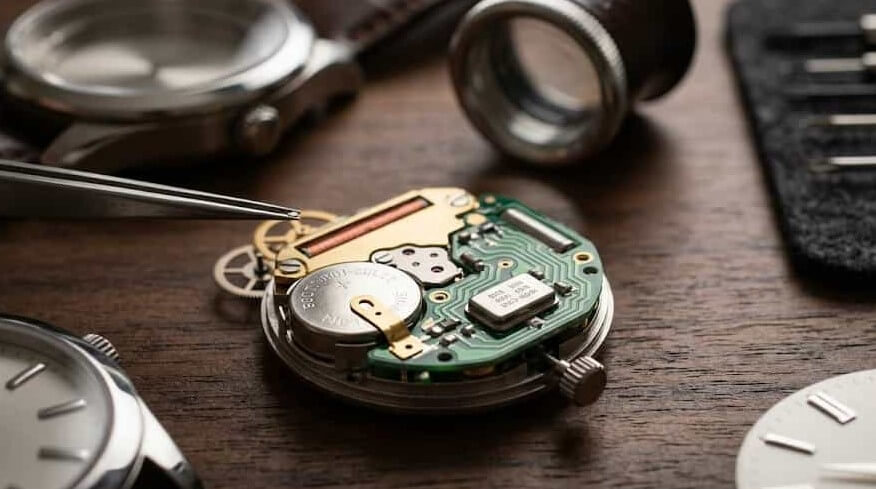
A quartz movement is an electronic watch mechanism powered by a battery and regulated by a tiny quartz crystal to keep time with exceptional accuracy. The battery supplies electrical energy to an electronic circuit, which uses the quartz crystal as a timing reference so the watch can measure seconds, minutes, and hours in a controlled way.
The term quartz here refers to quartz (silicon dioxide), a mineral found in the Earth’s crust with special properties that make it ideal for precise timekeeping. At a simple level, the electronic movement uses the quartz crystal to create a very steady rhythm, and that rhythm sets the pace for the watch hands.
Since the 1969 introduction of the Seiko Astron—one of the first commercially successful quartz wristwatches—this technology has become the most common type of watch movement worldwide, found in everything from basic everyday watches to many higher-end models because it is generally reliable, convenient, and consistent.
A Brief History of Quartz Watches (Context)
Before 1969, the watch industry was dominated by mechanical watches. These timepieces relied on either manual movement (hand-wound by the wearer) or automatic movement (self-winding through wrist motion). Both types stored energy in a coiled mainspring, which powered a series of gears and a mechanical escapement to regulate time. Winding was a regular ritual, accuracy drifted noticeably over days and weeks, and watches were expensive, delicate instruments accessible mainly to those who could afford them.
Everything changed on Christmas Day 1969, when Seiko introduced the Astron. This breakthrough device used a battery-powered quartz crystal instead of a mainspring to regulate timekeeping. The result was striking: the Astron kept time far more accurately than any mechanical watch, required no winding, and cost significantly less to manufacture. This technology suddenly made reliable, precise timekeeping available to nearly everyone.
The impact on the watchmaking industry was profound. Swiss manufacturers, who had dominated mechanical watchmaking for centuries, faced an existential threat. This period, known as the quartz crisis, saw traditional mechanical watch sales plummet as affordable, accurate quartz watches flooded the market. Many historic Swiss brands either collapsed or were forced to abandon mechanical production entirely.
By the late twentieth century, the dust had settled. Quartz became the dominant standard worldwide. Mechanical watches survived and evolved into a niche market valued for craftsmanship and tradition rather than everyday timekeeping. Quartz technology itself continued to advance, spawning variations like solar-powered and kinetic models. Today, the quartz watch is ubiquitous—so common that most people wearing a watch own a quartz timepiece without thinking twice about it.
What Makes Quartz Special? The Piezoelectric Effect
At the heart of every quartz watch lies a remarkable physical property called piezoelectricity. This is the foundation that explains why quartz crystals are so reliable for timekeeping. Piezoelectricity is the ability of certain materials, like quartz (silicon dioxide), to generate an electrical charge when mechanical pressure is applied to them. But for watches, the reverse is equally important: when electrical current is applied to quartz, it vibrates at an extremely consistent frequency.
Think of a tuning fork struck in mid-air. It vibrates at a fixed pitch, oscillating back and forth at the same rate every single time you strike it. A quartz crystal works much the same way, except instead of being struck by a hammer, it is powered by electrical current from a battery. The crystal is precisely cut and shaped—typically in a tuning-fork configuration—so that when voltage is applied, it vibrates at an exact, predictable frequency. This oscillation is what makes quartz watches so accurate.
The Reverse Piezoelectric Effect
The reverse piezoelectric effect is the complementary property: when pressure or vibration is applied to quartz, it produces an electrical charge. This bidirectional behavior—electricity causing vibration, and vibration producing electricity—allows quartz to serve as both the timekeeper and the signal generator in a watch. The crystal vibrates in response to electrical pulses, and those vibrations are detected by the watch’s electronic circuit, creating a feedback loop that maintains precise timekeeping.
The Quartz Crystal: Tuning Fork Shape and Frequency
Most quartz watch crystals are cut in what is called an XY-cut, a specific orientation that optimizes the piezoelectric response. The crystal is shaped like a miniature tuning fork with two prongs, each prong oscillating back and forth in perfect synchronization. This shape and orientation ensure that the vibration remains stable across a wide range of temperatures and conditions.
The standard frequency chosen for watch quartz crystals is 32,768 hertz (Hz), meaning the crystal vibrates 32,768 times per second. This frequency is central to understanding how quartz watches work at the electronic level. The consistency of this oscillation—rarely deviating from the target frequency—is what gives quartz watches their legendary accuracy compared to mechanical timepieces.
Why 32,768 Hz? The number 32,768 is 2 raised to the 15th power (2^15), a power of two. Electronic circuits use binary logic and can divide frequencies by powers of two very efficiently. By choosing a frequency that is a power of two, engineers can divide the 32,768 oscillations down to exactly one pulse per second using simple frequency-dividing circuits. Each successive division by two cuts the frequency in half, so starting from 32,768 Hz, just 15 divisions yield one pulse per second—the heartbeat that drives the watch hands. This elegant design choice makes the circuitry simpler, more reliable, and less power-hungry.
The stability of this oscillation under electrical power is what gives quartz its advantage over mechanical systems, which rely on gravity, friction, and mechanical springs to regulate time. Mechanical watches can drift significantly over the course of a day due to wear, temperature changes, and the natural decay of spring energy. Quartz crystals, by contrast, vibrate at nearly the same rate regardless of these external factors, making them inherently more accurate.
Quartz vs. Mechanical Watches—Key Differences
While quartz watches dominate the market today, mechanical watches remain highly valued for their craftsmanship and heritage. Understanding how these two movement types differ helps clarify why quartz became so popular and why some people still prefer mechanical movements.
The following table compares the key features of quartz and mechanical watches:
| Feature | Quartz | Mechanical |
|---|---|---|
| Power source | Battery (1–5 years per change) | Mainspring (wound manually or via wrist motion) |
| Accuracy | Around ±15 seconds per month | Around ±20 seconds per day |
| Maintenance | Battery replacement; minimal servicing | Regular servicing (cleaning, lubrication, adjustment) |
| Second-hand motion | Ticks once per second in distinct steps | Sweeps smoothly around the dial |
| Lifespan | 20+ years (limited by circuit availability in very old watches) | 20+ years; often 100+ years with proper care |
| Cost | Generally more affordable | Typically higher due to skilled craftsmanship |
These are approximate examples. Actual performance varies by watch model, condition, and how well it has been maintained.
Power Source and Operation
The most fundamental difference between quartz and mechanical watches lies in how they are powered. A quartz watch relies on a small battery that sends electrical current through a quartz crystal, which then vibrates to regulate timekeeping. A mechanical watch stores energy in a tightly wound mainspring. As the spring slowly unwinds, it releases energy that powers the gears and escapement mechanism, moving the watch hands forward.
Mechanical watches come in two varieties: manual movement (hand-wound) requires you to wind the crown regularly to tighten the mainspring, while automatic movement (self-winding) uses a rotor that spins with your wrist motion to wind the spring automatically as you wear the watch.
Accuracy: Electronic Precision vs. Mechanical Variables
Accuracy is where the difference becomes most apparent. Quartz watches typically maintain accuracy to within around 15 seconds per month, a dramatic advantage over mechanical watches. This precision stems from the quartz crystal’s ability to vibrate at an extremely consistent electronic frequency of 32,768 Hz, with very little deviation.
Mechanical watches, even high-quality ones, generally achieve accuracy of only around 20 seconds per day, meaning they can drift by 2 to 3 minutes per month without adjustment. This larger margin of error occurs because mechanical timekeeping depends on the interaction of gravity, friction, and wear on many moving parts. Over time, lubrication degrades, pivot points wear, and the balance wheel’s performance changes—all factors that affect precision.
Maintenance Requirements
Quartz watches demand minimal maintenance. The primary task is replacing the battery every 1 to 5 years (most commonly every 2 to 3 years). Beyond that, a quartz watch needs no regular servicing unless it stops working or shows signs of water damage.
Mechanical watches, by contrast, require more hands-on care. Most watchmakers recommend professional servicing every 3 to 5 years. This service includes cleaning internal parts, applying fresh lubrication, and making fine adjustments to keep the movement running smoothly. Without regular servicing, friction and wear accumulate, accuracy declines, and the watch may eventually stop.
The Second-Hand Tells the Story
A quick visual cue can tell you which movement type you are looking at: observe the second hand. On a quartz watch, the second hand ticks once per second, moving in distinct, visible steps. On a mechanical watch, the second hand typically sweeps smoothly and continuously around the dial. This difference reflects their underlying operation: the quartz watch’s electronic pulses drive the motor one step per second, while the mechanical escapement allows the balance wheel to oscillate and move the hands in a flowing motion.
Lifespan and Long-Term Durability
Both quartz and mechanical watches can last 20 or more years with proper care and periodic battery or service intervals. However, their long-term outlooks differ slightly. Mechanical watches are renowned for longevity; many vintage mechanical watches from the 1960s and earlier remain fully functional and are actively restored and worn today. Well-maintained mechanical watches can easily reach 100 years or more.
Quartz watches can also enjoy long lifespans, but they face a practical limitation: as they age beyond 30 to 40 years, the integrated circuits that power them may become obsolete, making replacement parts difficult or impossible to source. A mechanical watch, meanwhile, can often be repaired by sourcing older or replica parts that are still available or custom-made.
Battery Life & Watch Lifespan—What to Expect
Many people assume that when the battery dies, the watch itself has reached the end of its life, but that is rarely true.
Battery ≠ Watch Death
A depleted battery almost always means the battery needs to be replaced, not that the watch is finished. Quartz watches are designed with routine battery replacement in mind, and a fresh battery will usually bring them back to normal operation.
Battery lifespan: what is realistic?
In everyday use, a typical battery lifespan ranges from 1–5 years, with most quartz watches needing a new battery roughly every 2–3 years. The exact interval depends on how the movement is built and how the watch is used.
Main factors that affect battery lifespan include:
- Watch type and features (simple analog watches tend to use less power; digital displays, backlights, alarms, and chronographs can drain the battery faster)
- Usage patterns (frequent use of lights, alarms, and chronograph functions increases power draw)
- Temperature and environment (very low temperatures can temporarily reduce battery output; extreme heat over time can stress both the battery and the electronics)
Signs your battery is nearing end-of-life
Common signs that a quartz watch battery is almost exhausted include the second hand skipping or pausing, the watch losing time or running noticeably slow, or the watch stopping altogether even though there is no visible damage. When you see these signs, plan a battery replacement soon rather than waiting for the battery to sit dead inside the case.
Watch lifespan vs battery lifespan
Battery lifespan is short compared to overall watch lifespan. While a single battery lasts only 1–5 years, a well-made quartz watch can often deliver a lifespan of 20+ years with basic maintenance and periodic battery changes.
This long lifespan is possible because the core timekeeping parts are designed to be durable. The quartz crystal itself does not easily wear out under normal conditions, and solid-state electronic components have no moving parts, so there is much less mechanical wear than in a traditional mechanical watch.
Over several decades, however, some very old quartz watches can face limits related to integrated-circuit availability in their specific design. If the original electronic circuit fails and the exact part is no longer made, repair can become more difficult, even if the rest of the watch is still in good condition.
Battery replacement and maintenance
Replacing the battery is a routine part of quartz watch maintenance, similar to changing the batteries in a remote control or smoke detector.
- If you are unsure how to open the case or which battery type to use, it is safer to visit a jeweler or watch service center for battery replacement.
- Some watches have a simple battery hatch or clearly marked opening system that allows careful do-it-yourself replacement, but forcing a case open can damage gaskets or scratch the watch.
- When changing the battery, it is good practice to note the exact battery type so future replacements are straightforward.
Why prompt replacement matters: leakage and corrosion
Letting a dead battery sit inside a watch for a long time increases the risk of leakage. Battery leakage can lead to corrosion on the contacts and nearby components, which may cause poor connections, erratic behavior, or complete failure of the movement.
To protect the watch’s longevity:
- Replace the battery soon after you notice the watch has stopped due to power loss.
- If you are storing a watch for a long period and do not plan to wear it, consider having the battery removed to avoid leakage while it sits unused.
- Have any visible signs of leakage or corrosion inspected and cleaned by a professional as soon as possible.
Handled this way, regular battery replacement becomes a simple part of keeping a quartz watch running reliably for decades.
Pros and Cons of Quartz Watches
Pros of quartz watches
- Accuracy: Quartz watches are generally far more accurate than a mechanical watch because an electronic timebase regulated by a quartz crystal is very stable in everyday conditions.
- No winding required: Once you set the time, the watch runs on battery power, so there is no need for daily winding or wearing it constantly to keep it running.
- Affordable to purchase: Quartz movements are simpler and faster to produce than traditional mechanical designs, which usually makes quartz watches more budget-friendly across many brands and styles.
- Reliable and low-maintenance: For most owners, routine care mainly comes down to occasional battery changes instead of periodic full mechanical servicing.
- Suitable for active use: With fewer delicate moving parts under constant mechanical stress, quartz watches are generally more practical and shock-resistant for sports, outdoor activities, and everyday bumps.
Cons of quartz watches
- Battery replacement needed: Because quartz watches draw power from a battery, the battery must be replaced periodically, which adds some ongoing cost and inconvenience even though the interval is fairly long.
- Perception of less craftsmanship: Some enthusiasts feel that quartz movements lack the visible hand-finishing, intricate assemblies, and traditional watchmaking skills associated with high-end mechanical designs.
- Long-term repair challenges: In very old quartz watches, the specific electronic circuit inside the movement can eventually become hard to source, which may limit repair options if it fails.
- Collector appeal: Many collectors describe quartz watches as having less emotional appeal or character than mechanical pieces, so they may be less satisfying for people who value heritage and mechanical complexity as part of the ownership experience.
Types of Quartz Movements (Overview)
While the term “quartz movement” refers to any watch powered by a battery and regulated by a quartz crystal, quartz watches come in several distinct types. Understanding these categories helps you recognize what you are looking at when shopping or learning about different watches and what quartz movement means in terms of display and function.
Analog Quartz
Analog quartz is the most common type you will encounter. It uses a stepping motor to move traditional watch hands around a dial, and the second hand produces the distinctive ticking motion—one tick per second—that many people associate with quartz watches. This is the standard movement found in the vast majority of quartz watches across all price ranges.
Digital Quartz
Digital quartz watches display time on an LCD or LED screen rather than using moving hands. The quartz crystal and electronic circuit still regulate timekeeping with the same precision as analog quartz, but the output is a numeric display instead of mechanical hand movement. Digital quartz watches are common in sports watches, alarms, and everyday casual timepieces.
Hybrid Quartz
Hybrid quartz watches combine both analog hands and a digital display on the same dial. This rare movement type allows the watch to show time in two formats simultaneously, offering flexibility for users who want both visual styles. Hybrid models are less common and typically more expensive than pure analog or digital options.
Solar and Kinetic Quartz
Beyond standard battery-powered quartz, solar quartz watches charge via light exposure, and kinetic quartz watches harvest energy from wrist movement. Both still use a quartz crystal for timekeeping regulation but replace or supplement the traditional battery with alternative energy sources.
Frequently Asked Questions About Quartz Watches
Does a quartz watch need a battery?
Yes. A quartz watch is powered entirely by a battery, which sends electrical current to the quartz crystal. Battery lifespan typically ranges from 1 to 5 years, with most watches requiring replacement every 2 to 3 years. See the Battery Life section for details.
How long do quartz watches last?
A quartz watch can last 20 or more years with proper maintenance and periodic battery replacements. Battery lifespan and overall watch lifespan are separate: replacing a dead battery does not mean the watch itself has reached the end of its life, provided the internal circuits and components remain functional. See Battery Life & Watch Lifespan for more information.
What does quartz do in a watch?
The quartz crystal oscillates (vibrates) at a precise and stable frequency when electrical current is applied to it. These oscillations serve as the timekeeping reference that regulates how fast the watch hands move, making quartz watches highly accurate. Learn more in the Piezoelectric Effect section.
Why is a quartz watch more accurate than a mechanical watch?
Quartz watches rely on the stable electronic oscillation of a quartz crystal, which vibrates at a consistent frequency unaffected by gravity, friction, or wear. Mechanical watches depend on springs, gears, and escapement systems that are subject to these forces, resulting in gradual drift over time. See the Quartz vs. Mechanical Watches comparison for detailed accuracy figures.
Do I need to wind a quartz watch?
No. Unlike manual mechanical watches, quartz watches do not require winding. The battery supplies all necessary power automatically, making quartz watches convenient for everyday wear without routine maintenance.
How often do I replace the battery?
Battery replacement is typically needed every 1 to 5 years, with most quartz watches requiring a new battery every 2 to 3 years. The exact interval depends on battery capacity, watch power consumption, and usage patterns. Check your watch periodically; if it stops or loses time noticeably, a battery change is likely needed. Refer to the Battery Life section for factors affecting lifespan.
What happens if I don’t replace the battery?
The watch will stop running once the battery is fully depleted. More importantly, an old or dead battery left in the watch can leak corrosive chemicals that damage internal circuits and components, potentially making repairs expensive or impossible. Replace batteries promptly to avoid this risk, as explained in the Battery Life section.
Can a quartz watch be repaired?
Often yes, provided replacement parts and integrated circuits are available. Many quartz watches from the last few decades can be serviced by qualified watchmakers with access to components. However, very old quartz watches may face limitations if the specific electronic circuits are no longer manufactured, making repair difficult or uneconomical. See Lifespan and Long-Term Durability for more details.
Quartz Watch Care & Maintenance Tips
Proper care and timely battery replacement are the keys to keeping your quartz watch running reliably for 20+ years. A few simple habits prevent leakage, corrosion, and unnecessary service costs while protecting your investment.
Use the checklist below to maintain your quartz watch:
- Replace the battery every 1–5 years, typically around 2–3 years for most watches. Check your owner’s manual or ask a jeweler for guidance based on your model and usage.
- Have a professional replace the battery if you are unsure how to do it safely or if your watch requires tools to open the case.
- Note the battery type when it is replaced, so you can match it accurately next time and avoid compatibility issues.
- Do not delay battery replacement after your watch stops ticking. Old batteries can leak corrosive chemicals that damage the internal circuits and require costly repair.
- Keep the watch clean and dry. Wipe the case and band occasionally with a soft cloth, and avoid exposing it to saltwater, extreme humidity, or prolonged moisture.
- Store the watch in a safe, dry place when you are not wearing it. A watch box or soft pouch protects it from dust, temperature swings, and accidental damage.
- If your watch does not tick after a battery change, have it serviced by a qualified watchmaker. This may indicate a circuit issue, a worn contact, or a step motor problem that requires professional attention.
Following these steps ensures your quartz watch remains accurate and functional for decades, even as batteries are replaced multiple times over its lifespan.