What Size Strap Does a Rolex Submariner Take?
A Rolex Submariner takes either a 20mm or 21mm strap, depending on the case size and generation of your watch. The strap size is determined by the lug width—the measurement of the gap between the lugs (the small posts on either side of the watch case where the strap attaches). Understanding which size your Submariner requires is essential before purchasing a replacement strap or bracelet, as using the wrong width can result in a poor fit or potential damage.
Here is the core lug width breakdown:
- Older 40mm case models use a 20mm lug width (references like 116610, 16610, and 114060).
- Newer 41mm case models, introduced in 2020 and beyond, use a 21mm lug width (references like 126610LN and 124060).
Submariner Lug Width by Model
| Case Size | Lug Width | Example References |
|---|---|---|
| 40mm | 20mm | 116610, 16610, 114060 |
| 41mm | 21mm | 126610LN, 124060 |
In August 2020, Rolex introduced a significant update to the Submariner line. The new generation moved from a 40mm case to a 41mm case, and along with that came the shift from a 20mm lug width to a 21mm lug width. This change affects every strap or bracelet you might want to use with your watch. A 20mm strap will not fit properly in 21mm lugs, and forcing a 21mm strap into 20mm lugs risks damaging both the strap and your watch case. This is why many strap manufacturers now explicitly state which models and lug widths their products are designed for, and why it is critical to confirm your exact model before shopping.
A quick way to orient yourself: Rolex reference numbers starting with 11 (like 116610) typically belong to the older 40mm generation, while references starting with 12 (like 126610LN or 124060) typically indicate the newer 41mm generation. However, always verify your specific reference number against a sizing guide or contact your strap supplier to confirm. If you are uncertain about your model, the next section will walk you through how to measure your lugs directly to determine the exact size you need. Once you have confirmed your lug width, you can explore the best straps available for your specific case size and personal style preferences.
How to Measure Your Submariner’s Lug Width
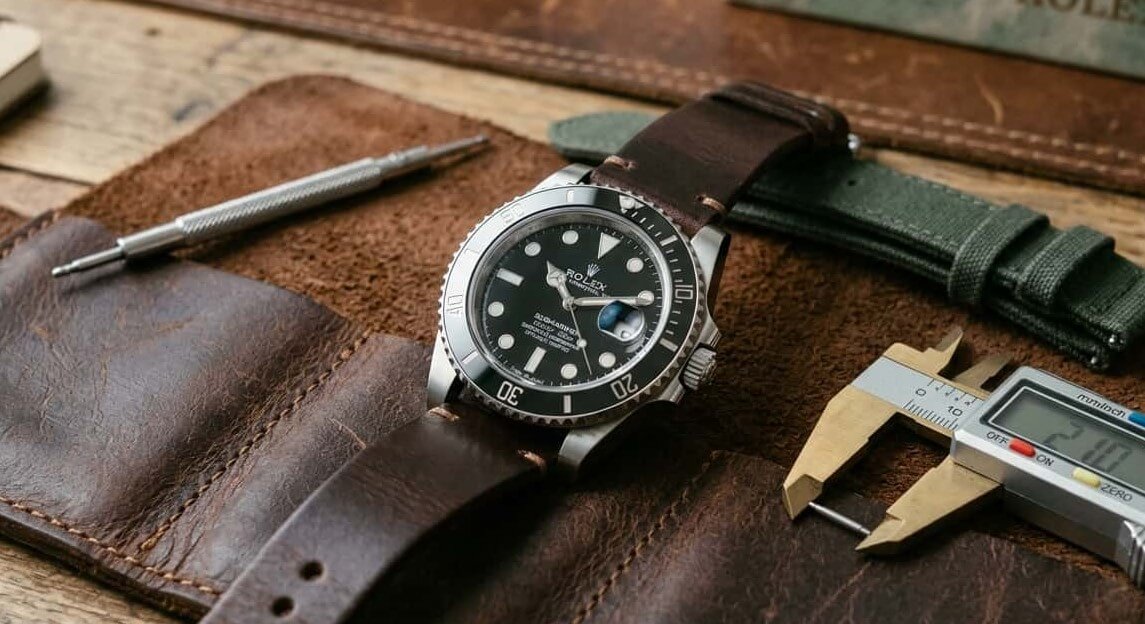
Measuring your Rolex Submariner’s lug width is the most reliable way to confirm your strap size and avoid buying the wrong strap. This simple process ensures you get the exact fit for your specific model.
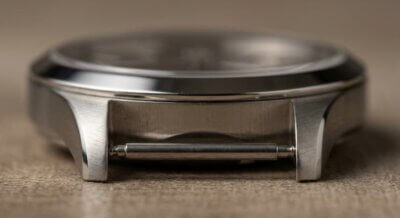
Lug width refers to the distance between the two protruding lugs on each side of the case, where the spring bars hold the strap or bracelet in place. Spring bars are the small metal pins that compress to secure the strap ends between the lugs.
Step-by-Step Measurement Guide
- Prepare a clean, flat workspace with good lighting. Have a precision ruler or caliper ready, marked in millimeters.
- Remove the existing bracelet or strap if possible, or carefully slide it aside to expose the full space between the lugs. This avoids bracelet interference, a common mistake that leads to inaccurate readings.
- Identify your lugs: Older models may have drilled lugs with small holes on the inside, making spring bar removal easier for access. Newer models often have solid lugs without holes, so use tools carefully to prevent scratches.
- Place the ruler or caliper flat across the open space between the lugs, from inner edge to inner edge where the spring bars sit. Ensure it sits level without angling.
- Read the measurement at lug level, not the case curve. Double-check twice—most Subs measure exactly 20mm for 40mm cases or 21mm for 41mm cases.
This measurement method keeps things straightforward for first-time swappers. When handling spring bars during removal, use a spring bar tool or bracelet tweezers for precision, and go slow to protect the case edges, especially on solid lugs.
Common Measurement Mistakes to Avoid
- Measuring over the bracelet or strap, which blocks the true lug gap and gives a false wider reading.
- Using a non-precision ruler that rounds to the nearest half-millimeter.
- Assuming size based on case diameter alone without checking drilled or solid lugs for access.
- Not measuring both sides, as rare manufacturing variances could occur.
- Rushing without double-checking, leading to ordering the wrong strap.
If you only do one thing, expose the bare lugs, measure flat across the gap, and verify twice—this quick check confirms your strap size before any purchase. Proceed carefully to avoid scratches, and consult a professional if unsure.
Rolex Submariner Band Size by Model
The Rolex Submariner lineup includes both no-date and date variants, which are simply versions without or with a date window at the 3 o’clock position. These variants share the same lug width sizing within their respective generations, making strap selection straightforward once you identify your model.
The key distinction lies in the older 40mm case models, which use a 20mm lug width, versus the newer 41mm case models from the 2020+ generation, which use a 21mm lug width. This shift aligns with the transition to 12xxxx reference numbers as a general heuristic, though always confirm your specific watch.
How to use this chart: Locate your reference number (often engraved between the lugs), note the case size, and match to the corresponding lug width for your strap size. This covers common models; it’s not exhaustive, so measure your lugs if unsure—stick to 20mm for older 40mm cases and 21mm for 2020+ 41mm cases.
| Case Size | Lug Width | Example References |
|---|---|---|
| 40mm | 20mm | 114060, 116610, 16610 |
| 41mm | 21mm | 124060, 126610LN |
This sizing applies as unisex guidance regardless of gender—fit depends on your wrist size and personal preference, ensuring the Submariner remains versatile for all wearers.
Best Strap Types for Your Rolex Submariner
Choosing the right strap for your Rolex Submariner can transform its look and feel, whether you’re dressing it up or taking it diving. All recommendations here come in both 20mm and 21mm widths to match your model’s lug width—check the sizing table earlier to confirm yours before purchasing.
Nylon Pull-Through Strap
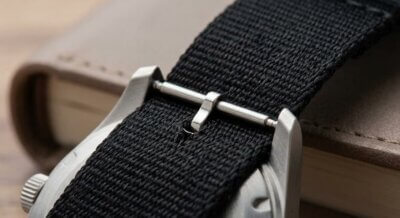
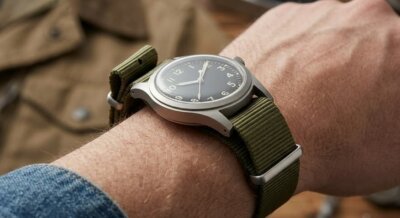
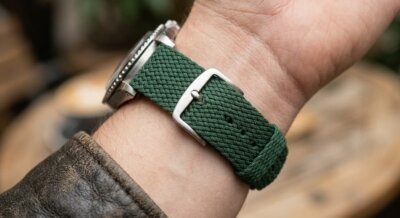
This versatile strap slides through a single pass between the lugs for a secure, slim fit. It’s highly durable for everyday wear and gained fame from James Bond in early films. For a modern twist, pair it with your Submariner for casual outings.
Rubber or Tropical Rubber
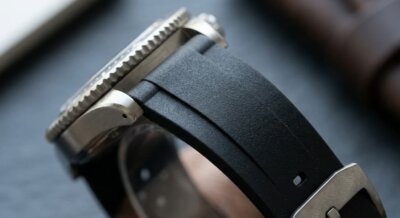
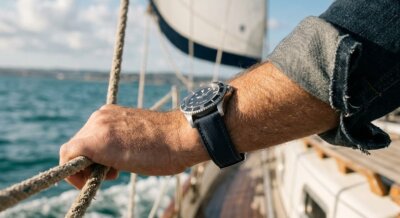
Ideal for water activities, rubber straps offer excellent water resistance and a sporty dive-ready profile. Tropical rubber adds a textured, vintage-inspired look perfect for diving adventures, staying flexible even after submersion.
Leather or Suede
These deliver a formal elegance, elevating your Submariner for suits or events. A smooth leather or soft suede example shines at dinners, but note the scratch-risk from case contact—handle with care during wear.
Sailcloth, Canvas, or Perlon
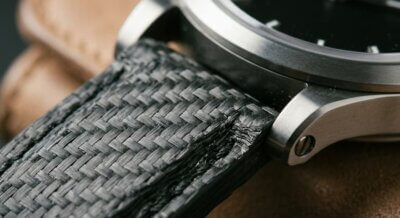
As casual alternatives, sailcloth provides a rugged texture, canvas offers breathability, and Perlon weaves lightweight comfort. They’re durable for daily use without the formality of leather.
Compared to the factory-default Oyster bracelet, which includes built-in scratch protection for robust wear, aftermarket straps prioritize style variety over metal solidity.
The table below compares key strap types by use case, comfort, water suitability, and tradeoffs to help narrow your choice.
| Strap Type | Best For | Comfort | Water Suitability | Key Tradeoffs | Scratch Risk |
|---|---|---|---|---|---|
| Nylon Pull-Through | Everyday versatile | High, breathable | Good, quick-dry | May shift slightly | Low |
| Rubber/Tropical | Diving/sport | Medium, grippy | Excellent | Less formal | Moderate |
| Leather/Suede | Formal events | High, soft | Poor | Needs care | Higher from case contact |
| Sailcloth/Canvas/Perlon | Casual daily | High, lightweight | Fair | Texture varies | Low |
Choose Your Strap: Simple Decision Tree
- If diving or water sports → Rubber or tropical rubber for secure, resistant fit.
- If formal occasions → Leather or suede for refined style.
- If versatile everyday wear → Nylon pull-through for durability and ease.
- If casual outings → Sailcloth, canvas, or Perlon for comfortable alternatives.
Quick Glossary:
- Lug width: Space between the case lugs where the strap attaches (20mm or 21mm for Submariner).
- Pull-through: Strap design passing through lugs once for slim profile.
- Oyster bracelet: Rolex’s metal default with links for adjustability and protection.
How to Change Your Rolex Submariner Strap Safely
Swapping your Rolex Submariner strap or bracelet is straightforward when you use the right tools and technique. The key is patience, quality equipment, and understanding whether your case has drilled or solid lugs. This section walks you through both methods and highlights common first-swap pitfalls to avoid.
Tools You’ll Need
- Spring bar tool: the primary removal and installation lever
- Bracelet tweezers: for careful manipulation without finger pressure on the case
- Quality version: invest in a solid spring bar tool and tweezers; the extra cost pays off in safety and precision
- Avoid cheap slip-prone tools: budget versions lack grip and can slip off spring bars, gouging the case
- Fabric shaver for wear: optional but helpful for cleaning old strap lint from the case before installing a new strap
Step-by-Step Strap Removal and Installation
The process differs slightly depending on whether your Submariner has drilled lugs (common in older models like the ref 16610 and ref 114060) or solid lugs (standard on modern cases). Follow the method that matches your watch.
For Drilled-Lug Cases (Older Models)
- Place your watch on a soft cloth or padded surface to protect the case back and bezel.
- Locate the spring bar holes at the top and bottom of each lug. Drilled lugs have visible holes through which the spring bar ends protrude slightly.
- Insert the flat end of your spring bar tool into the hole, angling it to compress the spring bar inward.
- As you compress the bar, gently pull the strap or bracelet away from the case with your other hand. The spring bar should slide free.
- Repeat on the opposite lug for that end, then move to the other side of the watch.
For Solid-Lug Cases (Modern Cases)
- Place your watch on a soft cloth or padded work surface.
- Hold the watch firmly but gently; do not press the case against hard surfaces during this process.
- Using your spring bar tool, insert the flat end between the lug and the strap at a slight angle, aiming for the spring bar end underneath.
- Apply light, steady pressure to compress the spring bar inward. Avoid sudden movements or excessive force, as these can slip and scratch the case.
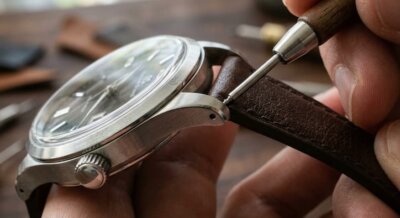
- Once you feel the spring bar compress, use bracelet tweezers to carefully pull the strap or bracelet away from the case. The tweezers give you fine control and keep your fingers away from the case surface.
- Repeat on the opposite side of the same lug, then move to the other side of the watch.
Protecting Your Case from Scratches
The most common damage during strap changes is accidental scratching of the case lugs or side walls. To minimize this risk, go slowly, support the strap during removal with tweezers rather than yanking with your fingers, and never rest your spring bar tool or tweezers on the polished case surfaces.
First-Swap Pitfalls to Avoid
- Ordering the wrong size strap: Confirm your lug width (20mm or 21mm) before purchasing. A strap that is too wide or too narrow will not fit safely or will shift during wear.
- Using cheap or damaged tools: A slipping spring bar tool or bent tweezers can gouge the case. Quality tools are worth the investment.
- Not accounting for your case type: Older models have drilled lugs; newer ones have solid lugs. Using the wrong technique for your case type can damage the lugs or spring bars.
- Ignoring water exposure with strap choice: Leather or suede on a dive watch risks damage during water activities, while rubber or tropical rubber handles submersion better. Match the strap type to your activities.
Tips for Perfect Fit and Durability
Achieving the right fit for your Rolex Submariner strap goes beyond simply matching the lug width. Strap thickness, wrist size, material choice, and care during installation all play a role in comfort, longevity, and protecting your watch case from scratches.
Strap Thickness and Case Clearance
Strap thickness is often overlooked but directly affects how well your strap sits between the lugs and interacts with the case. A thickness of around 1.2mm is a useful target for most Submariner straps, as it provides a snug fit without pinching or leaving excessive gaps that allow the strap to shift during wear.
When a strap is too thick—typically 1.5mm or more—it can create visible gaps at the lugs or, in worst cases, bind against the case shoulder and limit comfortable movement. When a strap is closer to 1.2mm, it nestles neatly between the lugs with minimal play and aligns smoothly with the case profile. Thinner straps (under 1mm) may feel loose and allow the strap to move side to side, which is particularly noticeable on metal bracelets but also affects rubber and leather options.
Before purchasing a replacement strap, check the product specifications for thickness. If not listed, contact the maker or seller—it is a straightforward specification and well worth confirming.
Wrist Sizing and Fit Examples
Rolex Submariner straps are designed for wrists in the range of 14 to 21 centimeters in circumference. Most comfort zones fall between 14.5 and 18 centimeters, though this varies by individual preference for snugness and strap material.
Here are three concrete examples based on different wrist sizes:
- Small wrist (14.5–15.5cm): A nylon pull-through strap or a single-pass leather strap works well, as both materials are thin and adjustable without excess bulk. You will typically position the strap in the tighter adjustment points and may find that rubber straps sit slightly loosely. Nylon pull-through designs allow you to overlap the strap to any desired length, making them ideal for smaller frames.
- Medium wrist (16–17.5cm): This is the most common fit range. All strap materials—nylon, rubber, leather, and canvas—feel balanced. Standard strap positioning and length recommendations align well, and you have flexibility to choose based on style and activity rather than accommodation concerns.
- Large wrist (18–21cm): Rubber and canvas straps tend to fit comfortably without feeling cramped. Leather straps may require careful adjustment positioning to avoid awkward wrapping. Nylon pull-through straps remain a versatile option due to their adjustability. Metal bracelets are generally the easiest choice for larger wrists.
Remember that strap comfort also depends on the material’s flexibility and how you prefer to wear your watch—snug for sports, looser for daily wear, or adjusted for different seasons or clothing layers.
Scratch Prevention and Case Care
The Oyster case on your Submariner is durable, but it is not immune to scratches. Straps can interact with the case in three main ways during strap changes and daily wear:
- During installation, the strap material can drag across the case flank if the spring bar tool is not controlled carefully.
- At the lug shoulders, where the strap edge meets the case, friction from daily flexing can create fine scratches over time, especially with stiffer materials like leather and canvas.
To minimize risk, use a spring bar tool with a smooth, beveled tip (not sharp or jagged), and support the case with one hand while inserting or removing the strap. For daily wear, softer materials like nylon and thin rubber straps reduce lug-shoulder friction compared to thick leather or stiff canvas. If you prefer leather or canvas for formal occasions, rotating between straps reduces cumulative wear on any single attachment point.
Curved Spring Bars for Vintage Leather
If you are planning to use a vintage leather strap or a curved strap designed for older Submariner cases, consider curved spring bars instead of the standard straight bars. Curved bars follow the natural arc of drilled lugs on older models and can provide a slightly more secure seat and easier installation. They are particularly useful if your leather strap has a curved attachment profile that does not align flush with standard straight bars. However, curved bars are situational—modern solid-lug cases and most contemporary aftermarket straps work best with standard straight spring bars. Confirm compatibility with your strap maker before ordering.
Visual Strap Thickness Guide
To quickly assess whether a strap thickness is appropriate, imagine the space between the two lugs on your Submariner. Ideally, your strap should occupy about 80 to 90 percent of that gap when inserted, leaving just a whisper of space visible from the side. If the strap sits loosely with obvious daylight showing, it is likely under 1mm. If the strap binds, strains the lugs, or creates visible bulging at the lug shoulders, it exceeds 1.4mm. A strap at 1.2mm will feel stable, sit flush, and allow you to fasten and unfasten it without excessive force—a good sign of correct thickness.
Testing Before Committing
If possible, try a strap on your watch in person or order from a seller with a return policy. Wrist circumference, skin sensitivity, and personal comfort preferences vary widely. A strap that feels perfect for one person may feel too tight or too loose for another, even with the same case size. Measure your wrist in centimeters and test the strap at different adjustment positions before deciding it is the right fit.
Common Mistakes and FAQs
Even experienced collectors make errors when swapping Rolex Submariner straps. Here are the most frequent pitfalls to avoid, focusing on size mismatches and water exposure.
Common Mistakes
- Buying the wrong lug width: A 20mm strap on a 41mm case (or 21mm on a 40mm case) leads to loose fitment, gaps between the lugs, and straps that slide side-to-side. Always measure your lug width or check the model chart to confirm.
- Confusing reference numbers: Reference 116610 (40mm/20mm) is easily confused with 126610LN (41mm/21mm). Always verify your exact reference number against a sizing guide to ensure compatibility.
- Assuming all Submariners share one size: The 2020+ shift to 41mm cases with 21mm lug width confuses many, especially when mixing older and newer references.
Frequently Asked Questions
What size strap for Rolex Submariner?
Rolex Submariner strap size depends on the case: 20mm lug width for older 40mm models like ref 114060 or 116610, and 21mm for newer 41mm models like ref 126610LN or 124060. Measure your lug width to confirm.
20mm or 21mm for my Submariner?
Choose 20mm for 40mm cases (older refs like 16610 or 116610) and 21mm for 41mm cases (2020+ refs like 126610LN). Ref 116610 is 20mm (40mm), not 21mm like the successor 126610LN. Measure to avoid fit issues.
How to measure lug width?
Use a digital caliper across the inside of the lugs where spring bars sit—expect 20mm on 40mm cases or 21mm on 41mm cases. This confirms your lug width precisely; refer to the model chart for quick reference.
Best straps for 40mm vs 41mm?
For 40mm models (20mm lug width), nylon pull-through or rubber work well. For 41mm models (21mm lug width), match with tropical rubber for dive use or nylon for versatility. Always measure first to confirm your model’s width.
Does Rolex case scratch straps?
Case edges can rub softer straps like leather during wear, especially if thick. Opt for approximately 1.2mm strap thickness on your case to minimize contact; durable options like rubber or nylon pull-through resist better.
How to change Submariner strap without damage?
Compress spring bars carefully with quality tools on drilled lugs (older models) or solid lugs (newer models), watching case clearance. Follow the safe removal steps in this guide to protect your watch.