What is FKM Rubber? (Definition & Origins)
FKM rubber, short for fluoroelastomer, is a type of high-performance synthetic rubber engineered to resist extreme conditions. Unlike natural rubber or silicone, FKM is defined by its fluorine-based molecular structure, which gives it exceptional resistance to heat, chemicals, oils, UV rays, and environmental degradation. When you hear “FKM” in watch strap discussions, you are talking about a material originally developed for aerospace, automotive, and industrial applications where durability and reliability cannot fail.
What Makes FKM Different: The Fluorine Advantage
The term “fluoroelastomer” tells you what makes this material special. “Fluoro” refers to fluorine, a highly reactive element bonded into the rubber’s molecular chain. This fluorine bonding creates a dense, stable structure that resists breakdown when exposed to oils, solvents, extreme heat, and ultraviolet light. In practical terms, this means an FKM watch strap will not become sticky, degrade, or lose color as quickly as natural rubber or standard silicone under harsh conditions.
FKM also has naturally higher density than silicone, which translates to a firmer, more structured feel initially. This engineered density is intentional: it provides shape retention and durability over years of wear, though it does mean a brief adjustment period before the material softens and molds to your wrist. This is covered in detail in the comfort section, but knowing the “why” now helps explain what you will experience.
From Industrial Applications to Your Wrist
FKM rubber earned its reputation in demanding environments. Aerospace engineers specified it for seals and gaskets that must withstand fuel exposure, temperature swings from freezing altitudes to engine heat, and years of stress cycling. Divers and water-sports professionals adopted FKM for the same reason: it resists saltwater corrosion, maintains flexibility in cold ocean conditions, and does not absorb moisture the way softer materials do. Industrial mechanics and military equipment users rely on it to resist oils, hydraulic fluids, and cleaning solvents that would degrade or soften lesser rubbers.
Watch manufacturers recognized these same properties translate perfectly to wrist wear. A watch strap faces sunscreen, sweat, insect repellent, accidental contact with oils and lotions, and years of UV exposure. FKM’s chemical resistance and aging stability—proven in aerospace and nautical contexts—make it an ideal choice for straps that need to stay comfortable, maintain their appearance, and resist odor buildup through extended daily wear.
Manufacturing and Material Structure
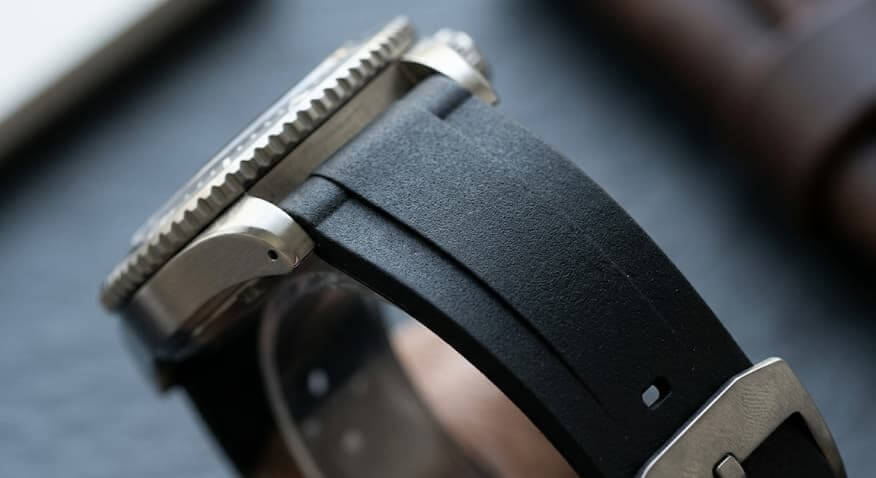
FKM rubber is typically vulcanized (chemically cross-linked) and molded during manufacturing, a process that locks in its durability and shape-holding properties. This molding creates a stable, non-porous surface texture that contributes to its resistance to staining and dust accumulation compared to materials with open-weave or porous surfaces.
What FKM Is and What It Isn’t
- FKM is a synthetic rubber, not a natural material. It is engineered for consistent performance and durability across manufacturing batches.
- FKM is not silicone. While both are synthetic, silicone is softer, more flexible immediately, and less resistant to long-term chemical exposure and UV degradation.
- FKM is not natural rubber. Natural rubber offers comfort but lacks chemical resistance and can become brittle, sticky, or discolored with age and sun exposure.
- FKM is industrial-grade in heritage and performance, but it is designed to be skin-friendly and comfortable for all-day wear once broken in.
How Does FKM Feel on Your Wrist?
FKM rubber feels noticeably firmer and more structured than silicone when you first put it on, but this is by design—not a drawback. The material’s engineered density creates a secure, supportive sensation that many users report feels premium and stable, especially during active use. Understanding this initial feel and how it evolves is key to appreciating why FKM watch straps are favored for both everyday wear and demanding conditions.
Initial Tactile Experience: Firm Yet Comfortable
When you first strap an FKM watch band onto your wrist, you will notice it feels denser and less pliable than silicone. This firmness is not rigidity—the strap bends and flexes normally—but rather a controlled, resilient structure that holds its shape. The material is soft to the touch; it simply does not collapse or conform immediately. Many users describe this as feeling solid and secure, almost like a natural extension of the wrist rather than a loose accessory.
This engineered density serves a practical purpose: it distributes pressure evenly across the contact points on your wrist, reducing hot spots and pressure concentration that can occur with softer materials. Over time, as you wear the strap daily, the material gradually softens and molds gently to your individual wrist contours, creating a custom fit without stretching out of shape.
Comfort Evolution: The Break-In Period
FKM watch straps improve in comfort over their first 2 to 4 weeks of wear. Here is what to expect:
- Week 1: The strap feels firm and structured. It may feel slightly less immediately plush than silicone, but most users find it reassuringly secure. Any mild pressure sensation typically comes from the newness rather than discomfort.
- Weeks 2–4: The material begins to soften slightly and conform to the shape of your wrist. Pressure distribution improves, and the strap starts to feel less formal and more integrated into your daily routine.
- Month 2 and beyond: The strap reaches its optimal comfort balance—still supportive and shaped to your wrist, but noticeably softer and more accommodating than in week one. This is when most users report the best all-day wearability.
Secure Fit and Pressure Distribution
One of FKM’s key comfort advantages is how it handles pressure across the wrist. Unlike softer materials that can bunch, shift, or create isolated pressure points, FKM distributes the strap’s weight and tension more evenly. This means fewer “hot spots” where the strap digs in, making it more comfortable during extended wear, workouts, and activities where you need the watch to stay stable.
The secure fit sensation means the strap does not slide or rotate on your wrist during movement or vigorous activity. This stability is especially valuable if you wear your watch during sports, hiking, or fieldwork—situations where a loose strap can be distracting or even unsafe.
Sweat and Moisture Handling
FKM does not feel clammy or sticky when you sweat, unlike silicone, which can trap moisture and develop a tacky surface. FKM’s quick-drying feel means the strap stays comfortable even during intense exercise or in humid conditions. The material does not absorb sweat the way silicone can, so you avoid that wet-rubber sensation that many users find unpleasant. This is particularly important if you wear your watch during gym sessions, swimming, or in tropical climates.
Skin Sensitivity and Reactivity
FKM is typically non-reactive for most skin types and does not contain the proteins found in natural rubber that can trigger latex sensitivity. It is generally well-tolerated by people with sensitive skin, though individual reactions vary. Unlike some cheaper rubbers or older silicone formulations, FKM does not typically cause irritation, rashes, or staining even with prolonged contact.
The material is also hypoallergenic in practical terms, making it a safer choice than natural rubber if you have known latex sensitivity. If you have previously experienced skin reactions to rubber or silicone straps, FKM is worth trying, though it is always wise to patch-test new materials if you have severe sensitivities.
Dust and Lint Resistance
FKM’s anti-static properties mean it attracts far less dust and lint compared to silicone, which can become visibly fuzzy over time. This keeps your strap looking cleaner and reduces the need for frequent cleaning. The smooth, matte finish of FKM also resists the visible dust accumulation that can make silicone straps look dingy.
Comfort Comparison: FKM vs. Silicone at a Glance
The table below contrasts the tactile and comfort experience of FKM and silicone across key wear scenarios:
| Experience | FKM Rubber | Silicone |
|---|---|---|
| Day 1 Feel | Firm, structured, secure sensation. Feels premium and stable. | Soft and pliable immediately. Feels comfortable right away. |
| Sweat Exposure | Quick-drying, non-sticky feel. Stays comfortable in humid conditions. | Can feel clammy or sticky. Absorbs moisture and may trap sweat. |
| Long-Wear Comfort (After 4+ Weeks) | Molds to wrist while maintaining shape. Increasingly custom-fitted feel. | Remains soft but may stretch over time. Can develop loose or droopy feel. |
| Dust and Lint Attraction | Minimal. Resists visible dust accumulation. | High. Often appears fuzzy or dingy after weeks of wear. |
| Buckle Hole Integrity Over Time | Holes remain uniform and tight after years; clasp grip stays secure. | Holes stretch and enlarge within 12–18 months; clasp becomes loose or unreliable. |
| Aging on Skin | Stays smooth and clean-feeling. No odor buildup or stickiness. | May become tacky, sticky, or develop mild odor over months. |
| Pressure Distribution | Even, minimal hot spots. Comfortable for active use and all-day wear. | Can create localized pressure points; may bunch or shift. |
A Real-World Example: Week 1 vs. Week 8
On day one, an FKM strap feels noticeably firmer than silicone, with slight pressure along your wrist. By week eight, the strap has molded to your wrist contours, feels secure but also integrated like a second skin, and remains clean-looking with no lint accumulation—a contrast to silicone straps, which often show visible lint pickup, stretching around the buckle holes, and early signs of discoloration or stickiness by month two.
Break-In Expectations Checklist
Here is what to realistically expect as your FKM watch strap settles in:
- Strap will feel firm at first. This is normal and intentional, not a sign of defect.
- Firmness will gradually soften over 2 to 4 weeks of regular wear.
- The strap will mold gently to your wrist shape without stretching out permanently.
- Comfort improves noticeably by week 4 and continues to improve through week 8.
- Most users do not experience break-in discomfort. If the strap causes persistent pain or marks, the fit size may need adjustment.
- Sweat feel remains non-sticky and clean throughout break-in and beyond.
- Pressure sensation decreases as the strap conforms, rather than increasing over time.
The break-in period is not a limitation—it is a feature. Unlike silicone that can feel good initially but deteriorates and becomes sticky months later, FKM’s break-in transforms the strap into an increasingly custom-fitted accessory that only improves with time.
Superior Durability & Chemical Resistance
While FKM rubber costs more upfront than silicone, much of that premium reflects its ability to resist the everyday wear, sun exposure, and chemical contact that degrade cheaper materials. Understanding these durability advantages explains why FKM watch straps often outlast silicone by years and maintain their appearance far longer.
Mechanical Durability & Wear Resistance
FKM rubber is engineered to withstand repeated flexing, stretching, and contact stress without tearing, cracking, or developing permanent deformation. This matters because watch straps experience constant micro-movements: your wrist bending throughout the day, the strap sliding on and off, and the buckle or clasp putting localized pressure on specific zones.
The dense, supple structure of FKM means these repetitive stresses don’t accumulate into visible damage the way they do with softer materials. After six months to a year of daily wear, a quality FKM strap typically shows minimal visible creasing, no stress cracks at the buckle attachment, and buckle holes that remain tight and uniform. Silicone, by contrast, often begins to show stretched, enlarged holes and a general loss of structural integrity around stress points within 12–18 months of regular use.
This superior wear resistance is a direct result of FKM’s molecular structure: the fluorine-rich polymer chains bond more tightly, distributing stress more evenly rather than concentrating it in weak zones. For users who wear their watch daily and care about long-term appearance, this resistance to visible wear is noticeable and valuable.
UV & Aging Resistance
Sun exposure is one of the primary enemies of synthetic rubber straps. UV radiation breaks down polymer chains, leading to discoloration, brittleness, and a dull or chalky appearance. FKM rubber resists this degradation significantly better than silicone or natural rubber, thanks to its fluorine content and engineered stability.
In practical terms, a black or dark-colored FKM strap worn outdoors regularly will retain its rich color and matte finish for several years. A comparable silicone strap in the same conditions may begin to show noticeable fading, yellowing, or a dull, washed-out tone within 12–24 months. This isn’t purely cosmetic: as silicone ages under UV, it also becomes slightly more brittle and less flexible, reducing comfort.
FKM’s resistance also means that colored or patterned FKM straps fade more slowly, making them a better choice if you value visual consistency over time. For watches worn frequently in bright sunlight—such as diving watches, sports watches, or daily-wear pieces used during outdoor activities—FKM’s UV stability translates to a noticeably fresher appearance year after year.
Chemical Resistance & Real-World Exposures
Watch straps contact more chemicals than most people realize. Sunscreen, insect repellent, skin oils, sweat, perfumes, lotions, solvents in hand sanitizers, and even household cleaners can come into contact with your strap. How a material responds to these exposures determines whether it remains comfortable and visually intact or becomes sticky, discolored, and degraded.
FKM rubber is highly resistant to oils, fats, greases, and many common solvents—a heritage from its aerospace and automotive origins, where it must survive exposure to hydraulic fluids, fuels, and industrial chemicals. This resistance means that even prolonged contact with sunscreen, lotion, or skin oils doesn’t cause the strap to become tacky, sticky, or discolored. A diver wearing an FKM strap and applying generous sunscreen before a beach day will notice the strap remains comfortable and dry to the touch, whereas silicone in the same scenario can develop a slightly greasy, clammy feel and may show spotty discoloration over time.
Insect repellent is another common culprit. Products containing DEET (a standard insect repellent) can break down silicone, causing it to become softer, stickier, and more prone to discoloration. FKM resists DEET exposure, maintaining its structural integrity and matte finish. For outdoor enthusiasts—hikers, campers, fishermen—who frequently apply insect repellent, this difference becomes noticeable after several months of use.
Sweat is ubiquitous for active users, and while both FKM and silicone are waterproof, how they handle prolonged sweat contact differs. FKM’s low moisture absorption and quick-drying properties mean sweat doesn’t degrade the material or create a breeding ground for odor-causing bacteria. Silicone, being more porous, absorbs sweat residue, which can lead to discoloration and a subtle stale-sweat odor that’s difficult to eliminate even with cleaning.
Anti-Static & Dust/Lint Resistance
FKM rubber has a naturally lower static electrical charge than silicone. In plain terms, this means an FKM strap attracts dust, lint, and fine debris less aggressively than silicone. Over weeks and months, this difference becomes visually apparent: an FKM strap maintains a cleaner appearance with less embedded lint, while a silicone strap may show a fuzzy coating of trapped particles, especially along edges and in textured zones.
This isn’t a revolutionary benefit, but it does reduce the frequency of cleaning needed to keep your strap looking sharp, and it contributes to FKM’s overall durability narrative: a material that stays cleaner-looking and requires less fussy maintenance is a material that ages better visually.
Visual Durability & Aging Over Time
The cumulative effect of FKM’s mechanical durability, UV resistance, chemical resistance, and anti-static properties is a strap that looks fresher and more premium after extended wear. Specific aging patterns are explored in the comparison below.
After approximately one year of daily wear in varied conditions—outdoor use, occasional water exposure, sunscreen, and general activity—a quality FKM strap typically retains its original matte finish, shows minimal color fading, has no visible stress cracks or enlarged buckle holes, and feels almost identical in structure to when new. The strap may show subtle signs of wear in high-flex zones, but these are usually only visible upon close inspection.
In the same timeframe, a silicone strap used identically may show noticeable stretching around the buckle holes, some fading of color (especially if black or dark), potential discoloration patches from sunscreen or sweat, a slight loss of that initial softness (as the material hardens from UV exposure), and accumulated lint trapped in its texture. The strap feels less “new” and may begin to show the early stages of the tackiness or stickiness that silicone develops as it degrades.
After two years, these differences become more pronounced. An FKM strap may show subtle patina or minor scuffs but retains structural integrity, color, and a premium tactile feel. A silicone strap is often noticeably stretched, discolored, possibly tacky to the touch, and beginning to feel brittle or less supple—signs that it may need replacement sooner rather than later.
Durability Comparison Across Materials
The following table compares FKM against the most common alternatives for watch straps:
| Feature | FKM Rubber | Silicone | Natural Rubber |
|---|---|---|---|
| Cracking & Stress Cracks | Highly resistant; maintains structure under repeated flexing | Prone to small cracks at stress points (buckle, holes) after 12–18 months | Susceptible; cracks form relatively quickly in sun and dry conditions |
| UV & Aging Resistance | Excellent; retains color and matte finish for 3+ years of outdoor use | Moderate; noticeable fading and dullness within 12–24 months in bright sun | Poor; degrades quickly; becomes brittle and discolored within months of regular sun exposure |
| Chemical & Oil Resistance | Superior; resists sunscreen, insect repellent, skin oils, sweat, and solvents | Moderate; can become tacky, stained, or softened by oils, sunscreen, and DEET | Poor; degrades rapidly when exposed to oils, solvents, or sunscreen |
| Stretched Buckle Holes | Minimal stretching; holes remain uniform after years | Noticeable stretching within 12–18 months; holes enlarge and weaken clasp fit | Rapid stretching; holes enlarge quickly, compromising strap security |
| Stickiness Over Time | Maintains dry, matte feel throughout lifespan | Can develop sticky or clammy texture as material breaks down | Becomes sticky and degraded; unpleasant to wear |
| Dust & Lint Attraction | Resists static charge; stays relatively clean-looking | Attracts lint and dust; visible fuzzy coating after weeks of wear | Attracts and retains debris; ages poorly visually |
| Color & Finish Retention | Retains original color and matte finish for 3–5 years of typical daily wear | Noticeable fading, yellowing, or dulling within 12–24 months | Poor color retention; fades and becomes dull within months |
| Typical Lifespan (Daily Wear) | Typically 3–5 years (usage-dependent) | Typically 1–2 years (varies by conditions) | Often 6–12 months |
Lifespan depends on care, climate, activity level, and chemical exposure. These are general expectations, not guarantees.
What Happens to Silicone After Two Years
To illustrate the real-world durability difference, consider a typical progression for a silicone watch strap worn daily in varied conditions:
- Months 1–6: The strap feels soft and comfortable, but lint begins to accumulate visibly along edges. If exposed to sunscreen or insect repellent, slight discoloration patches may appear.
- Months 6–12: Buckle holes noticeably enlarge. The strap’s overall thickness and suppleness decrease slightly (from UV hardening). If black or dark-colored, fading becomes obvious. The strap may develop a subtle stale odor from trapped sweat residue that doesn’t fully wash out.
- Months 12–24: Stretching around the buckle is pronounced; the clasp fit becomes loose. The strap may feel slightly tacky or clammy to the touch, especially in warm conditions or after sweating. Color is noticeably faded. Accumulated lint gives it a dingy appearance despite cleaning attempts. Many users choose to replace the strap at this stage.
By contrast, an FKM strap in the same conditions typically shows minimal change through the first two years and remains comfortable and visually fresh well into year three or beyond.
Why FKM’s Durability Matters in Practice
The durability advantage of FKM translates directly to lower replacement frequency and better long-term value. A user who purchases an FKM strap for $60–$80 and wears it for 4–5 years before needing replacement pays roughly $12–$20 per year. A user buying a silicone strap for $25–$30 every 1–2 years pays $12–$30 per year. Over a five-year span, the lifetime cost can be comparable or even favor FKM, while the ownership experience—a strap that remains comfortable, looks fresh, and handles daily life without degradation—is notably superior.
For serious watch enthusiasts, divers, outdoor professionals, and anyone who wears their watch through varied conditions, this durability foundation makes FKM the practical choice.
Temperature & Water Resistance
FKM rubber is often chosen for active and outdoor watch use because it stays stable across a wide range of temperatures and remains comfortable and reliable in wet, sweaty, or humid conditions.
In everyday terms, that means an FKM watch strap is designed to feel predictable when you move from an air-conditioned office to a hot car, from a winter sidewalk to a heated gym, or from dry land into the pool.
Heat resistance in real life
One of the most useful traits of FKM rubber is how well it holds its shape and firmness in the heat.
- In a parked car on a hot day, an FKM watch strap is less likely to go floppy or overly soft, so the watch does not start sliding around on your wrist.
- In direct summer sun, the material is designed to keep its structure rather than sagging or stretching.
- During high-activity situations, like a long run or intense gym session, it stays supportive instead of feeling gummy.
This stable feel in heat is part of why FKM rubber is widely used in demanding environments where seals and gaskets must keep performing under high temperatures.
Cold resistance for winter wear
FKM rubber also keeps its flexibility in the cold better than many everyday strap materials.
- On a winter morning walk, it is less prone to getting stiff or plasticky on your wrist.
- Skiing, snowboarding, or simply shovelling snow, the strap is designed to bend with your wrist instead of feeling like a rigid ring.
- That flexibility helps the watch stay comfortably in place instead of digging into the skin when layers of clothing press against it.
Compared with some cheaper rubbers that can become hard and brittle in the cold, an FKM watch strap is engineered to remain usable and comfortable in low temperatures.
Temperature & resistance properties at a glance
The following table gives a simple overview of how an FKM watch strap typically performs across key environmental factors, using qualitative descriptions rather than hard numbers.
| Property | FKM rubber performance |
|---|---|
| Heat resistance | Designed to stay stable and supportive in high ambient heat, strong sun, and warm indoor environments without excessive softening. |
| Cold resistance | Maintains useful flexibility in freezing conditions, with less tendency to turn rigid or brittle on the wrist. |
| UV stability | Resists damage and surface breakdown from regular sunlight exposure, helping the strap keep its feel and appearance over time. |
| Chemical exposure | Engineered to tolerate contact with oils, sweat, and everyday chemicals better than many basic rubbers, reducing the risk of swelling or surface damage. |
Waterproof use: fresh and salt water
FKM rubber is inherently suitable for full water exposure in normal watch-strap use.
- You can wear an FKM watch strap in the pool, ocean, shower, or bath without worrying about the material absorbing water.
- The strap itself does not change your watch’s water resistance rating; it simply holds up well to being wet.
- Because the material does not soak up water, it feels lighter and more predictable on the wrist after you come out of the water.
Both fresh and salt water are within the intended use range for an FKM watch strap.
- In fresh water (pools, lakes, rivers), the strap typically rinses clean and dries quickly.
- In salt water (ocean swimming, diving, sailing), it is good practice to give the strap a brief rinse in fresh water afterward to remove salt crystals and keep the surface feeling smooth.
This simple rinse step is usually enough to maintain a pleasant feel and appearance without turning strap care into a chore.
Quick-drying feel vs trapped moisture
Because FKM rubber does not absorb water or sweat, it can offer a quick-drying feel after wet use.
- After a swim or shower, droplets tend to sit on the surface and then evaporate or wipe off easily.
- Once surface moisture is gone, the strap usually feels dry against the skin rather than damp for a long time.
- This contributes to less of that “clammy” sensation some people experience with softer, more absorbent materials.
In contrast, silicone can feel very soft at first touch but often traps a thin film of moisture between the strap and the skin because it hugs the wrist more loosely and can cling to sweat.
- That trapped layer of moisture can make silicone feel slick and sticky during and after activity.
- It may also encourage more frequent odor buildup if not cleaned regularly.
FKM rubber is not a magic solution, but its denser, less absorbent surface tends to shed water faster and feel drier between the strap and skin.
Sweat handling during activity
In sweaty situations like workouts, summer commuting, or outdoor sports, FKM rubber is designed to handle moisture in a predictable way.
- Sweat mainly stays on the surface rather than soaking into the material.
- A quick rinse under a tap or a wipe with a towel usually removes most residue.
- The strap keeps its shape and does not rely on stretching to stay on the wrist, which helps it feel consistent from one session to the next.
Silicone, by comparison, often feels softer from day one but can become slippery against sweaty skin, which may lead to more micro-adjusting and repositioning of the watch during a long workout.
Why FKM tends to resist odor
FKM’s impervious surface means sweat and oils sit on top rather than soaking in. Because the material dries quickly, it does not retain moisture where odor-causing bacteria typically thrive. Many users report less odor buildup compared to other materials, though regular rinsing after sweaty activity is still recommended.
FKM in wet conditions: diver and swimmer example
To understand how this plays out in the real world, it helps to picture a simple pool or open-water scenario.
Imagine a swimmer starting the day with a silicone strap.
- Before getting in the water, the strap feels very soft and flexible.
- During the swim, water and sweat mix under the strap, and the smooth silicone can slide around slightly on the wrist.
- After leaving the pool, a thin film of moisture lingers between the silicone and the skin, which can feel clammy until it finally evaporates.
Now picture the same swimmer with an FKM watch strap.
- Before the swim, the strap feels more structured but secure on the wrist.
- In the water, the denser material stays put and does not swell or loosen, so the watch sits where you expect it.
- When the session ends, most water beads on the surface and can be shaken or patted off, leading to a quicker return to a dry, stable feel.
For divers, this predictable behavior in and out of the water is one reason FKM rubber is popular for dive-style straps: the material holds up under repeated wet and dry cycles without becoming saggy or overly sticky.
Temperature extremes: winter alpine cold vs desert heat
FKM rubber is also well-suited for people who move between very different climates or spend time in temperature extremes.
Consider winter alpine conditions.
- On a cold mountain morning, a strap made from a basic rubber might stiffen, making it harder to buckle over gloves or under cuffs.
- An FKM watch strap is designed to stay more flexible, so it wraps around insulated clothing more easily and stays comfortable on bare skin when you remove layers.
Now consider desert-style heat.
- Under strong sun and high ambient temperatures, some materials can soften so much that the watch starts sliding or twisting on the wrist.
- FKM rubber aims to maintain its supportive feel, so the strap stays consistent even when the environment is hot and dry.
This combination of cold flexibility and heat stability makes FKM a practical choice for travel, outdoor work, and sports that take place across different seasons and climates.
FKM vs. Silicone: The Key Differences
Silicone watch straps are comfortable, affordable, and instantly familiar. FKM rubber straps cost more upfront and feel firmer at first. Yet over weeks and months, the comparison shifts dramatically. Understanding the real trade-offs—not marketing claims—helps you choose the strap that matches your actual use and values.
Durability and Long-Term Shape Retention
FKM rubber’s mechanical strength is its signature advantage. The material resists tears, punctures, and the slow degradation that affects silicone over time. FKM maintains its original shape and buckle integrity for years, even under daily wear and active use.
Silicone, by contrast, gradually loses structure. The small holes where the buckle prong passes through can stretch and enlarge over 12–24 months. The strap itself may begin to stretch around the circumference, requiring tighter adjustments. This isn’t a defect in silicone—it’s the material’s nature. Silicone is inherently more elastic, which feels great initially but becomes a liability as years pass.
For someone who wears the same strap daily for 2+ years, FKM typically outlasts silicone by a significant margin.
The Comfort Evolution: Day 1 vs. Month 2
This is where the most important myth about FKM needs reframing.
Silicone feels softer and more comfortable on day 1. It drapes easily, has minimal break-in resistance, and many people love the tactile sensation immediately. FKM, by contrast, feels noticeably firmer and denser when new. Some users notice this density and worry they’ve made the wrong choice.
What happens next changes the equation. Over 2–4 weeks, FKM molds to your wrist’s contours. The material doesn’t become soft—it becomes custom-fitted. Users consistently report that after the break-in period, FKM feels more secure and supportive than the day they put it on. The firmness transforms into structure.
Silicone, meanwhile, often becomes less comfortable over time. As it stretches and loses elasticity, it can feel loose or, conversely, tacky and sticky against skin. The initial softness trades off against long-term comfort stability.
Moisture, Sweat, and the Quick-Drying Advantage
Both materials are waterproof in the sense that water passes through them without damaging the strap. The practical difference lies in how they handle moisture over hours.
Silicone absorbs and traps sweat and moisture within its structure. After a swim or an intense workout, a silicone strap stays wet and clammy for extended periods. This trapped moisture can create odor, irritation, or residue buildup over weeks.
FKM rubber resists moisture absorption. Sweat and water bead up and dry quickly, leaving the strap feeling dry to the touch within minutes. This property makes FKM the clear choice for swimmers, divers, gym users, and anyone in humid climates.
Chemical Resistance and Visible Degradation
Daily contact with oils, sunscreen, insect repellent, lotions, and solvents (in professional or industrial settings) degrades silicone noticeably. These substances can cause discoloration, stickiness, or a tacky film on silicone straps. Over 12–18 months of regular sunscreen exposure, a white or light-colored silicone strap may yellow or darken.
FKM resists these chemical insults. A user who applies sunscreen daily or works around oils and fuels will notice far less discoloration or surface degradation on an FKM strap. The material holds its color and matte finish much longer.
Dust, Lint, and Static Attraction
Silicone’s slightly tacky surface tends to attract dust and lint, especially in dry environments. Lint clings visibly to silicone straps, requiring frequent cleaning to maintain appearance.
FKM’s engineered density and lower surface tack mean it attracts less dust and lint. This isn’t a dramatic difference, but over weeks of wear, FKM straps typically look cleaner with less maintenance.
Comparison Table: FKM vs. Silicone
The following table summarizes the practical differences across the most important criteria for daily wear:
| Feature | FKM Rubber | Silicone |
|---|---|---|
| Initial feel (day 1) | Firmer, structured, slightly stiff | Soft, supple, immediately comfortable |
| Comfort after 4–8 weeks | Molds to wrist; feels secure and supportive | May feel looser; can become tacky or sticky |
| Shape retention after 1 year | Maintains original fit; buckle holes stay tight | Stretches gradually; buckle holes enlarge |
| Moisture after swimming | Quick-drying; minimal clammy feel | Traps moisture; remains wet and clammy for hours |
| Sweat handling during exercise | Resists odor buildup; feels dry quickly | Absorbs sweat; may cause odor or skin irritation |
| Chemical exposure (sunscreen, oils) | Resists discoloration; maintains color | May yellow, darken, or become sticky |
| Dust and lint attraction | Minimal; stays visibly cleaner | Attracts lint easily; requires frequent cleaning |
| Expected lifespan with daily wear | 3–5+ years before noticeable wear | 1–2 years before stretching and degradation |
| Upfront cost | Higher (typically $50–80 per strap) | Lower (typically $20–35 per strap) |
| Best suited for | Active use, water sports, daily wear, professionals | Casual wear, budget-conscious buyers, frequent changes |
Understanding the Break-In Period
The 2–4 week break-in for FKM is not a defect; it is an engineered feature. FKM rubber is manufactured with a specific density that provides durability, chemical resistance, and long-term shape memory. This density means the material is less yielding than silicone on day 1.
Over the first two to four weeks, the material gradually molds to your wrist’s specific contours. The buckle adjustment holes may feel slightly tighter at first, but this security is what prevents the stretch-and-slip problem common in silicone straps.
By week 4, most FKM users report that the strap feels custom-fitted—more comfortable than it did on day 1. This comfort trajectory is opposite to silicone’s, which often plateaus or declines as months pass.
Myth vs. Reality
Several myths complicate the FKM vs. silicone decision. Here are the most common ones:
- Myth: FKM is uncomfortable because it’s firmer. Reality: FKM’s firmness is engineered density, not poor design. After a 2–4 week break-in, most users find FKM more supportive and secure than silicone, especially for active use or longer wear periods.
- Myth: Silicone is always the softer, more comfortable choice. Reality: Silicone feels softer initially, but this advantage fades. Over months, silicone can become loose, sticky, or tacky, actually reducing comfort compared to FKM’s stable, molded fit.
- Myth: FKM never needs maintenance. Reality: FKM resists chemical attack and odor better than silicone, but it still benefits from occasional rinsing with soap and water, especially after sweaty workouts or sunscreen exposure.
- Myth: All rubber watch straps are the same. Reality: FKM is a specialized aerospace-grade material with distinct chemical and temperature properties. It is fundamentally different from natural rubber or generic synthetic elastomers commonly used in cheaper straps.
- Myth: FKM is only for professional or extreme use; it’s overkill for everyday wear. Reality: FKM is designed for durability and long-term value, but is equally suitable for casual daily office wear where appearance and lifespan matter. Many office workers and casual wearers choose FKM precisely because the strap maintains its look and fit for years without maintenance hassles.
Cost-Per-Wear: Why Upfront Price Isn’t the Full Story
FKM watch straps cost roughly 2–3 times more than silicone at purchase. However, cost-per-wear—the total expense divided by months or years of use—often tells a different story.
The following cost-per-wear comparison uses illustrative prices and assumes daily wear. Actual prices vary by brand and retailer; adjust these numbers to match your local market.
- Silicone strap: $25 upfront, worn daily, replaced after 18 months (due to stretching, discoloration, or degradation). Cost per wear: roughly $0.05 per day. Over 3 years, you purchase two straps ($50 total) and spend time shopping for replacements.
- FKM strap: $65 upfront, worn daily, still in excellent condition after 4 years. Cost per wear: roughly $0.04 per day. One purchase; one-time decision.
These numbers are illustrative and depend on your wear frequency, activities, and local pricing. The point is that FKM’s higher initial cost often balances against fewer replacements and lower total expense over a 3–5 year period, especially if you wear the same watch regularly.
For someone who changes watch straps monthly or uses straps casually, silicone’s lower upfront cost may still make more sense.
Quick-Pick Guide: Choose FKM If… Choose Silicone If…
To help clarify the decision, here are scenarios where each material shines:
Choose FKM if you:
Lifestyle & Activity:
- Wear the same watch daily or most days of the week.
- Swim, dive, or engage in regular water sports.
- Exercise and sweat heavily; worry about odor or moisture buildup.
- Work outdoors, around oils, solvents, sunscreen, or chemicals.
- Live in a hot, humid, or UV-intense climate.
Value & Long-Term:
- Prefer a strap that maintains its original fit and appearance for years.
- Value durability and longevity over immediate softness.
Choose Silicone if you:
Lifestyle & Activity:
- Prefer immediate soft comfort and minimal break-in sensation.
- Use the strap for casual, low-activity wear (office work, light daily use).
- Want to experiment with multiple colors without major investment.
Budget & Replacement:
- Change watch straps frequently for style or seasonal reasons.
- Have a tight budget and plan to replace straps every 12–18 months.
- Are unsure if you will stick with a particular watch or style long-term.
Neither choice is objectively “wrong”—it depends on your lifestyle, priorities, and how long you plan to wear the strap.
FKM vs. Natural Rubber & TPU: Why FKM Wins
While silicone dominates the affordable watch strap market, two other materials appear in strap offerings: natural rubber and TPU (thermoplastic polyurethane), also called polyurethane. Understanding how FKM compares to these alternatives helps clarify why premium watch brands and active-lifestyle enthusiasts often choose FKM despite its higher upfront cost.
What Are Natural Rubber and TPU?
Natural rubber comes from rubber trees and has been used in industrial applications for over a century. In watch straps, it offers a traditional feel and can be softer than FKM, but it degrades faster under UV exposure and chemical stress. Natural rubber is less common in modern watch straps because its aging and maintenance demands exceed those of synthetic alternatives.
TPU (thermoplastic polyurethane) is an engineered synthetic plastic-rubber hybrid that sits between silicone and FKM in terms of properties. It is flexible, affordable, and water-resistant, making it popular in budget and mid-range straps. However, TPU tends to yellow over time, can become tacky or sticky with age, and offers less chemical resistance than FKM.
Material Comparison: The Four-Way Breakdown
The following table shows how FKM, silicone, TPU, and natural rubber perform across key strap qualities:
| Feature | FKM Rubber | Silicone | TPU (Polyurethane) | Natural Rubber |
|---|---|---|---|---|
| Durability | Excellent. Resists tears, cracks, and wear over years. Maintains shape and integrity. | Good. Flexible but can stretch, tear, or lose elasticity over 12-24 months. | Moderate. Can yellow, become sticky, or develop surface cracks after 1-2 years. | Fair. Prone to cracking, brittleness, and degradation, especially outdoors. |
| UV Resistance | Superior. Resists fading and brittleness. Color and matte finish remain stable for years. | Moderate. Can yellow or fade, especially if exposed to prolonged sun. | Weak. Yellows noticeably and can become chalky with extended sun exposure. | Poor. Degrades quickly under UV; becomes brittle and discolored within months. |
| Chemical Resistance | Excellent. Resists oils, sweat, sunscreen, insect repellent, and solvents without degrading. | Moderate. Can become sticky or discolored when exposed to oils, lotions, and cleaners over time. | Fair. Resistant initially but can degrade, become tacky, or leach plasticizers with chemical exposure. | Poor. Swells, softens, or degrades when exposed to oils, solvents, or chemicals. |
| Temperature Stability | Excellent. Remains flexible in cold and maintains structure in heat. Ideal for extreme climates. | Good. Handles moderate temperatures but can stiffen in cold or soften in heat. | Moderate. Functional in most climates but can stiffen in very cold conditions and soften under prolonged heat. | Poor. Becomes stiff in cold and can soften or flow in high heat. |
| Comfort & Fit | Firm initially; molds to wrist over 2-4 weeks. Secure, pressure-distributing fit that improves with wear. | Immediately soft and comfortable. Can feel loose or stretched after several months. | Soft and comfortable initially. Can become tacky or lose flexibility, making fit inconsistent. | Soft but deteriorates rapidly. Often feels loose or uncomfortable as it ages and loses elasticity. |
| Water & Sweat Handling | Excellent. Quick-drying, repels moisture, resists odor buildup. Ideal for swimmers and athletes. | Moderate. Absorbs sweat and moisture, which can trap odors and cause irritation or residue buildup. | Good. Water-resistant and relatively quick-drying, though can trap some moisture and develop odor over time. | Poor. Absorbs water and sweat; becomes slippery and promotes odor and mold growth. |
| Price Range | Higher upfront ($60-80+ typically). Long-lasting, reducing cost-per-wear over 3+ years. | Low ($20-35 typically). Affordable but may need replacement within 1-2 years, affecting total cost. | Moderate ($25-50 typically). Mid-range price but potential stickiness and yellowing reduce perceived value after 1-2 years. | Low to moderate ($15-40 typically). Inexpensive initially but short lifespan makes it poor value. |
| Best Use Case | Active lifestyles, water sports, outdoor adventures, extreme climates, professional/industrial settings, daily premium wear. | Casual daily wear, fashion-focused users, frequent strap changes, budget-conscious buyers. | Budget-conscious buyers, casual wear, users indifferent to long-term color retention or surface feel changes. | Vintage strap restoration, specialized applications. Not recommended for modern everyday use. |
Real-World Scenarios: Which Strap Fits Your Life?
Different materials suit different lifestyles. Use this guide to identify which strap material aligns with your typical watch wear:
| Scenario | FKM Suitability |
|---|---|
| Daily Office Work | Excellent choice. Professional matte finish, secure fit, no odor issues. Lasts years without visible aging. Silicone is also good for desk wear but may stretch or yellow after 1-2 years. TPU is affordable but may develop yellowing. Natural rubber is unsuitable for office wear due to rapid degradation. |
| Water Sports & Swimming | Best choice. Quick-drying, moisture-repelling, odor-resistant. Ideal for frequent water exposure and chlorine/salt environments. Silicone is acceptable but absorbs moisture and traps sweat. TPU provides good water resistance but may trap some moisture. Natural rubber becomes waterlogged and promotes mold. |
| Outdoor Hiking & Climbing | Best choice. Handles temperature swings, resists UV damage, sheds dirt easily, unaffected by sweat or sunscreen. Maintains appearance for years. Silicone is acceptable but sunscreen exposure may cause stickiness. TPU may yellow with extended sun exposure. Natural rubber degrades rapidly under UV and temperature extremes. |
| Gym, Sweat & Moisture-Heavy Activities | Excellent. Resists odor, quick-drying, handles repeated sweat exposure without degradation or stickiness. Best for athletes. Silicone is moderate but absorbs sweat and odor. TPU is good but may develop mild odor after repeated sweating. Natural rubber becomes slippery and smelly with sweat. |
| Professional / Industrial (Oils, Solvents, Chemicals) | Best choice. Superior chemical resistance makes it ideal for mechanics, soldiers, aerospace workers, or laboratory settings. Maintains integrity and appearance despite chemical exposure. Silicone degrades with oils and solvents. TPU may degrade with repeated solvent exposure. Natural rubber is unsuitable for industrial environments. |
Natural Rubber: Why It Has Fallen Out of Favor
Natural rubber was a staple in vintage watch straps and tool watch designs. However, its performance limitations have made it a niche choice in modern strap manufacturing. Natural rubber becomes brittle and cracks under UV exposure within months of outdoor use. It swells or softens when exposed to oils, solvents, or chemicals, making it unsuitable for professionals or anyone using sunscreen and insect repellent regularly. It also absorbs water and sweat, promoting odor and mold growth. For these reasons, natural rubber is now reserved for specialty vintage restorations or collectors who understand its maintenance demands.
TPU: A Compromise That Shows Its Age
TPU emerged as a budget-friendly synthetic alternative and offers advantages over natural rubber: it is water-resistant, lightweight, and more durable than natural rubber. However, TPU has its own drawbacks. Over 12 to 24 months, TPU commonly yellows or takes on a chalky appearance, especially with sun exposure. The material can become tacky or sticky to the touch as plasticizers migrate to the surface. While initially comfortable, TPU straps often lose their firm structure and feel loose or floppy after a year of regular wear. For users prioritizing long-term appearance and feel consistency, TPU underperforms compared to FKM.
Professional & Industrial Use: Where FKM’s Advantages Justify the Price
Consider a professional mechanic or aerospace technician who wears a watch strap daily in an environment with oils, fuels, and industrial cleaners. After three months, a silicone strap would become sticky and discolored, making it uncomfortable and visually unappealing. A TPU strap might show yellowing and loss of structural integrity. A natural rubber strap would swell and soften, losing its fit. An FKM rubber strap, by contrast, resists all of these exposures without visible degradation or tactile change. The strap maintains its matte finish, secure fit, and feel as if new after years of use. In this context, the initial cost premium of FKM (often $40 to $60 more than silicone) becomes irrelevant when measured against durability and cost-per-wear over three to five years of continuous use.
Cost-Per-Wear Over Time
A practical way to evaluate strap material value is cost-per-wear. Assume an FKM strap costs $70 and a silicone strap costs $30. If the FKM strap lasts five years (1,825 wears) at daily use, the cost-per-wear is roughly $0.04. If the silicone strap requires replacement every 18 months and you buy three of them over five years (total cost $90, 547 wears), the cost-per-wear is roughly $0.16—four times higher. Over a decade, the cost advantage of FKM becomes even more pronounced, especially if the watch strap is worn daily or frequently.
The Verdict: Why FKM Is Often the Strongest Choice
FKM rubber is often the strongest choice for most active, professional, and long-term watch strap users because of its fluorine-based chemistry, which confers strong resistance to UV, heat, chemicals, and environmental stress. Natural rubber has largely been displaced by synthetics due to its poor UV and chemical resistance. TPU offers an affordable synthetic option but compromises on long-term appearance and feel consistency. Silicone remains a legitimate choice for casual daily wearers who prioritize initial comfort and frequent strap changes over durability and long-term value. For users seeking a strap that will look and feel as intended for years, handle exposure to sunscreen, sweat, oils, and temperature extremes, and deliver consistent cost-per-wear value, FKM rubber is the material engineered to deliver.